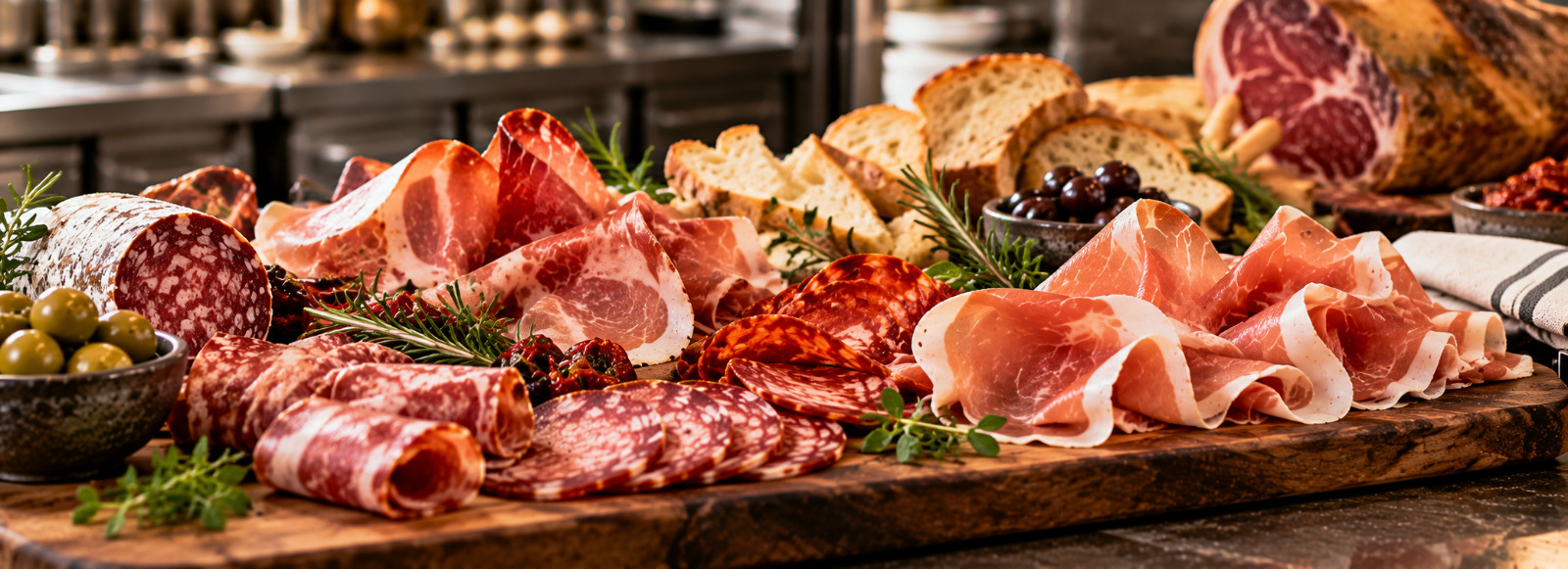
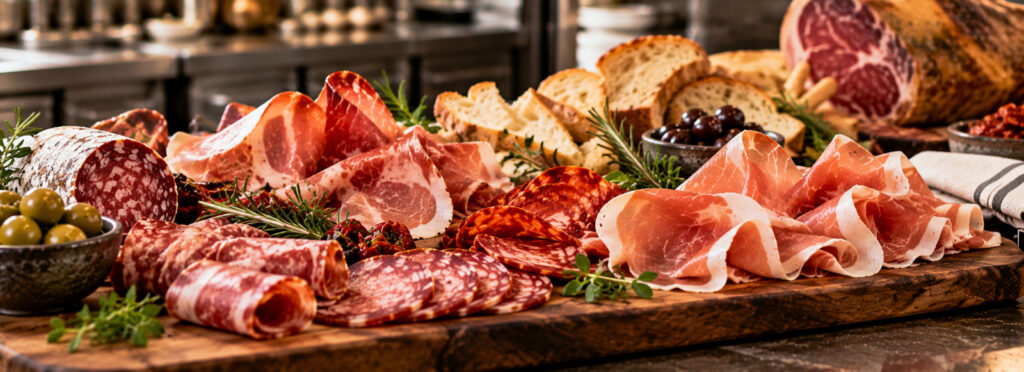
Charcuterie boards appear simple: cured meats, cheeses and a few accompaniments arranged for sharing. Behind that apparent simplicity, however, lies a series of decisions involving thickness, portioning, product handling, presentation and service speed.
The charcuterie board has become one of the most adaptable formats in modern foodservice.
It appears in traditional restaurants.
Wine bars.
Hotels.
Gastronomy counters.
Bistros.
Aperitivo concepts.
Its success is easy to understand.
It encourages sharing, pairs naturally with drinks and gives businesses an opportunity to showcase regional products.
But a good board is not simply a collection of ingredients placed on wood or ceramic.
Slicing is part of the recipe
Thickness changes how cured meat feels in the mouth.
A very thin slice may feel delicate and almost melt as it is eaten.
A thicker slice can create a different perception of structure and chew.
Neither approach is universally correct.
The appropriate cut depends on the product and on the experience the chef wants to create.
This means slicing is not merely preparation.
It is a culinary decision.
Consistency becomes important when volume increases
One charcuterie board can be assembled almost intuitively.
Fifty boards during a busy aperitivo require a system.
The kitchen or service area needs to manage:
- slicing;
- portioning;
- cheese preparation;
- accompaniments;
- storage;
- plating;
- replenishment.
At this scale, small inefficiencies become significant.
Where the professional slicer fits
A commercial meat slicer can help create repeatability and organise high-frequency slicing.
Professional slicers are available in different configurations, including gravity and vertical models.
The correct choice depends on the operation.
Factors may include:
- products being sliced;
- dimensions;
- frequency of use;
- working position;
- cutting capacity;
- available space;
- cleaning procedures.
There is no reason to assume that one configuration is automatically the best for every business.
Blade diameter is not the whole story
Equipment is often compared using the easiest specification to understand.
For slicers, this is frequently blade diameter.
But a larger blade does not automatically make a machine more suitable.
Operators should also evaluate the actual cutting capacity and compare it with the size and shape of the products they expect to process.
The correct question is not:
“Which slicer has the biggest blade?”
It is:
“Which slicer can handle the products we actually use?”
Slice to order or prepare in advance?
This is an operational question with no universal answer.
A high-volume deli counter may work differently from a restaurant selling only a few charcuterie boards per evening.
The decision should consider product characteristics, service speed, food-safety procedures and quality objectives.
The workflow should be designed around the business rather than copied from another venue.
Autumn can transform the classic board
Seasonality provides an opportunity to move beyond the standard meat-and-cheese combination.
Autumn accompaniments might include:
- pears;
- grapes;
- chestnuts;
- nuts;
- honey;
- preserves;
- mushrooms;
- artisan bread.
The board becomes more than an appetiser.
It can become a small representation of the season.
Portion control matters
Charcuterie is often relatively high-value inventory.
Small inconsistencies repeated across hundreds of portions can affect margins.
For this reason, restaurants should define portion standards rather than relying entirely on visual estimation.
Consistent slicing can support this process, but it does not replace weighing or other portion-control systems where required.
Presentation and profitability need to coexist
A board overloaded with ingredients may look generous.
It may also have a food cost that no longer makes sense.
The objective should not be to cover every centimetre.
Negative space can improve presentation.
Careful arrangement can make a controlled portion appear more intentional and premium.
Good presentation is not necessarily about adding more food.
It is about making every component look deliberate.
Safety is non-negotiable
Professional slicers require careful operation.
Safety guards and product-holding systems should be used as designed.
Cleaning and sharpening procedures should follow manufacturer instructions.
Shortcuts taken to save a few seconds can introduce unnecessary risk.
The professional standard is not simply speed.
It is controlled speed.
Visible equipment communicates professionalism
In delis, gastronomy counters and open kitchens, customers may see the slicer.
That means its condition becomes part of the visual environment.
A clean and organised slicing station reinforces professionalism.
A neglected machine communicates something very different.
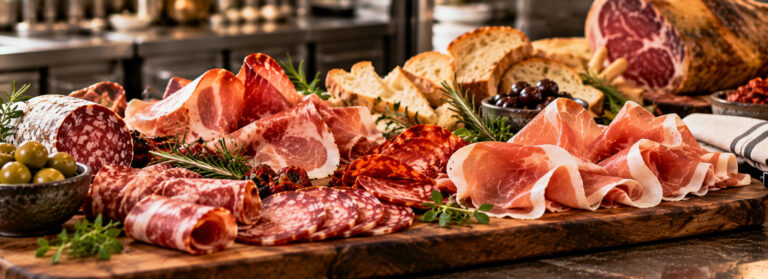
Chef Costantino’s seasonal interpretation
Autumn Gourmet Charcuterie Board with Cured Meats, Cheeses, Pears, Chestnuts and Honey
The concept keeps the familiar structure of a sharing board but introduces seasonal contrast.
Saltiness from the cured meats.
Richness from the cheeses.
Sweetness from pear and honey.
Texture from chestnuts.
The board becomes a composition rather than an assortment.
A simple board is the result of many controlled details
The guest sees a plate designed for sharing.
The professional sees:
product selection, slicing, portioning, storage, mise en place, presentation and service.
This is a recurring theme in foodservice.
The simpler the final product appears, the more important invisible organisation can become.
Professional equipment focus: commercial meat slicers and professional slicing equipment.
TAGS
commercial meat slicer, professional slicer, charcuterie board, cured meats, cheese board, restaurant aperitivo, wine bar, deli equipment, portion control, professional kitchen, restaurant equipment, foodservice equipment, HoReCa
Sull'autore