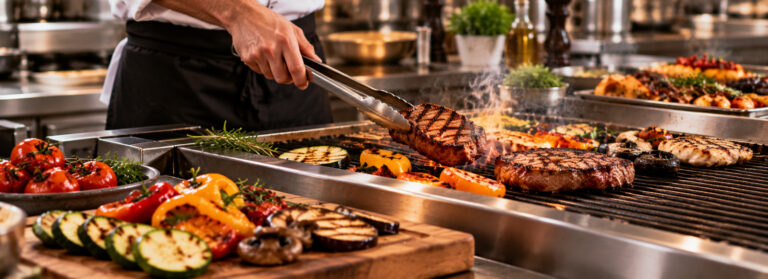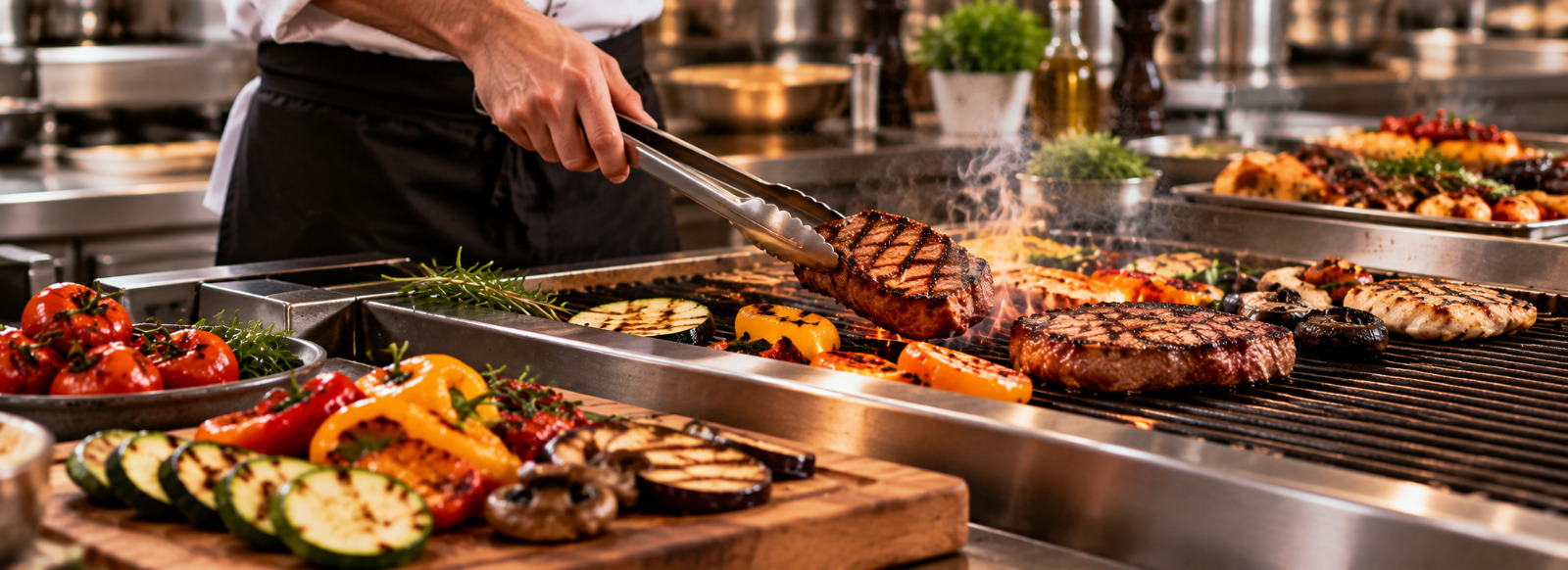
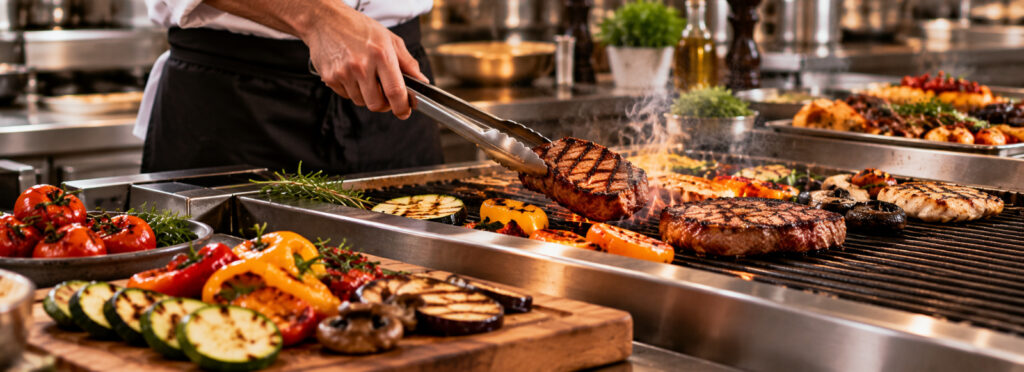
Grilling may evoke summer, outdoor cooking and barbecue, but in professional restaurants it is a year-round production method. As the season changes, mushrooms, root vegetables and richer accompaniments can completely redefine what comes off the grill.
Few cooking techniques communicate immediacy as effectively as grilling.
The customer understands it.
The chef feels it.
Heat is direct, cooking can move quickly and the margin between a well-managed product and an overcooked one can be small.
For this reason, the grill station is often one of the clearest examples of the relationship between skill and equipment.
Grilling is controlled exposure to heat
A professional grill does not automatically create a well-cooked steak.
The result still depends on variables such as:
- product;
- cut;
- thickness;
- starting condition;
- heat intensity;
- cooking time;
- handling;
- resting where appropriate.
Understanding these variables is part of the cook’s expertise.
The real test is peak service
One steak tells us very little about a restaurant’s grill capacity.
The real test comes when multiple orders arrive simultaneously.
This is why equipment sizing should consider the number of grilled portions expected during the busiest period rather than relying only on total restaurant seating.
A 100-seat restaurant with a broad menu may place relatively little pressure on the grill.
A smaller steak-focused restaurant may place far more.
Surface area is production capacity
Every item occupies physical space for a period of time.
Once the available surface becomes fully committed, the station has reached a practical limit.
Attempting to solve this simply by overcrowding the grill can make cooking management more difficult.
For this reason, usable cooking area should be compared with peak production requirements.
Gas or electric?
This question is often presented as though one answer should win.
In professional foodservice, the decision is more nuanced.
Operators need to evaluate:
- specific machine characteristics;
- available utilities;
- installation;
- required output;
- kitchen layout;
- maintenance considerations;
- applicable ventilation or extraction requirements.
The correct solution is site-specific.
Preheating is part of production planning
A grill station does not begin working when the first order arrives.
Equipment may require preparation before service according to its operating instructions.
This should be included in opening procedures.
A professional kitchen works best when the station is ready for demand rather than reacting to demand after it appears.
Autumn changes the context
Grilling can remain at the centre of the plate while seasonal ingredients transform the dish.
Consider:
- porcini mushrooms;
- radicchio;
- pumpkin;
- onions;
- potatoes;
- fennel;
- autumn herbs.
A grilled protein served with these elements immediately moves away from summer barbecue associations.
This demonstrates an important commercial principle:
seasonality does not always require a new cooking method.
Sometimes the method stays and the surrounding ingredients change.
Vegetables deserve the same technical attention
Professional grilling should not be discussed only in relation to meat.
Vegetables respond to heat according to structure, water content, thickness and preparation.
A poorly prepared vegetable does not become interesting simply because it has grill marks.
Cutting and pre-treatment where appropriate remain part of the process.
One station, several food categories
A grill may handle meat, fish and vegetables during the same service.
This versatility is useful but increases the importance of organisation.
Raw and cooked products must be managed appropriately, and allergen and cross-contact considerations should be integrated into the operation’s procedures.
Versatility without workflow can quickly become confusion.
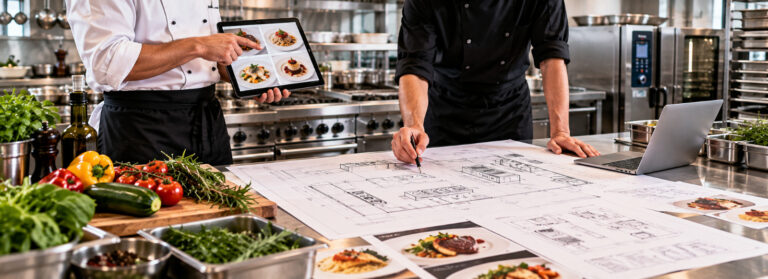
The station around the grill matters too
Professional efficiency depends on more than the cooking surface.
Where are the raw products?
Where are the utensils?
Where are seasonings?
Where are finished plates?
Where does the cooked product rest when the recipe requires it?
A badly organised station can waste time even when the grill itself is perfectly adequate.
Extraction and ventilation belong to the project
Cooking equipment cannot be considered independently from the environment in which it operates.
Installation, ventilation and extraction requirements must be assessed according to the specific equipment and applicable requirements.
This should happen during planning, not after the machine arrives.
Chef Costantino’s seasonal interpretation
Grilled Entrecôte with Porcini Mushrooms and Herb-Roasted Potatoes
The grill remains the central cooking technique.
Porcini, potatoes and herbs provide the seasonal identity.
It is a good example of how a restaurant can refresh a familiar cooking method without redesigning the entire kitchen.
The best grill is the one the station can actually use
Equipment should not be evaluated in isolation.
A powerful grill inside a poorly organised station cannot reach its potential.
Professional performance emerges from the relationship between:
machine + cook + mise en place + workflow + peak demand.
That is what turns grilling from a cooking method into a reliable restaurant system.
Professional equipment focus: commercial gas and electric grills, selected according to the operation and installation requirements.
TAGS
commercial grill, professional grill, restaurant grill, steakhouse equipment, grilled meat, grilled vegetables, porcini mushrooms, autumn menu, professional cooking equipment, restaurant kitchen, kitchen workflow, foodservice equipment, HoReCa
Sull'autore