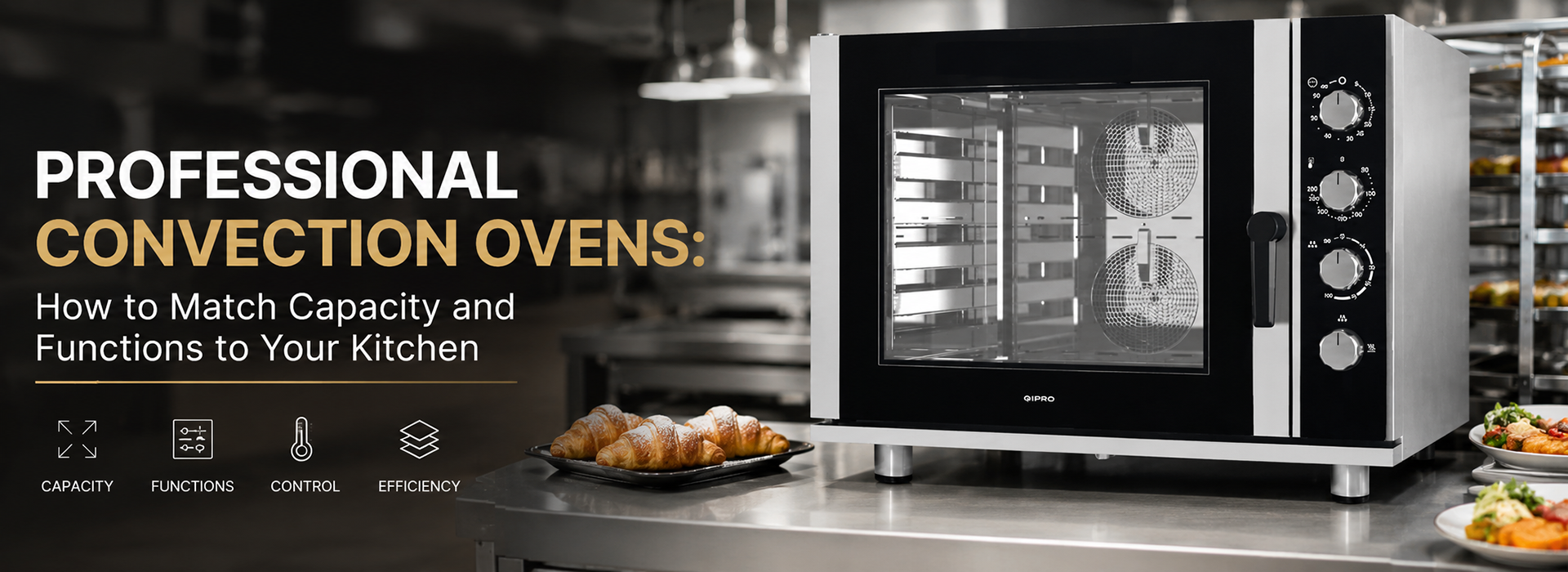

A professional convection oven can become one of the most productive pieces of equipment in a commercial kitchen. It can support food preparation in restaurants, hotels, catering operations, bakeries, pastry shops and ready-meal businesses.
Its performance depends not only on cooking temperature but also on airflow, tray capacity, fan management, available steam functions and control precision.
Selecting the right model requires an assessment of the kitchen’s actual production needs. An oven that is too small can create delays during busy services, while an oversized appliance may occupy valuable space and consume more energy than necessary.
Start with the kitchen’s production requirements
Before comparing individual ovens, it is important to identify what the equipment will be expected to produce.
A café or small bistro may use a compact oven for breakfast products, small batches of vegetables, baked dishes and regeneration.
A full-service restaurant may need to cook meat, fish, gratins, side dishes and prepared components throughout the same service.
Hotels, catering companies and institutional kitchens often require a larger capacity to prepare consistent portions in significant quantities.
Bakeries and pastry laboratories must pay particular attention to tray format, spacing between guides and airflow around delicate or leavened products.
The correct oven should match the menu, production volume and organisation of the business.
Choosing the appropriate oven capacity
Professional oven capacity is generally indicated by the number and format of trays or containers that fit inside the cooking chamber.
Compact three- or four-tray ovens may be suitable for businesses with limited output or restricted installation space.
Six-, seven- and ten-tray models provide greater capacity for restaurants, hotels, catering operations and production laboratories. High-volume businesses can also consider larger ovens or trolley-loading systems.
When assessing capacity, consider:
- the quantity placed on each tray;
- the average cooking time;
- the number of cycles required each day;
- peak production periods;
- the possibility of cooking compatible products together;
- spacing required between trays;
- available working and installation space.
The stated number of trays alone does not determine the oven’s practical productivity. Products need sufficient space around them to allow effective airflow.
GN 1/1 and 600×400 mm tray formats
Tray format should be checked before ordering an oven, particularly when the business already owns trays, racks and food containers.
The GN 1/1 format is widely used in restaurants, hotels, catering operations and professional foodservice. Standardised Gastronorm containers can support preparation, cooking, storage and transport within the same organised system.
The 600×400 mm format is common in bakeries and pastry laboratories. It is suitable for biscuits, pastries, dough products and many sweet or savoury baked preparations.
Some ovens can accommodate both GN 1/1 and 600×400 mm trays. These models can offer additional flexibility to businesses that combine foodservice and bakery production.
However, operators must also check the distance between guides. Products that rise or have a significant height require more space than flat bakery items.
Electric or gas power
Professional convection ovens are available with electric or gas power.
Electric ovens offer precise control and a wide range of capacities. Compact units may operate on a single-phase connection, while larger models generally require a three-phase supply.
Before purchasing an electric oven, verify the voltage, total absorbed power and electrical capacity available at the premises.
Gas ovens can be suitable for high-volume kitchens with an appropriate gas supply. Their installation must take account of gas connections, ventilation, extraction and the technical requirements specified by the manufacturer.
The choice should be based on:
- available utilities;
- installation costs;
- expected daily usage;
- energy costs;
- production capacity;
- local technical and safety requirements.
Installation and commissioning should always be carried out by qualified professionals.
Dry convection or combination cooking with steam
A standard convection oven circulates heated air through the cooking chamber. It can be used for roasting, browning, gratinating and baking a broad range of products.
Combination ovens add controlled humidity or steam to the cooking process.
Steam can help reduce excessive moisture loss, support the regeneration of prepared food and maintain tenderness in certain meat, fish and vegetable dishes.
Direct-injection models introduce water into the cooking chamber to create humidity. More advanced combination ovens allow closer management of the relationship between hot air and steam.
A dry convection oven may be sufficient for businesses that mainly produce roasted or baked dishes. A combination model offers greater flexibility when the kitchen needs to cook, regenerate and manage different levels of humidity.
Mechanical, digital and touchscreen controls
The control panel affects how the oven is operated and how easily cooking results can be repeated.
Mechanical controls provide straightforward adjustment of temperature, time and, when included, humidity. They are suitable for standard production with simple cooking cycles.
Digital controls allow more precise settings and may include programmable recipes, multi-stage cooking and core probe management.
Touchscreen systems can provide advanced recipe storage and detailed control of different cooking parameters. They can be particularly useful in kitchens where several operators must reproduce the same preparations consistently.
The most advanced control system is not automatically the best choice for every business. Its features should provide a practical benefit within the kitchen’s daily workflow.
Airflow and fan management
Airflow is central to convection cooking. The fan distributes heat and helps reduce temperature differences across the chamber.
Ovens with reversing fans can provide more balanced air distribution. Adjustable fan speeds allow the operator to adapt the airflow to different products.
A stronger airflow can support browning and surface drying when cooking roasted vegetables, meat and gratinated dishes.
A moderate fan speed may be more appropriate for fish, lightweight pastry products and delicate preparations that could dry out or become distorted.
Trays should not be overloaded or positioned in a way that completely restricts the movement of air.
Core probe and programmable cooking
A core temperature probe measures the temperature inside the food rather than relying only on the time set by the operator.
It is especially useful for meat and fish, where the size, thickness and starting temperature of each portion can affect the required cooking time.
Programmable cooking allows frequently used settings to be stored and repeated. This can support production consistency and simplify training for different members of the kitchen team.
These functions are most valuable when the business establishes clear preparation procedures and uses the stored programmes consistently.
Cleaning and routine maintenance
Cleaning should be considered when choosing the oven, not only after it has been installed.
Removable tray guides, rounded internal corners and automatic washing systems can reduce the time required for routine cleaning.
Daily and scheduled maintenance should include:
- cooking chamber;
- tray guides and racks;
- trays and containers;
- internal door glass;
- door gasket;
- drain;
- core probe;
- accessible fan area, according to the manufacturer’s instructions.
Grease and food residue can generate smoke, unwanted odours and reduced operating efficiency.
Only detergents and cleaning procedures approved for the specific oven should be used.
A practical application: pistachio-crusted salmon
Pistachio-Crusted Salmon with Roasted Fennel and Citrus Yogurt Sauce demonstrates how convection cooking can manage different elements of the same dish.
The fennel begins cooking before the salmon is placed in the oven. During the final stage, the circulating air supports the browning of the vegetables and the pistachio crust.
Careful time and core temperature control help preserve the salmon’s moisture and texture. The chilled citrus yogurt sauce is added only during plating to provide freshness and contrast.
The Chef Costantino recipe is published in Italian and includes precise quantities, professional preparation methods, service organisation, plating, allergens and indicative Food Cost.
DISCOVER THE CHEF COSTANTINO RECIPE
Plan the oven around the workflow
The right professional oven should fit the kitchen’s production system rather than forcing the business to reorganise around unsuitable equipment.
Before requesting a quotation, prepare clear information about:
- business type;
- required tray format;
- preferred capacity;
- products to be prepared;
- available power supply;
- required steam functions;
- maximum external dimensions;
- need for a stand, extraction system or accessories.
This information makes it easier to compare compatible models and avoid both insufficient and unnecessary specifications.
Explore professional convection ovens
Compare professional ovens for restaurants, catering businesses, hotels, bakeries and pastry production. The available range includes compact convection ovens, electric and gas models, direct-steam units and combination ovens with different capacities and control systems.
EXPLORE PROFESSIONAL CONVECTION OVENS
Sull'autore