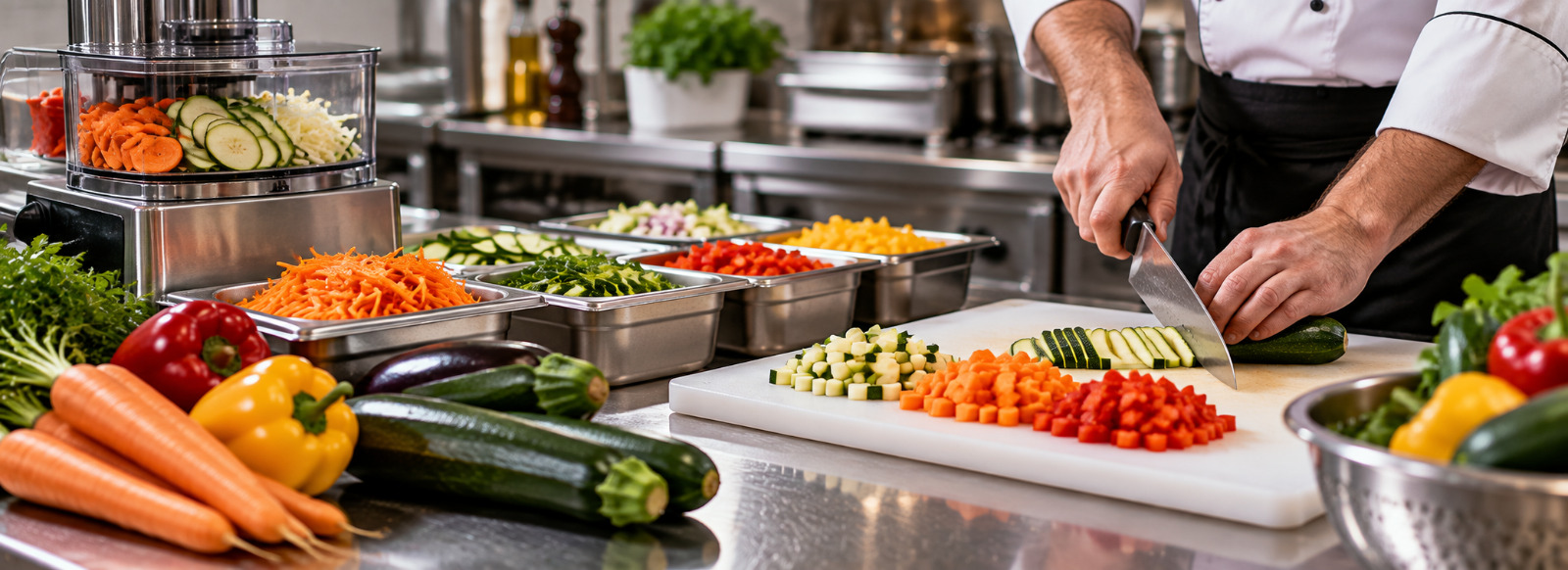
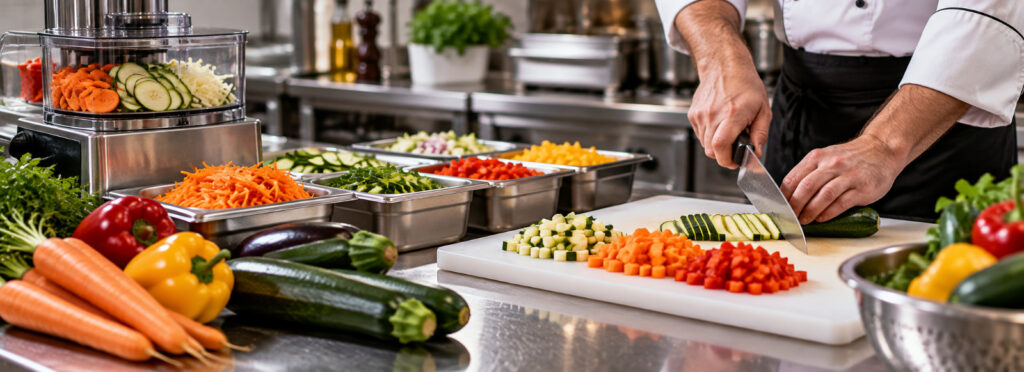
Julienne, slices, cubes and other cuts are often treated as a visual detail. In professional kitchens, however, size and consistency can influence cooking behaviour, presentation, portioning and labour. When volumes increase, vegetable preparation becomes a production issue.
Much of professional cooking happens before heat is ever applied.
Vegetables need to be washed, trimmed, peeled where required, cut, portioned and organised.
For one portion, this may take very little time.
Multiply the same actions across dozens or hundreds of portions and preparation becomes a significant part of labour.
This is why efficient kitchens pay close attention to mise en place.
Shape affects more than appearance
Consider two pieces of the same vegetable with very different dimensions.
Placed into the same cooking process, they may not reach the same texture at the same moment.
Uniformity can therefore help improve predictability.
This matters in:
- roasting;
- frying;
- gratins;
- soups;
- vegetable sides;
- salads;
- garnishes.
A consistent cut can contribute to a more consistent final product.
Autumn can dramatically increase vegetable preparation
Cold-season menus often introduce ingredients such as:
- pumpkin;
- cabbage;
- carrots;
- potatoes;
- fennel;
- onions;
- root vegetables.
At the same time, restaurants may increase production of soups, gratins, roasted vegetables and hot side dishes.
This can create significant preparation work before service begins.
When does manual cutting become a bottleneck?
There is no universal kilogram figure.
The answer depends on labour, menu and frequency.
A chef performing a specialised decorative cut may be creating genuine culinary value.
A chef repeating the same standard cut for a large volume of vegetables may be spending skilled labour on a repetitive operation.
This is where professional equipment becomes worth considering.
How professional vegetable cutters fit into the workflow
A commercial vegetable cutter can support repetitive preparation tasks.
Depending on the machine and compatible accessories, different cuts may be possible.
This qualification matters.
Not every vegetable cutter automatically produces every possible cut.
Operators should therefore examine:
- compatible discs;
- intended products;
- required cut;
- production volume;
- dimensions;
- cleaning procedures;
- manufacturer specifications.
The menu should determine the configuration.
Do not buy accessories before analysing the menu
A long list of available discs can look impressive.
But unused accessories do not improve productivity.
A better approach is to review the menu and identify the cuts performed most frequently.
Perhaps the kitchen mainly needs slicing.
Perhaps it frequently prepares julienne-style vegetables.
Perhaps several different preparations justify a broader accessory set.
Equipment should follow actual production.
Consistency can support portion control
Uniform preparation can also help with portioning.
When products are processed consistently, it may become easier to build standard recipes and repeat presentation.
This does not eliminate the need for weighing where precise portion control is required.
But it contributes to a more controlled production environment.
Labour should be used where skill creates value
This is one of the most important principles of professional kitchen design.
The objective of machinery should not simply be “to replace people.”
A better question is:
which tasks require culinary judgement, and which are repetitive mechanical operations?
If equipment reduces time spent on repetitive work, skilled staff can focus on:
- cooking;
- seasoning;
- finishing;
- quality control;
- plating.
That is a more useful way to think about automation.
Safety must never be traded for speed
Cutting equipment must be used with the guards, pushers and safety systems specified by the manufacturer.
Improvised methods and bypassing safety mechanisms are not productivity improvements.
Cleaning procedures also require care because cutting components can remain hazardous when the machine is switched off.
Chef Costantino’s seasonal interpretation
Autumn Vegetable Mille-Feuille Gratin
This dish makes the importance of cutting immediately visible.
The structure depends on layers.
Thickness influences both presentation and cooking behaviour.
The cut is therefore not simply preparation.
It is part of the architecture of the dish.
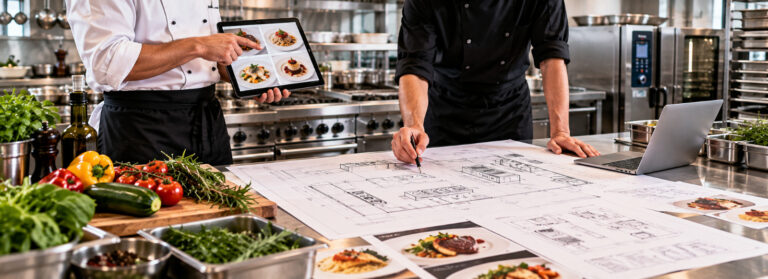
Mise en place determines how service begins
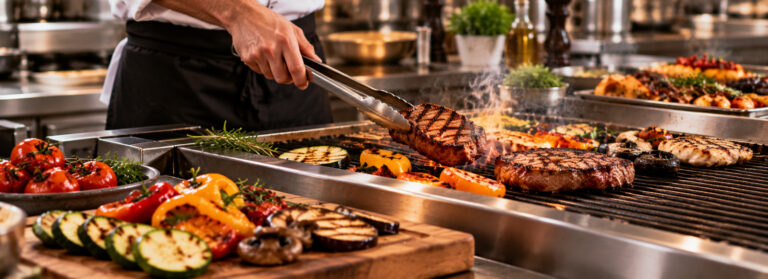
Professional kitchens often focus heavily on cooking equipment because it is where the visible transformation happens.
But service can only move as quickly as preparation allows.
If vegetables are not ready, the grill, oven or range cannot compensate.
This makes vegetable preparation equipment part of a much larger operational principle:
a kitchen is only as efficient as the workflow connecting each stage.
Professional equipment focus: commercial vegetable cutters and compatible professional cutting accessories.
TAGS
commercial vegetable cutter, professional vegetable cutter, vegetable preparation, mise en place, food preparation equipment, vegetable cutting, autumn vegetables, commercial kitchen, restaurant productivity, kitchen workflow, restaurant equipment, foodservice equipment, HoReCa
Sull'autore