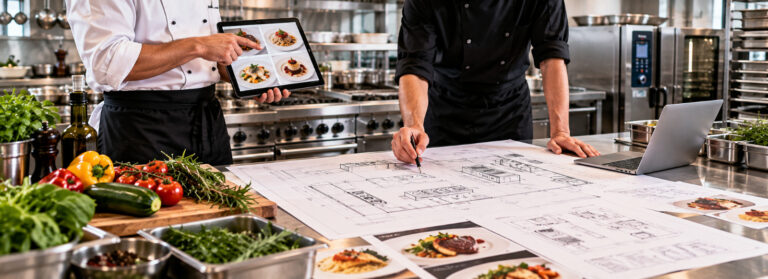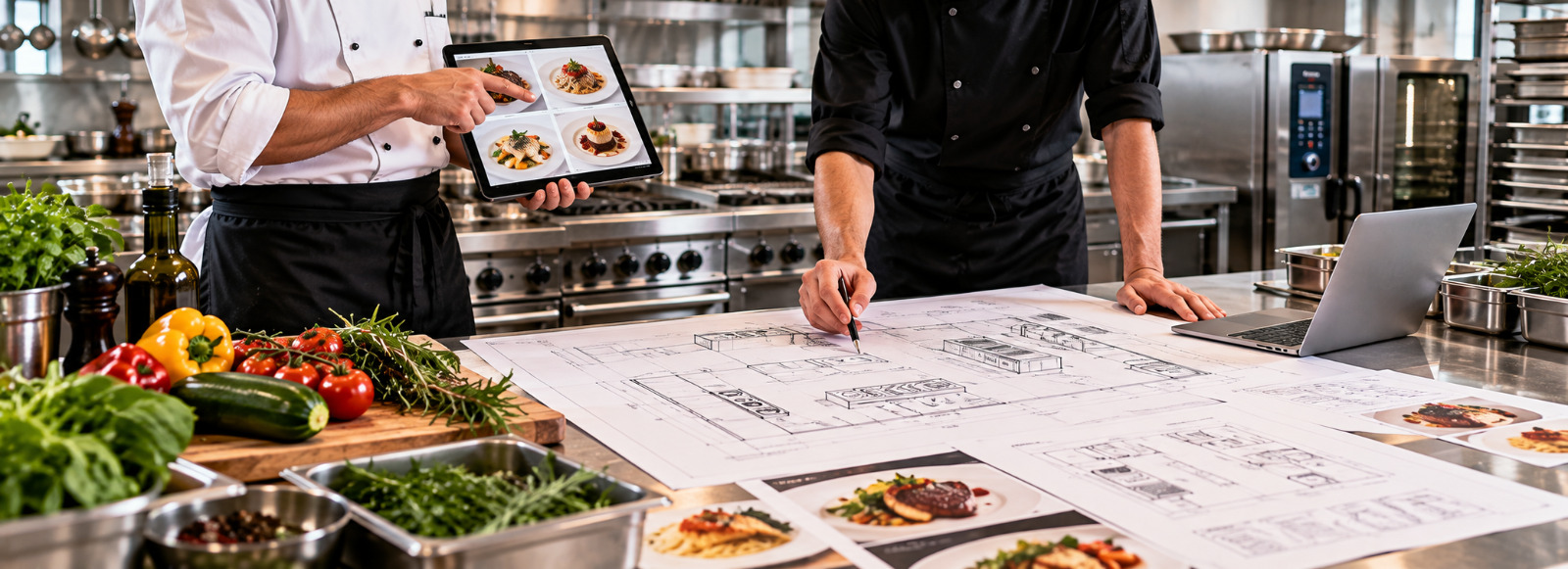
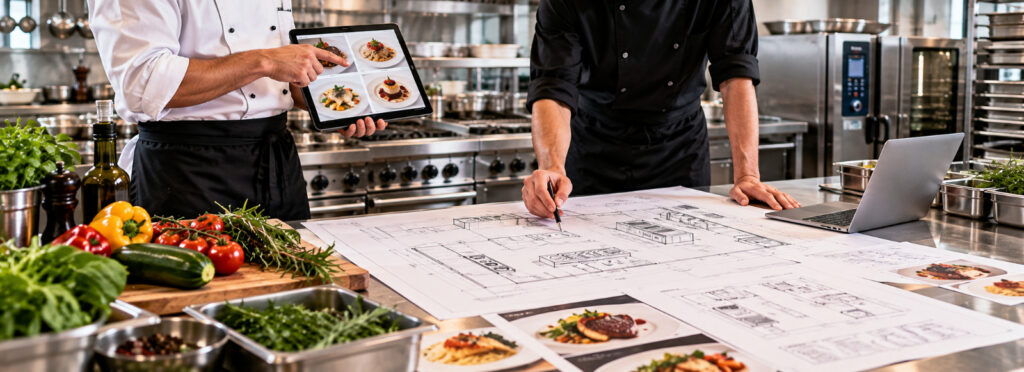
Opening a restaurant often begins with a shopping list: oven, refrigerator, fryer, dishwasher and preparation equipment. Professional kitchen planning should begin somewhere else entirely — with the food, the workload and the journey each product will take through the operation.
A commercial kitchen can contain excellent equipment and still work badly.
This may sound contradictory.
It is not.
A kitchen is not simply a room filled with machines.
It is a production system.
And the performance of that system depends on how well its components work together.
Start with the menu
The menu tells us what the kitchen needs to do.
Each dish can be translated into operations:
receive ingredients;
store them;
wash and prepare them;
cut, mix or process them;
cook them;
hold or manage them as required;
finish;
plate;
serve.
Once these operations are mapped, equipment requirements begin to make sense.
Without this analysis, equipment selection becomes guesswork.
Seat count is only the beginning
“We have 100 seats.”
This is useful information.
But it is not enough to design a kitchen.
One hundred guests in a pizzeria create a different production pattern from one hundred guests in a steakhouse.
A hotel restaurant operates differently from a bakery.
A butcher shop with prepared food operates differently from a fine-dining kitchen.
Operators should therefore analyse:
- menu structure;
- expected covers;
- order distribution;
- peak demand;
- production volumes;
- number of services;
- staffing;
- delivery frequency;
- level of in-house preparation.
The equipment follows these answers.
Every kitchen has a bottleneck
Imagine a restaurant with a high-capacity oven but insufficient preparation capability.
The oven will spend part of its potential waiting for product.
Now imagine a kitchen with extremely fast cooking equipment but inadequate refrigerated storage for mise en place.
Again, one section limits the rest.
This is the concept of the bottleneck.
The performance of the kitchen is not simply the sum of every machine’s maximum specification.
It depends on how effectively the stages connect.
Bigger is not always better
Oversizing equipment can appear to provide security.
But it may also mean:
- higher capital expenditure;
- more floor space;
- different utility requirements;
- unnecessary capacity.
Undersizing critical equipment creates the opposite problem.
The goal is not maximum size.
It is appropriate capacity.
Peak demand is more useful than average demand
Average figures can hide operational stress.
A restaurant might serve 120 covers over an evening, but if a large proportion of orders arrive within one hour, the kitchen must survive that hour.
This is why peak analysis is so important.
How many fried portions might be ordered simultaneously?
How many pizzas?
How many grilled dishes?
How many dishwasher racks will return during the busiest phase?
Equipment sizing becomes more realistic when the business models the rush rather than the average.
Refrigeration is part of workflow
Cold storage should not be treated as a separate purchasing category.
It is connected to the menu.
The kitchen needs to understand:
- incoming ingredients;
- delivery frequency;
- preparation batches;
- containers used;
- stock rotation;
- service mise en place.
A refrigerator may offer significant nominal volume and still be poorly suited to the way a specific kitchen needs to organise food.
Usable workflow matters.
Preparation deserves equal attention
Cooking equipment often receives the largest share of attention because it is visually impressive.
But preparation may consume enormous amounts of labour.
Depending on the menu, professional kitchens may need equipment such as:
- vegetable cutters;
- bowl cutters;
- slicers;
- mixers;
- fresh-pasta machines;
- other specialised preparation machines.
These machines should not be purchased because they “belong in a professional kitchen.”
They should be purchased because the menu creates enough repetitive work to justify them.
Utilities must be checked before the purchase
A machine exists within a building.
Electrical supply, gas, water, drainage, ventilation and extraction requirements may all influence what can be installed.
Dimensions matter too.
Not just the final position of the machine, but also the route required to bring it into the building.
Technical verification before purchase can prevent expensive surprises later.
Design for movement
Watch a cook during service.
How many steps are required to collect ingredients?
Where are utensils?
Where are plates?
Where does waste go?
Where does dirty equipment move?
Repeated unnecessary movement costs time.
Over an entire service, poor layout can produce hundreds of unnecessary actions.
Good kitchen design therefore considers people as well as machines.
Think about cleaning before opening day
Every piece of equipment eventually needs to be cleaned.
The layout should allow staff to access the areas that require routine cleaning and maintenance.
A machine squeezed into an impractical position may create operational problems long after installation.
Hygiene is easier to maintain when it is considered during design.
Plan for growth — without designing an imaginary business
New operators often face two opposite mistakes.
One is designing only for opening-day demand.
The other is buying equipment for a future level of business that may never arrive.
A better approach is to identify realistic growth scenarios.
Could takeaway become important?
Could production increase?
Could a product currently purchased externally eventually be made in-house?
The layout can allow some flexibility without turning every machine into an oversized investment.
More than 45,000 products — but the search should begin with a requirement
Ristorazione-Refrigerazione offers a catalogue of more than 45,000 professional products covering preparation, cooking, refrigeration, display and other foodservice applications.
A large catalogue is useful only when the buyer knows what to compare.
A practical selection process can begin with:
function → required capacity → dimensions → utilities → installation → technical characteristics.
Only then should individual models be compared.
One question before every equipment purchase
Complete this sentence:
“We need this machine because…”
If the answer describes a clear production requirement, the purchasing process has a solid starting point.
If the answer is simply “because professional kitchens have one,” more analysis is probably needed.
The best professional kitchen is not the one with the most equipment.
It is the one where every important piece of equipment has a reason to be there.
TAGS
commercial kitchen design, professional kitchen design, restaurant equipment, catering equipment, commercial refrigeration, cooking equipment, food preparation equipment, restaurant planning, kitchen workflow, restaurant startup, foodservice, HoReCa
Sull'autore