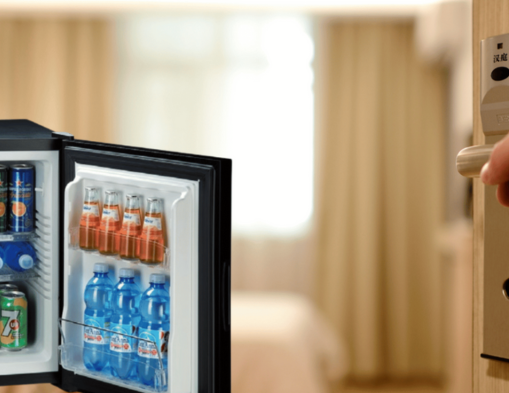

In hotels, a minibar is more than just a small fridge: it is a service that significantly enhances the guest’s perception of comfort and quality. Choosing the right model ensures a balance between operational efficiency, low energy consumption, quiet operation, and aesthetic integration with the room design.
⚙️ Key Factors to Consider
✅ Cooling Technology and Noise Level
- Absorption or thermoelectric models are very quiet, ideal for rooms where acoustic comfort is a priority.
- Compressor models provide higher cooling performance but may produce more noise and require proper ventilation.
✅ Energy Consumption and Efficiency Class
- Low daily consumption helps reduce operational costs.
- Opt for models with high energy efficiency rating and environmentally friendly refrigerants.
✅ Size, Capacity, and Installation Type
- Typical capacity: 20–40 liters for standard rooms.
- Built-in or freestanding models: proper ventilation and accessibility are essential for integrated installations.
✅ Glass Door vs Solid Door
- Glass door: enhances product visibility, encourages impulse purchases, and promotes in-room service.
- Solid/opaque door: provides better thermal insulation, privacy, and discreet aesthetic integration.
✅ Aesthetics, Integration, and Extra Features
- Minibar should blend with the room design: customizable panels, coordinated colors, internal LED lighting.
- Useful extras: reversible door, adjustable shelves, optional lock for hotel security.
🧩 Choosing the Right Model for Your Hotel
- Standard Room: 30–35 L, quiet technology, solid or glass door depending on sales strategy.
- Suite or Premium Room: 35–40 L+, glass door for product visibility, refined design, extra features for luxury appeal.
- Economy Hotels / B&Bs: compact models (~20–25 L), ultra-low energy consumption, space-saving installation.
- High-Occupancy or Busy Hotels: robust models with inventory management functions, low downtime, minimal maintenance.
🏁 Conclusion
Selecting the right minibar for a hotel means thinking beyond “just a fridge in the room”: it is a strategic element that enhances guest experience, optimizes operational costs, and strengthens the hotel’s image.
By evaluating technology, energy consumption, installation, and design, you can choose the model that best suits your target audience and service offer, ensuring quality, efficiency, and guest satisfaction.
Sull'autore