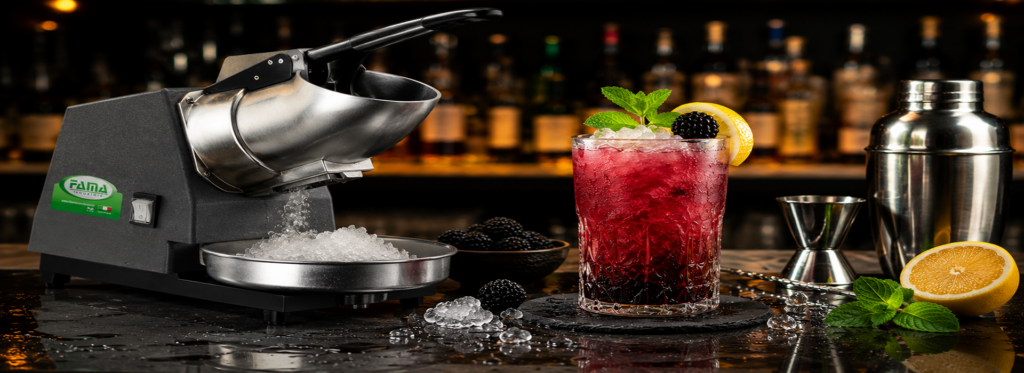
Crushed ice plays an important role in many beverage operations, from cocktail bars and restaurants to hotels, beach clubs and entertainment venues.
Producing crushed ice manually can become inefficient when service volumes increase.
A commercial ice crusher allows operators to process previously produced ice quickly and obtain the quantity of crushed ice required during service.
However, selecting the right machine requires more than comparing price and dimensions.
Businesses should evaluate production requirements, peak demand, available ice supply, workflow, installation conditions, cleaning procedures and technical support before purchasing.
What Does a Commercial Ice Crusher Do?
A commercial ice crusher mechanically reduces previously produced ice into smaller, irregular fragments.
It does not normally produce ice.
This distinction is essential because the business must already have an adequate supply of compatible ice available.
Commercial ice crushers can be particularly useful for businesses that:
- already operate a commercial ice maker;
- use crushed ice for selected cocktails and beverages;
- experience variable demand during service;
- need rapid on-demand processing;
- want to avoid storing excessive quantities of pre-crushed ice.
The equipment allows operators to transform ice only when required by the service.
Commercial Ice Crusher vs Ice Maker
An ice crusher and an ice maker perform different functions.
An ice maker produces ice from water through a refrigeration cycle.
An ice crusher processes ice that has already been produced.
Businesses without an adequate ice supply cannot replace an ice maker with an ice crusher.
At the same time, a cube ice maker may not eliminate the need for an ice crusher when the beverage menu includes recipes specifically designed for crushed ice.
For some operations, using both machines can provide greater flexibility.
Evaluate Your Actual Crushed Ice Demand
Before purchasing equipment, businesses should estimate how much crushed ice they actually use.
Important factors include:
- number of beverages served each day;
- percentage of drinks requiring crushed ice;
- quantity of ice used per serving;
- consumption during peak service periods;
- seasonal changes in demand;
- additional uses of ice within the business.
Average daily consumption alone may not provide enough information.
A cocktail bar may use most of its crushed ice within a few evening hours, requiring equipment capable of supporting short periods of intense demand.
Capacity and Processing Speed
Machine capacity should match the operational requirements of the business.
An undersized ice crusher may slow down beverage preparation and require continuous operation during peak periods.
An unnecessarily oversized machine may occupy valuable workspace and increase the initial investment without providing meaningful operational benefits.
Businesses should evaluate:
- processing capacity;
- speed of operation;
- recommended duty cycle;
- hopper size, where applicable;
- discharge method;
- compatibility with the available ice format.
Manufacturer specifications should always be checked before purchase.
Improve Beverage Station Workflow
Equipment positioning can directly affect service efficiency.
The commercial ice crusher should be located where operators can access it easily without creating unnecessary movement behind the bar.
An efficient workflow may include:
ice production → storage → crushing → beverage preparation → service.
The machine should be positioned close enough to the cocktail station for rapid use while maintaining adequate workspace for safe operation and cleaning.
Installation Requirements
Before purchasing a commercial ice crusher, businesses should verify the technical requirements of the selected model.
Important considerations may include:
- electrical supply;
- machine dimensions;
- ventilation clearance;
- stable support surface;
- access for cleaning;
- drainage requirements, when applicable;
- compatibility with the existing ice production system.
Planning the installation before delivery helps avoid operational problems and unnecessary modifications to the workspace.
Cleaning and Hygiene
Ice intended for beverages should be handled as a food product.
Regular cleaning is essential to maintain hygienic operating conditions.
Operators should:
- remove residual ice according to the manufacturer’s instructions;
- clean food-contact surfaces regularly;
- use cleaning products compatible with machine materials;
- keep ice scoops and containers clean;
- prevent direct hand contact with ice;
- inspect accessible components for residue accumulation;
- follow the manufacturer’s maintenance schedule.
Cleaning frequency should reflect the intensity of use and the requirements of the business’s food safety procedures.
Water Quality and Ice Supply
Although an ice crusher does not normally produce ice, the quality of the ice supplied to the machine remains important.
The ice should be produced using water suitable for food use and stored correctly before crushing.
Businesses operating commercial ice makers should also follow manufacturer recommendations concerning water quality, filtration and maintenance.
Poorly managed ice can affect hygiene, equipment performance and the quality of the final beverage.
Common Buying Mistakes
Assuming an Ice Crusher Produces Ice
A crusher requires an existing supply of compatible ice.
Businesses should evaluate total ice production capacity before purchasing.
Choosing Equipment Based Only on Price
Purchase price should be considered together with reliability, processing capacity, ease of cleaning, maintenance requirements and spare parts availability.
Ignoring Peak Demand
A machine that performs adequately during normal service may become a bottleneck during the busiest hours.
Failing to Check Ice Compatibility
Not every machine is designed to process every ice format.
Manufacturer specifications should be verified carefully.
Producing Excessive Crushed Ice in Advance
Crushed ice tends to melt and compact more quickly than larger ice formats.
On-demand production can help preserve the desired texture and reduce unnecessary handling.
Neglecting After-Sales Support
Professional equipment may require maintenance, replacement components and technical assistance during its service life.
Support availability should be evaluated before purchase.
How to Choose the Right Commercial Ice Crusher
Before purchasing, evaluate:
- actual crushed ice consumption;
- peak service demand;
- existing ice production capacity;
- compatible ice formats;
- processing speed;
- machine dimensions;
- available workspace;
- installation requirements;
- ease of cleaning;
- maintenance requirements;
- operator safety features;
- warranty conditions;
- technical support;
- spare parts availability.
The right machine should integrate efficiently into the existing beverage operation rather than creating additional workflow problems.
Frequently Asked Questions
Does a Commercial Ice Crusher Make Ice?
Generally, no.
A commercial ice crusher processes previously produced ice and reduces it into smaller fragments.
Can I Use Any Ice Cubes in a Commercial Ice Crusher?
Not necessarily.
Compatibility depends on the machine design and manufacturer specifications.
Always verify the recommended ice dimensions and formats.
Is an Ice Crusher Useful for a Small Cocktail Bar?
Yes, if crushed ice is required regularly and the business already has an adequate supply of compatible ice.
The correct capacity should be selected according to actual service volumes.
Should Crushed Ice Be Prepared in Advance?
Limited quantities may be prepared in advance when properly handled.
However, crushed ice tends to melt and compact quickly, so producing it close to service time is generally preferable.
Do Restaurants Need Both an Ice Maker and an Ice Crusher?
Some businesses may benefit from both machines.
The ice maker provides the necessary ice supply, while the crusher transforms part of that production into crushed ice when required.
Conclusion
Commercial ice crushers can improve beverage service efficiency for bars, restaurants, hotels and hospitality businesses that regularly use crushed ice.
Choosing the right machine requires evaluating more than processing capacity.
Actual consumption, peak demand, existing ice production, workflow, installation, cleaning requirements and technical support should all be considered.
A properly sized commercial ice crusher can reduce manual preparation, support faster beverage service and provide greater flexibility without requiring businesses to store large quantities of crushed ice in advance.
Recommended Internal Links
- Commercial Ice Makers
- Commercial Bar Equipment
- Professional Blenders
- Beverage Preparation Equipment
- Commercial Refrigeration Equipment
- Stainless Steel Bar Workstations
Explore our range of commercial ice crushers and professional ice-making equipment and choose the solution that best matches your beverage service volumes, available workspace and operational requirements.
Sull'autore