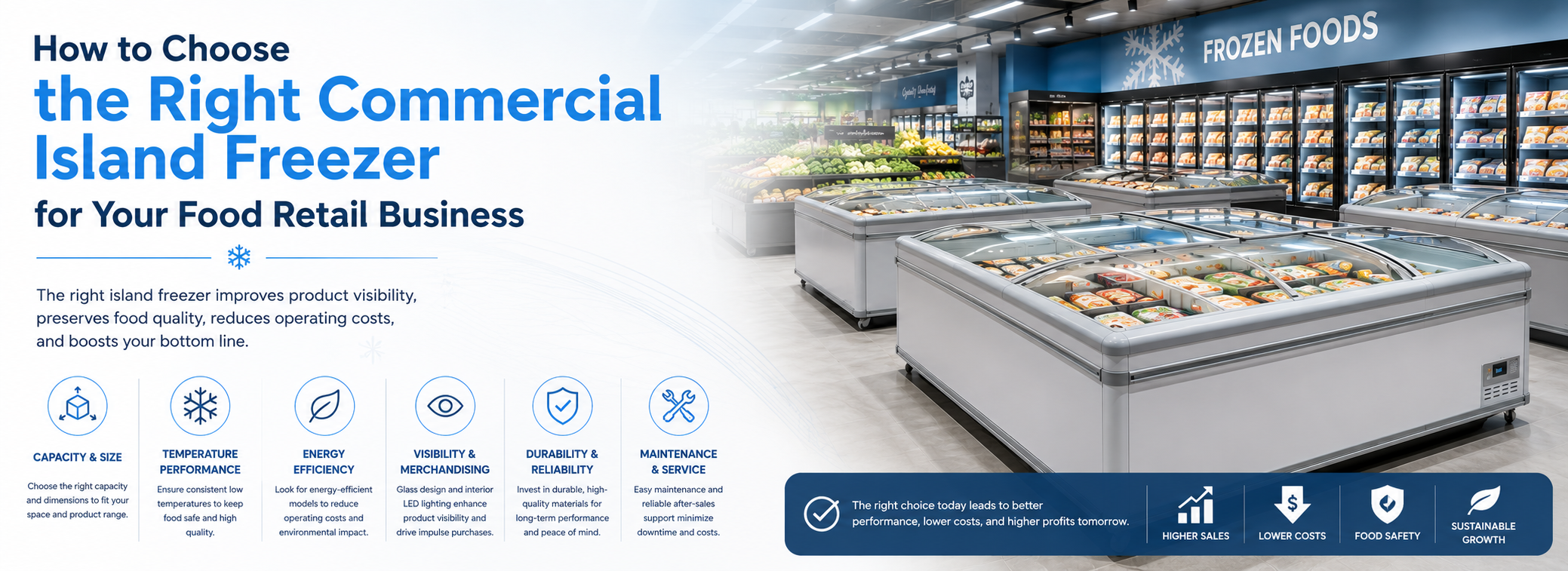

Commercial island freezers play a central role in supermarkets, grocery stores and frozen food retailers.
Their purpose goes far beyond simply keeping products frozen.
A well-designed freezer island helps improve product visibility, supports efficient replenishment, simplifies stock management and contributes to a better shopping experience.
Selecting the right equipment requires evaluating daily operations rather than focusing only on purchase price or storage capacity.
Factors such as merchandising, usable capacity, maintenance, accessibility and long-term operating costs all influence the overall performance of the refrigeration system.
Understanding Your Store Requirements
Every retail business has different operational needs.
Before selecting an island freezer, it is useful to analyse:
- available sales floor space;
- daily customer traffic;
- frozen product assortment;
- replenishment frequency;
- expected business growth;
- available back-of-house frozen storage.
Matching the equipment to the actual needs of the business helps avoid both under-sizing and unnecessary investment.
Capacity Should Match Product Turnover
Declared capacity is only one part of the purchasing decision.
Equally important is how efficiently the internal space can be organised.
A properly designed freezer should allow staff to:
- separate product categories;
- organise different package sizes;
- replenish products quickly;
- monitor stock levels;
- maximise usable storage space.
Internal baskets and dividers can make day-to-day management significantly easier.
Product Visibility Matters
Customers should be able to identify products quickly without searching through disorganised packaging.
For this reason it is advisable to:
- maintain clear product visibility;
- avoid excessive stacking;
- organise categories consistently;
- respect the maximum loading line;
- keep promotional products easy to identify.
A clean, organised display contributes to a more pleasant shopping experience.
Planning Daily Replenishment
Replenishment procedures should be standardised rather than improvised.
It is advisable to establish:
- scheduled replenishment times;
- stock verification before loading;
- defined staff responsibilities;
- packaging removal procedures;
- efficient routes between storage and the sales floor.
Reducing the amount of time that lids remain open also helps maintain more stable operating temperatures.
Preventive Maintenance
Routine maintenance contributes to long-term refrigeration performance.
Regular inspections should include:
- operating temperature;
- lid condition;
- door seals;
- condenser cleanliness;
- airflow;
- drainage systems;
- refrigeration performance.
Preventive maintenance often reduces unexpected downtime and extends equipment lifespan.
Common Purchasing Mistakes
Some of the most common mistakes include:
- choosing equipment based only on price;
- purchasing excessive storage capacity;
- ignoring available retail space;
- poor product organisation;
- blocking internal airflow;
- neglecting preventive maintenance;
- failing to plan replenishment procedures.
Careful planning before purchasing usually results in lower operating costs over time.
Conclusion
Choosing a commercial island freezer means evaluating much more than technical specifications.
The right equipment should support daily operations, improve merchandising, simplify replenishment and provide reliable frozen food storage.
A purchasing decision based on operational requirements rather than only initial investment can improve efficiency, reduce operating costs and contribute to a better customer experience.
Recommended Equipment
Professional equipment frequently used together with commercial island freezers includes:
- Commercial Island Freezers
- Upright Commercial Freezers
- Modular Cold Rooms
- Stainless Steel Shelving
- Stainless Steel Trolleys
- Refrigerated Preparation Tables
- Professional Digital Thermometers
Did You Know?
A well-organised commercial freezer island can reduce replenishment time, improve stock visibility and make inventory checks faster for store staff, while also making it easier for customers to locate frozen products.
Sull'autore