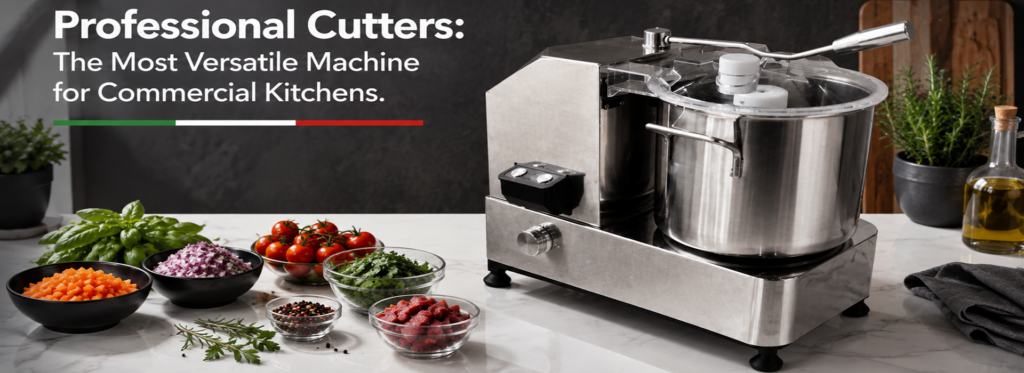
Among the most versatile pieces of equipment found in a professional kitchen, the professional cutter plays a leading role.
Thanks to its ability to chop, mince, emulsify, blend and process a wide variety of ingredients, it has become an indispensable machine for restaurants, hotels, delicatessens, food production laboratories, butcher shops, pastry shops and catering companies.
Its high-speed blades make it possible to produce perfectly uniform preparations in a very short time, improving kitchen organization while significantly increasing productivity.
What Is a Professional Cutter?
A professional cutter is a machine equipped with a stainless steel bowl and a high-speed blade assembly designed to process ingredients of different textures quickly and efficiently.
Unlike a conventional blender, a cutter is specifically engineered for intensive professional use, ensuring precision, consistency and reliability even during continuous operation.
Its versatility makes it one of the most widely used food preparation machines in modern commercial kitchens.
How Does It Work?
Its operation is both simple and highly effective.
Ingredients are placed inside the stainless steel bowl.
The high-speed blades rotate rapidly, allowing the machine to:
- chop;
- mince;
- emulsify;
- blend;
- knead;
- homogenize.
Processing time depends on the ingredient and the desired consistency.
Accurate control of processing time ensures repeatable, professional-quality results.
Main Advantages
Using a professional cutter offers numerous operational benefits.
Among the most important are:
- reduced preparation time;
- increased productivity;
- consistent processing quality;
- greater precision;
- reduced manual labor;
- exceptional versatility;
- repeatable results;
- improved kitchen workflow.
For businesses handling high production volumes, a professional cutter is an investment that significantly enhances operational efficiency.
Where Is It Used?
Professional cutters are commonly used in:
- restaurants;
- hotels;
- delicatessens;
- butcher shops;
- fish markets;
- food production laboratories;
- pastry shops;
- bakeries;
- catering companies;
- central production kitchens.
They are suitable for both savory and sweet preparations and are used daily in professional foodservice environments.
What Can Be Processed?
One of the greatest strengths of a professional cutter is its remarkable versatility.
It can process:
- vegetables;
- meat;
- fish;
- fresh herbs;
- cheese;
- nuts;
- bread;
- soft doughs;
- creams;
- mousses;
- sauces;
- pâtés;
- pesto;
- fillings;
- forcemeats;
- emulsions.
This broad range of applications makes the professional cutter one of the most complete preparation machines available for commercial kitchens.
Capacity and Models
Professional cutters are available in a wide range of sizes to meet the requirements of every foodservice business.
Bowl capacity is one of the most important selection criteria and ranges from compact countertop models to large-capacity units designed for intensive food production.
As a general guideline:
| Business Type | Recommended Capacity |
|---|---|
| Bars, cafés and small restaurants | 3–5 liters |
| Restaurants, hotels and delicatessens | 5–9 liters |
| Food production laboratories and catering companies | 9–15 liters |
| High-volume production facilities | Over 15 liters |
Choosing the appropriate capacity reduces the number of processing cycles and significantly improves kitchen efficiency.
Construction Materials
Professional cutters are built to withstand demanding daily use.
Commercial models are generally equipped with:
- stainless steel body;
- stainless steel processing bowl;
- heavy-duty stainless steel blades;
- transparent safety lid;
- ventilated motor designed for continuous operation;
- intuitive control panel;
- non-slip feet for maximum stability.
Stainless steel construction guarantees excellent hygiene, corrosion resistance, durability and easy cleaning.
How to Choose the Right Professional Cutter
Before purchasing a professional cutter, it is important to evaluate the specific production requirements of your business.
The main factors to consider include:
- quantity of food processed each day;
- types of ingredients to be prepared;
- bowl capacity;
- motor power;
- blade speed;
- ease of cleaning;
- spare parts availability;
- technical assistance.
Selecting equipment that matches your production needs ensures maximum efficiency and consistent results.
Cleaning and Maintenance
Proper maintenance is essential for preserving machine performance over time.
After every use, it is recommended to:
- completely empty the bowl;
- thoroughly wash the bowl and blades;
- remove all food residues;
- dry all accessible surfaces;
- inspect seals regularly;
- periodically check blade fastening.
Routine preventive maintenance minimizes downtime and helps maintain consistent food quality.
Common Mistakes
To achieve the best results, operators should avoid several common mistakes.
Among the most frequent are:
- overfilling the bowl;
- processing excessively hard products that are not suitable for the machine;
- using unnecessarily long processing times;
- failing to clean the cutter immediately after use;
- operating with worn blades;
- neglecting scheduled maintenance.
Following the manufacturer’s recommendations ensures reliable performance and extends equipment lifespan.
Summary Table
| Feature | Benefit |
|---|---|
| High-speed blades | Fast and precise processing |
| Outstanding versatility | One machine for numerous preparations |
| Stainless steel bowl | Maximum hygiene and durability |
| High productivity | Reduced preparation time |
| Easy operation | Minimal staff training |
| Simple cleaning | Improved food safety |
| Professional performance | Ideal for intensive production |
Frequently Asked Questions
Can a professional cutter process both raw and cooked ingredients?
Yes. Professional cutters are designed to process a wide variety of both raw and cooked ingredients, provided they are compatible with the machine’s specifications and the manufacturer’s recommendations.
Which foods can be processed?
A professional cutter can be used to prepare minced meat, fish, vegetables, fresh herbs, cheese, nuts, breadcrumbs, sauces, creams, pâtés, mousses, pesto, fillings, forcemeats and emulsions.
Can a cutter replace a blender?
No. Although the two machines share some functions, a professional cutter is specifically designed to deliver greater power, precision and consistency when processing solid and semi-solid ingredients, making it an essential machine for commercial kitchens.
How do I choose the correct bowl capacity?
Capacity should be selected according to the amount of food processed each day, the number of meals served and the kitchen’s workflow. A properly sized bowl reduces the number of production cycles and improves overall efficiency.
Is a professional cutter difficult to operate?
No. Modern cutters feature intuitive controls and are easy to use. After a brief introduction to operating procedures and safety instructions, staff can use the equipment quickly and efficiently.
Which construction materials are recommended?
For intensive professional use, it is advisable to choose models manufactured from stainless steel with high-strength stainless steel blades. These materials provide excellent hygiene, durability and long service life.
What maintenance is required?
The bowl and blades should be thoroughly cleaned after every use. It is also important to periodically inspect seals, blades and safety devices according to the manufacturer’s maintenance schedule.
What advantages does a professional cutter offer compared with manual preparation?
Using a professional cutter allows businesses to:
- significantly reduce preparation time;
- achieve uniform processing;
- improve preparation quality;
- increase kitchen productivity;
- standardize finished products;
- reduce manual labor.
Conclusion
The professional cutter is one of the most versatile and valuable machines in any modern commercial kitchen.
Its ability to chop, mince, emulsify, blend, knead and process an extensive range of ingredients allows chefs to prepare countless recipes more quickly while maintaining consistently high quality standards.
Before purchasing, businesses should carefully evaluate bowl capacity, motor power, construction quality, ease of cleaning and the availability of technical support. Selecting the right machine ensures reliable performance, long service life and seamless integration into daily kitchen operations.
In an industry where speed, precision and production continuity are essential, a professional cutter represents a strategic investment capable of significantly improving the efficiency of restaurants, hotels, delicatessens, butcher shops, pastry shops, food production laboratories and catering companies.
Related Category
To complete your food preparation area, explore the Professional Immersion Blenders category. These machines are ideal for blending, emulsifying and homogenizing ingredients directly inside pots and large containers, making them the perfect complement to a professional cutter.
Chef Costantino Recipe
Gourmet Beef Tartare with Fresh Herbs, Whole-Grain Mustard and Parmesan demonstrates how a professional cutter can produce a perfectly uniform meat texture while preserving its structure and quality. Used correctly, it speeds up preparation and delivers consistent results even during the busiest service periods.
Looking for a professional cutter for your commercial kitchen?
At Ristorazione-Refrigerazione, you’ll find a carefully selected range of professional cutters designed for restaurants, hotels, delicatessens, butcher shops, pastry shops, food production laboratories and catering companies.
Discover the model that best suits your production needs and let our specialists help you choose the ideal solution for your professional kitchen.
Sull'autore