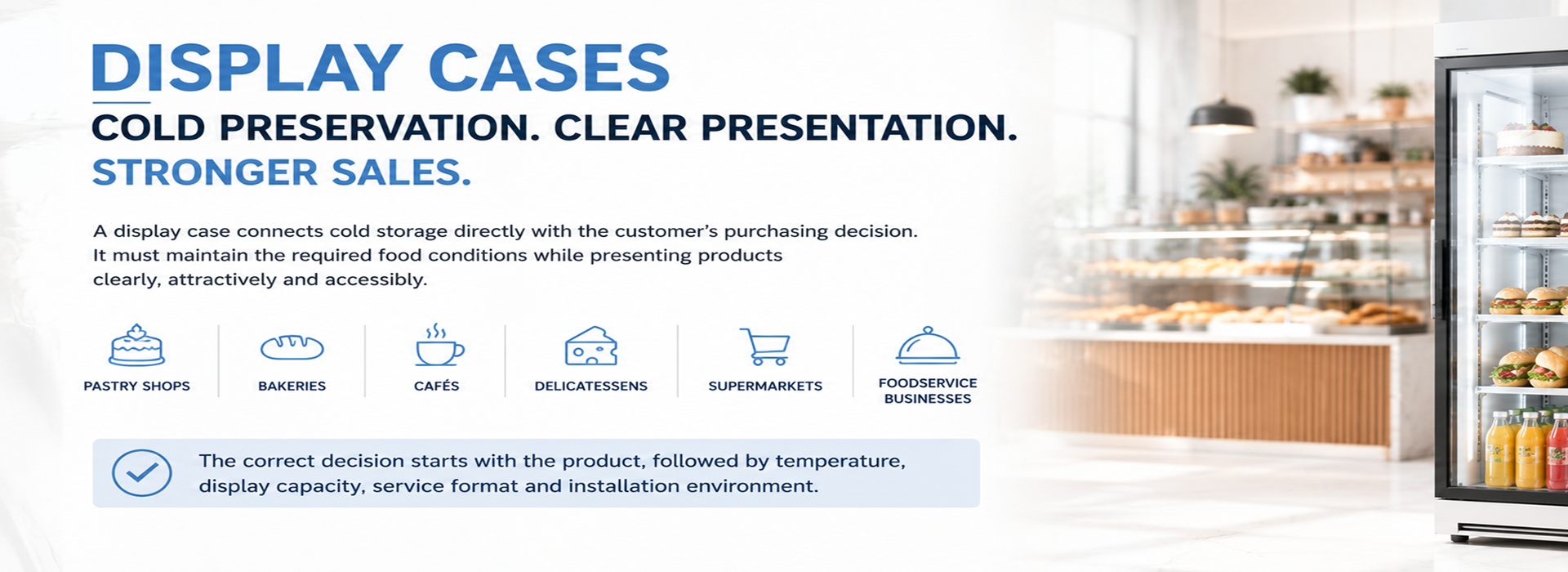
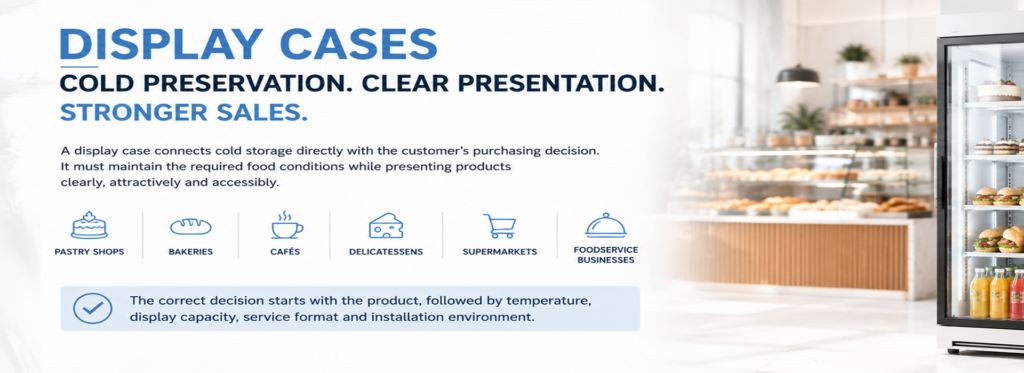
A commercial refrigerated display case connects cold storage directly with the customer’s purchasing decision. It must maintain the required food conditions while presenting products clearly, attractively and accessibly.
Pastry shops, bakeries, cafés, delicatessens, supermarkets and foodservice businesses need different display configurations. A case selected only for its appearance may provide unsuitable airflow, insufficient shelf space or poor access for service.
The correct decision starts with the product, followed by temperature, display capacity, service format and installation environment.
Define the Commercial Purpose
The display case may be intended to:
- present cakes and desserts;
- serve delicatessen products;
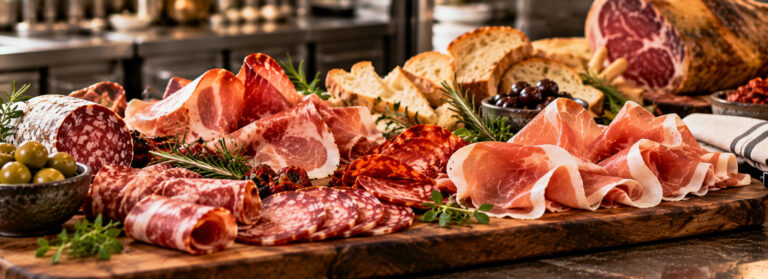
- hold cured meats and cheese;
- sell bottled drinks;
- present packaged foods;
- encourage impulse purchases;
- support self-service;
- highlight seasonal specialities.
Its function determines the required temperature, glass profile, shelving and method of access.
Analyse the Products
Every food category has different display requirements.
Cream desserts can be sensitive to airflow. Sliced cured meats and cheese may lose moisture. Drinks need strong shelving and sufficient vertical clearance. Prepared foods may require GN containers and easy operator access.
The product assessment should record:
- dimensions;
- weight;
- packaging;
- required temperature;
- expected display duration;
- replenishment frequency;
- sensitivity to light;
- sensitivity to drying;
- allergen considerations.
These details help eliminate models unsuitable for the actual application.
Calculate the Usable Display Area
External width alone does not indicate how much product the cabinet can present effectively.
Operators should calculate:
- usable shelf depth;
- number of display levels;
- spacing between shelves;
- maximum product height;
- clearance around air outlets;
- space occupied by the evaporator;
- room required for labels;
- separation between categories.
Capacity should be measured in actual display units such as cakes, trays, bottles, GN containers or packages.
Countertop Displays
Countertop units can be installed on service counters and are suitable for small-format products.
Typical applications include:
- cafés;
- bars;
- bakeries;
- till areas;
- small buffets;
- businesses with limited space.
The supporting surface must carry the weight of the fully loaded unit and provide a suitable viewing height.
Clearance is also required for ventilation, electrical connections and cleaning.
Floor-Standing Display Cases
Floor-standing cases provide a larger presentation area and may form the main section of a sales counter.
Before installation, check:
- width and depth;
- delivery route;
- overall height;
- electrical connection position;
- ventilation clearance;
- rear access;
- staff movement;
- customer circulation.
Doorways and corridors along the delivery route may need to be wider than the final installation space.
Assisted-Service Displays
In an assisted-service configuration, staff serve products from the rear.
This arrangement enables the business to:
- control portions;
- protect the food;
- explain products;
- manage utensils;
- maintain presentation standards;
- limit public handling.
Rear access should allow operators to work without awkward movements. Frequently ordered items should be easy to reach.
Self-Service Displays
A self-service display allows customers to remove the products.
It should provide:
- intuitive access;
- doors that close correctly;
- stable shelves;
- visible labels;
- clear prices;
- products that are easy to remove;
- sufficient customer space.
Frequent openings require effective temperature recovery. Staff must inspect the display regularly to maintain order and cleanliness.
Select the Correct Temperature Range
The operating range must match the food category and the site’s HACCP plan.
Before choosing a unit, confirm:
- adjustable range;
- uniformity across the shelves;
- recovery time;
- controller functions;
- alarms;
- probe position;
- behaviour during defrosting.
A case should not hold different products simply because all of them require refrigeration. Individual categories may need specific conditions.
Ventilated Refrigeration
Ventilated systems distribute cold air and can provide more uniform temperatures across several levels.
This may be useful when:
- the display is tall;
- several shelves are used;
- doors open frequently;
- replenishment is continuous;
- fast recovery is required.
Moving air can dry exposed food. Suitable containers, packaging or protective systems may therefore be necessary.
Static Refrigeration
A static system relies on natural air circulation.
Temperature differences may occur between areas, and products must be positioned accordingly.
Static refrigeration can suit certain preparations that are sensitive to moisture loss, provided that the temperature range and case design meet their requirements.
The decision should be based on product testing and technical information rather than a general preference.
Humidity and Product Quality
Humidity affects both appearance and texture.
Air that is too dry may cause:
- weight loss;
- cracked surfaces;
- dull glazes;
- dry edges;
- deterioration of sliced cheese and cured meat.
Excessive humidity may produce:
- condensation;
- sticky surfaces;
- loss of crispness;
- fogged glass;
- damaged decorations.
The correct balance depends on the food and the planned display time.
Straight or Curved Glass
Straight glass provides a contemporary, linear appearance.
Curved glass creates a softer, more traditional presentation.
The decision should consider:
- interior design;
- reflections;
- viewing angle;
- cleaning access;
- operator access;
- replacement costs;
- compatibility with multiple joined modules.
The design must support routine work as well as appearance.
Visibility and Condensation
Food loses commercial value when the customer cannot see it clearly.
Condensation may result from:
- high room humidity;
- temperature differences;
- repeated door openings;
- insufficient ventilation;
- proximity to an entrance;
- anti-fog system performance.
Heated glass and other anti-fog features can maintain visibility but also use energy and require maintenance.
Design the Lighting
Lighting should show the product accurately.
When comparing displays, evaluate:
- LED-strip position;
- brightness;
- colour rendering;
- shadows;
- glass reflections;
- heat generation;
- access for component replacement.
Warm lighting may complement certain bakery products but must not distort their real colour.
Organise the Shelves
Shelf arrangement should guide the customer’s eye and simplify replenishment.
Important features include:
- adjustable height;
- possible tilt;
- maximum load;
- ease of removal;
- material;
- usable surface;
- tray compatibility.
Heavy products need suitable support. Tall cakes require enough clearance to prevent damage to decorations.
Create Product Zones
Grouping related products makes the range easier to understand.
A pastry display can separate:
- whole cakes;
- individual portions;
- spoon desserts;
- fruit products;
- chocolate specialities;
- seasonal items.
A delicatessen display may organise:
- appetisers;
- first courses;
- main dishes;
- side dishes;
- cheese;
- cured meats.
Visual organisation must remain compatible with hygienic separation and allergen management.
Position Priority Products
Areas near eye level normally receive greater attention.
They can be assigned to:
- house specialities;
- seasonal products;
- new items;
- profitable products;
- recipes representing the business.
Core products should still remain easy to find. Commercial prioritisation must not create confusion or hide prices.
Integral Refrigeration Unit
An integral system contains the refrigeration unit within the display structure.
Installation is relatively straightforward, but heat is released into the premises. Ventilation grilles and required clearances must remain unobstructed.
An integral unit may suit businesses where:
- no remote technical space is available;
- installation needs to remain simple;
- display length is moderate;
- the room has sufficient ventilation.
Noise and heat output should be assessed under actual operating conditions.
Remote Refrigeration Unit
A remote unit can reduce heat and noise within the sales area.
It requires:
- professional refrigeration design;
- pipework;
- external unit or plant space;
- drainage;
- specialist installation;
- maintenance access.
The initial cost may be higher, but the configuration can improve comfort in larger premises or sites with several display cases.
Climate Class
The climate class must suit room conditions during the busiest period.
Heat sources can include:
- ovens;
- toasters;
- coffee machines;
- lighting;
- direct sunlight;
- external doors;
- customer presence.
A display case unsuitable for its environment may run continuously, consume more energy and struggle to maintain temperature.
Positioning in the Sales Area
The display should attract attention without creating an obstacle.
Its position must support:
- visibility from the entrance;
- customer movement;
- organised queuing;
- rear service;
- restocking;
- cleaning;
- maintenance;
- ventilation.
It should not be placed in direct sunlight or beside heat-producing appliances.
Replenishment During Service
Restocking should maintain an abundant, organised appearance without overloading the case.
Before opening the doors, staff should prepare:
- products;
- trays;
- labels;
- supports;
- utensils;
- the intended display space.
New products must be loaded using FIFO or FEFO procedures and should not conceal older items.
Load Products at the Correct Temperature
A display case holds and presents food; it is not designed to cool hot preparations rapidly.
Before loading:
- the case must be stabilised;
- products must be at the required condition;
- trays must be clean;
- labels must be ready;
- air outlets must remain clear.
Introducing warm food can affect the entire display.
Commercial Labelling
Labels help convert customer attention into a purchase.
They should be:
- readable;
- consistent;
- clearly associated with the product;
- stable;
- easy to update;
- compliant with applicable requirements.
Information may include the name, price, sales unit, allergens and a short distinctive description.
Labels must not hide products or obstruct airflow.
Allergen Management
Crumbs, utensils and surfaces can transfer allergens between products.
Professional organisation may require:
- identified trays;
- separated zones;
- dedicated utensils;
- protected containers;
- controlled serving sequences;
- validated cleaning;
- clear customer information.
Visual separation alone does not guarantee the absence of contamination.
Temperature Measurement and Records
The display shows the value measured by a sensor, not necessarily the temperature of every product.
The food-safety system should establish:
- instruments used;
- measurement points;
- monitoring frequency;
- limits;
- recording method;
- corrective actions;
- responsible staff.
Trays and decorations must not cover probes or air outlets.
Cleaning Glass and Runners
Visible cleanliness directly affects the perception of quality.
During the day, staff should check:
- fingerprints;
- condensation;
- crumbs;
- stains;
- label holders;
- handles;
- door runners;
- serving surfaces.
Complete cleaning requires products to be transferred to suitable refrigeration and approved components to be removed.
Defrost and Condensate
The system must remove ice from the evaporator and manage the resulting water.
Check:
- defrost type;
- timing or programming;
- condensate disposal;
- collection tray;
- drain;
- cleaning access.
Abnormal ice build-up should be investigated rather than addressed only by removing visible ice.
Energy Consumption
Actual consumption depends on the appliance and daily operating practices.
It may increase because of:
- high ambient temperature;
- doors left open;
- heated glass;
- overloading;
- dirty condenser;
- damaged seals;
- inadequate ventilation;
- unnecessarily low settings.
Energy use should be assessed together with usable display area and the sales volume the equipment can support.
Final Purchasing Checklist
Before ordering, confirm:
- products displayed;
- temperature range;
- usable display area;
- static or ventilated refrigeration;
- humidity requirements;
- assisted or self-service operation;
- glass profile;
- shelving;
- lighting;
- climate class;
- integral or remote refrigeration;
- utility connections;
- cleaning and maintenance access;
- energy consumption.
The range of professional refrigerated display cases available from Ristorazione‑Refrigerazione includes solutions for pastry, cafés, delicatessens, drinks and packaged foods in different sizes and configurations.
Sull'autore