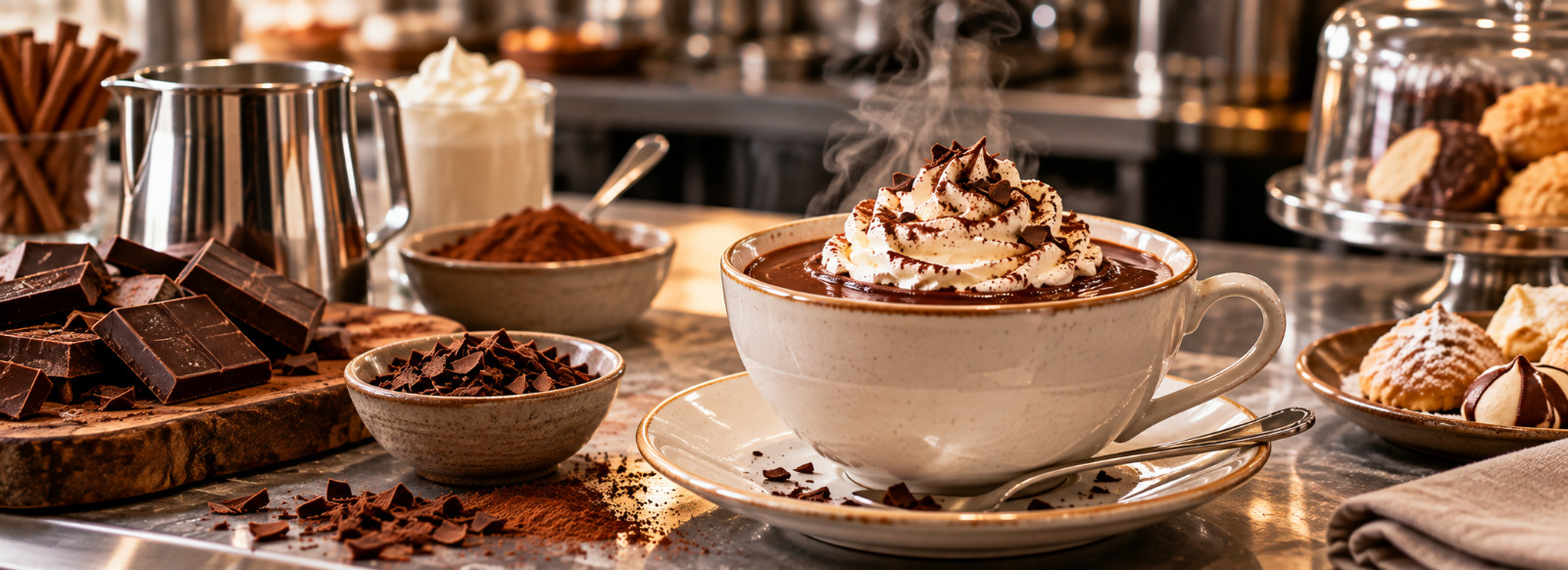
As temperatures fall, hot chocolate returns to cafés, hotels, pastry shops and restaurants. But what appears to be a simple seasonal beverage can become something much more valuable: a carefully designed product category capable of combining comfort, premium positioning and operational efficiency.
Few drinks communicate the arrival of colder weather as clearly as hot chocolate.
Coffee remains a year-round habit. Tea crosses seasons easily. Hot chocolate is different.
It carries a strong emotional association with autumn and winter: warmth, indulgence, childhood memories and the pleasure of slowing down.
For foodservice businesses, this makes it an interesting seasonal opportunity.
The mistake is to think of it simply as “another hot drink.”
From one drink to a small seasonal menu
A professional operation does not necessarily need ten completely different recipes.
One well-designed concept can generate several variations.
A hot chocolate menu might explore:
- dark chocolate;
- hazelnut;
- cinnamon or other spices;
- whipped cream;
- citrus notes;
- crunchy toppings;
- biscuit accompaniments;
- pastry pairings.
This allows a business to create variety without building an excessively complicated production system.
The principle is similar to many successful foodservice concepts:
start with a strong base and create controlled variations around it.
Texture is part of the flavour
Customers do not experience hot chocolate through taste alone.
They also perceive:
- temperature;
- density;
- smoothness;
- aroma;
- mouthfeel;
- presentation.
A very fluid drink creates a different experience from a thick, spoonable chocolate.
Neither is automatically correct.
What matters is that the texture matches the concept and can be reproduced consistently.
And this is where professional production becomes different from preparing one cup at home.
Consistency becomes the challenge
Imagine a café serving one excellent hot chocolate.
Now imagine serving dozens across an afternoon.
The second scenario introduces a different set of questions.
Can every portion maintain the intended consistency?
Can service remain fast?
Can the product be managed throughout the required service period?
Can staff reproduce the presentation?
Can the equipment be cleaned efficiently?
Professional foodservice is ultimately about repeatable quality.
Where professional hot chocolate machines fit
Commercial hot chocolate machines can support service in bars, cafés, hotels, pastry shops and other businesses where the product forms part of the seasonal offer.
However, models may differ in design, capacity and operating principle.
It is therefore important not to assume that every machine works in exactly the same way.
Operators should evaluate the specifications and intended use of the individual model.
Capacity should follow demand
The largest machine is not necessarily the best investment.
A small café with concentrated afternoon demand has different requirements from a hotel serving guests over a longer period.
Before selecting equipment, the operator should estimate:
- expected portions;
- peak demand;
- service duration;
- available counter space;
- cleaning routine;
- frequency of preparation.
This turns capacity from an abstract technical figure into an operational decision.
The pastry-shop opportunity
Hot chocolate becomes particularly interesting in pastry shops because it can be sold as part of a broader experience.
Instead of selling only a cup, the business can create pairings with:
- biscuits;
- croissants and other viennoiserie;
- cakes;
- tarts;
- hazelnut pastries;
- chocolate desserts.
This can change the commercial logic of the product.
The drink becomes the centre of a small tasting experience rather than an isolated purchase.
Hotels can use it differently
Hotels may have several opportunities to introduce seasonal hot chocolate.
Depending on the concept, it could appear during breakfast, afternoon service, lounge service or selected events.
The same basic product can therefore occupy different moments of the guest journey.
But each moment may require a different service strategy.
A breakfast buffet does not operate like an à la carte café.
Equipment and production should reflect that difference.
Presentation matters — but it must remain practical
A beautiful cup performs well in photographs and social media.
But an elaborate presentation requiring several minutes per portion can become problematic during peak demand.
The ideal garnish should therefore satisfy two criteria:
it should improve the product and remain operationally realistic.
This is especially important for high-volume businesses.
Do not forget beverage cost
Food cost principles do not stop at the kitchen door.
Hot chocolate still contains measurable quantities of ingredients.
Chocolate or preparation base, milk or other components, cream, toppings, nuts, biscuits and decorations all contribute to the final cost.
If the drink is positioned as a premium product, portioning becomes particularly important.
An uncontrolled topping station can quietly increase cost across hundreds of servings.
Allergens require attention
Milk, nuts and other ingredients frequently associated with hot chocolate and its garnishes may introduce allergen considerations.
Recipes, preparation procedures and communication should therefore be integrated into the business’s allergen-management system.
A visually attractive topping should never be treated as an operational afterthought.
Chef Costantino’s seasonal interpretation
Gourmet Dark Hot Chocolate with Hazelnut Crumble
The concept combines two contrasting sensations.
The hot chocolate provides warmth and creaminess.
The hazelnut crumble adds texture.
This small contrast transforms a familiar drink into something closer to a plated-dessert experience.
The machine supports the product. It does not create it.
This distinction is important.
A professional hot chocolate machine can help organise service.
But equipment cannot decide:
- which chocolate to use;
- how sweet the recipe should be;
- what texture suits the brand;
- which garnish creates balance;
- how the product should be priced.
Those remain culinary and commercial decisions.
The strongest seasonal concepts emerge when both sides work together:
a good recipe and an efficient service system.
Professional equipment focus: commercial hot chocolate machines.
TAGS
commercial hot chocolate machine, professional hot chocolate machine, hot chocolate, winter drinks, café equipment, bar equipment, hotel beverage service, pastry shop, dark chocolate, hazelnut, seasonal menu, foodservice equipment, HoReCa
Sull'autore