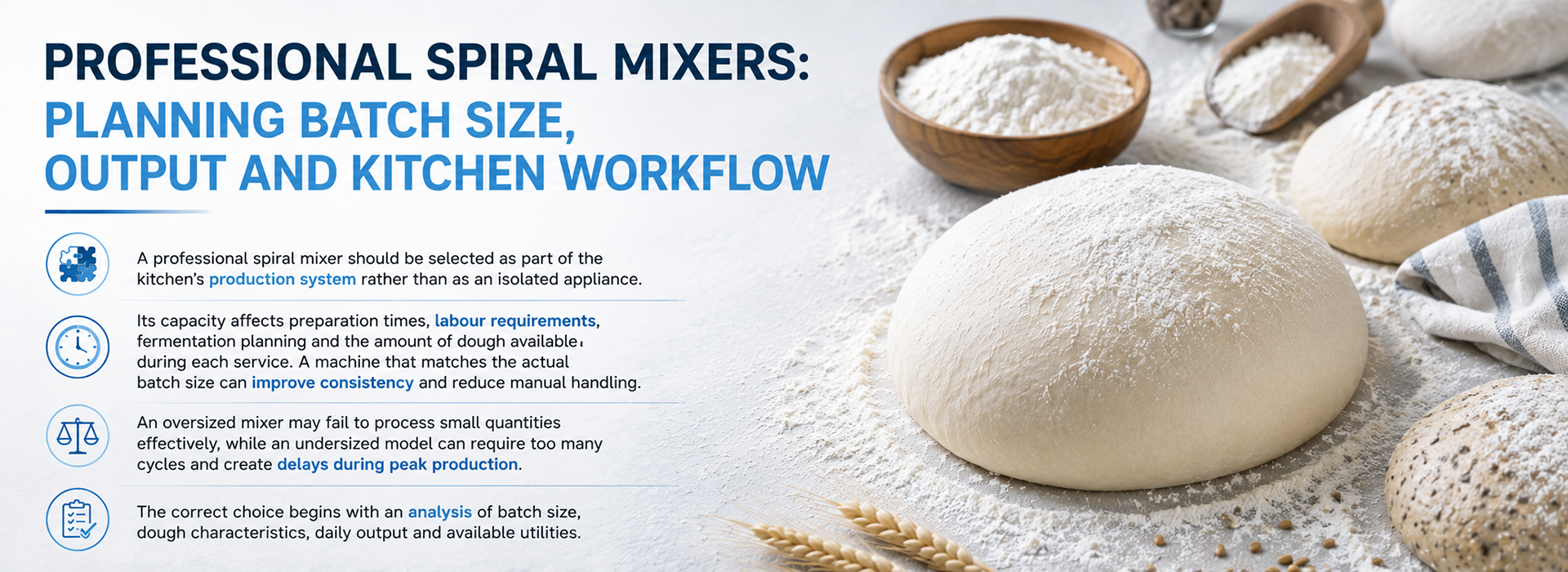

A professional spiral mixer should be selected as part of the kitchen’s production system rather than as an isolated appliance.
Its capacity affects preparation times, labour requirements, fermentation planning and the amount of dough available during each service. A machine that matches the actual batch size can improve consistency and reduce manual handling.
An oversized mixer may fail to process small quantities effectively, while an undersized model can require too many cycles and create delays during peak production.
The correct choice begins with an analysis of batch size, dough characteristics, daily output and available utilities.
Define the standard production batch
Before comparing machines, calculate the quantity of dough normally prepared during one cycle.
For a pizzeria, this can be determined by multiplying the number of dough balls by their individual weight.
If the business needs 80 portions weighing 250 g each, the required production is 20 kg of dough. This quantity can be prepared in one large cycle or divided into smaller batches according to fermentation schedules and service organisation.
A bakery should perform the same calculation for loaves, rolls, focaccia or other products.
The assessment should include:
- normal batch size;
- smallest batch used;
- maximum batch required;
- number of daily cycles;
- production peaks;
- expected future growth;
- different recipes processed by the same machine.
These figures provide a more reliable basis for selection than bowl volume alone.
Bowl volume and dough capacity are not the same
Mixer bowls are generally described in litres, while production is often expressed in kilograms of dough.
The litre value indicates internal bowl volume. It does not automatically correspond to the same number of kilograms of finished dough.
The effective capacity depends on:
- bowl geometry;
- spiral design;
- motor power;
- transmission system;
- dough consistency;
- manufacturer specifications.
A 20-litre bowl, for example, should not automatically be assumed to process 20 kg of dough.
Always compare the stated maximum dough capacity and guaranteed minimum quantity in addition to bowl volume.
Why minimum capacity matters
Professional operators frequently focus on maximum output, but minimum capacity can be equally important.
When a small amount of dough is placed in a very large bowl, the mass may not interact correctly with the spiral and breaker bar. Instead of developing evenly, it can move around the bottom of the bowl without receiving the required mechanical action.
This problem can affect:
- restaurants preparing occasional dough;
- businesses testing new recipes;
- pizzerias making separate speciality batches;
- bakeries producing limited seasonal products;
- laboratories with several dough types.
The mixer should be capable of processing the smallest quantity regularly required by the business, not only the largest.
Single-speed and two-speed mixers
Single-speed spiral mixers offer straightforward operation and may be suitable for traditional recipes with a standard mixing method.
Two-speed machines allow the production cycle to be divided into separate phases.
The first speed combines the ingredients and begins flour hydration. The second applies more intensive mechanical action and supports gluten development.
Two-speed operation can be useful for pizza, bread and high-hydration focaccia, but faster mixing must be controlled carefully.
Excessive second-speed processing can:
- increase final dough temperature;
- accelerate fermentation;
- increase oxidation;
- weaken an overdeveloped structure;
- reduce production consistency.
Mixing programmes should be defined according to flour characteristics, hydration and the required finished product.
Fixed head or lifting head
A fixed-head mixer generally has a bowl that remains attached to the machine.
This construction is robust and suitable for regular production. The operator removes the dough directly from the bowl once the cycle has finished.
A lifting head provides easier access and can simplify dough removal and cleaning.
Models with a removable bowl offer additional flexibility. The bowl can be detached and moved to another working area, depending on its dimensions and design.
A removable bowl may be useful when:
- several recipes are prepared consecutively;
- the dough must be transported to another station;
- additional bowls are used;
- production volume requires easier unloading;
- cleaning speed is an operational priority.
Lifting-head models require sufficient clearance around and above the machine.
Fixed bowl or removable bowl
A fixed bowl is a practical solution when the mixer remains in one position and follows a stable production schedule.
A removable bowl can support more complex workflows and high-volume production. However, the additional flexibility should be evaluated alongside available space, bowl weight and handling requirements.
Large quantities of dough can be heavy. Operators must be able to remove and transport the bowl safely, using appropriate systems when required.
The choice should reflect the complete path followed by the dough after mixing, including resting, dividing, shaping and fermentation.
Hourly output and actual productivity
Manufacturers may indicate the approximate quantity of dough a mixer can produce per hour.
Actual productivity also depends on:
- ingredient weighing;
- bowl loading;
- first-speed mixing;
- dough development;
- unloading;
- cleaning between recipes;
- organisation of the next production stage.
A machine with high theoretical output will not improve the overall workflow if the dough divider, worktable, fermentation area or oven cannot manage the same volume.
Capacity planning should therefore consider the complete production line.
Motor power and dough consistency
Motor power must be appropriate for the machine capacity and the types of dough processed.
Low-hydration and stiff dough create different resistance compared with softer and more hydrated preparations.
The bowl should never be filled beyond the capacity stated by the manufacturer, even when additional space appears to be available. Overloading can result in uneven mixing and unnecessary stress on the motor and transmission.
When requesting information, specify whether the mixer will be used for:
- pizza;
- bread;
- focaccia;
- high-hydration dough;
- stiff dough;
- sweet dough;
- several different preparations.
This helps identify a compatible machine rather than relying only on the stated kilogram capacity.
Single-phase or three-phase supply
Compact mixers are often available with a 230 V single-phase power supply.
Higher-capacity machines may require three-phase power. Before ordering, the business should verify voltage, phases, absorbed power and connection requirements.
Professional equipment may be supplied without a plug because the final connection must be adapted to the premises and local technical requirements.
A qualified technician should confirm compatibility before installation.
Managing final dough temperature
Mixing generates heat through friction. Final dough temperature affects yeast activity, fermentation time and production planning.
The main variables include:
- flour temperature;
- water temperature;
- room temperature;
- mixing duration;
- spiral speed;
- batch quantity;
- machine characteristics.
During warm periods, cooler water may be required. In colder conditions, water temperature may need to be increased according to the recipe and production method.
Measuring and recording the final temperature creates a useful reference for maintaining consistency throughout the year.
Timer, wheels and operational features
A timer helps standardise cycle duration and reduces dependence on operator estimation.
Wheels can simplify cleaning and repositioning, but they must be securely locked during operation.
Depending on the mixer, useful features may include:
- one or two timers;
- variable speed;
- digital control panel;
- reverse bowl rotation;
- lifting head;
- removable bowl;
- programmable cycles;
- safety guard;
- central breaker bar.
Features should be selected according to measurable workflow benefits, rather than simply choosing the machine with the longest specification list.
Cleaning and operator safety
The bowl, spiral, breaker bar and guard should be cleaned after each production cycle or whenever required by the business’s hygiene procedures.
The mixer must be switched off and disconnected before cleaning. Direct water jets must not be used on electrical components.
The safety guard must never be removed or altered. Operators must not place hands, scrapers or utensils inside the bowl while the machine is running.
Training should cover correct batch quantities, start and stop procedures, cleaning and emergency operation.
Professional application: high-hydration gourmet focaccia
High-Hydration Gourmet Focaccia with Confit Tomatoes, Stracciatella and Basil demonstrates how a spiral mixer can support controlled water incorporation and gluten development.
The dough is mixed while monitoring consistency and final temperature. Resting, folding and fermentation allow the structure to strengthen before the dough is transferred to the tray.
After baking, the focaccia is finished with stracciatella, confit tomatoes and fresh basil to preserve the texture and freshness of the toppings.
The complete Chef Costantino recipe will be published exclusively in Italian and will include precise quantities, professional procedures, service organisation, Food Cost and allergens.
[DISCOVER THE CHEF COSTANTINO RECIPE]
Select the mixer around your workflow
Before requesting a quotation, prepare the following information:
- type of dough;
- hydration level;
- minimum batch;
- standard batch;
- maximum batch;
- number of daily cycles;
- required speed configuration;
- fixed or removable bowl;
- available power supply;
- installation dimensions.
This information makes it possible to identify a mixer that supports productivity without creating unnecessary capacity or operational limitations.
Explore professional spiral and planetary mixers with different capacities and configurations.
Sull'autore