
Speed in a commercial kitchen does not come from cooking every product at the highest possible temperature. It comes from organising the workstation so that ingredients, equipment and staff operate as one continuous system.
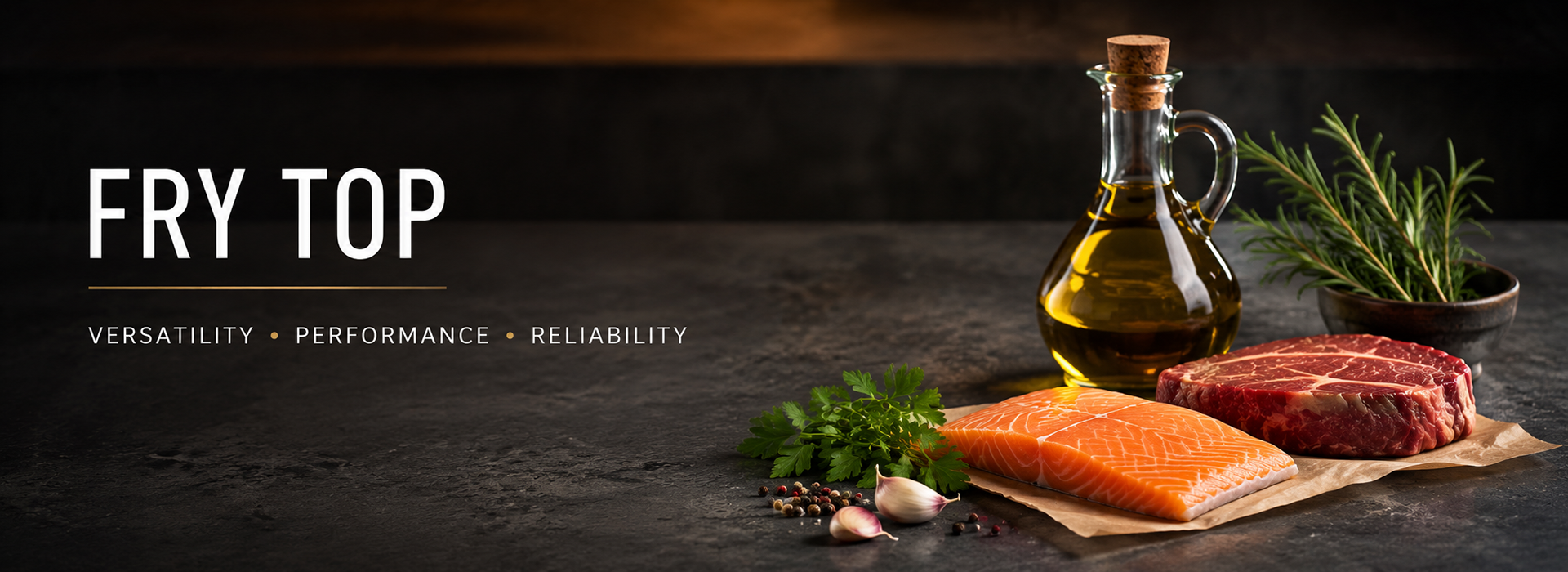
A professional fry top can become a highly productive part of that system. Its solid heated surface can handle meat, burgers, seafood, vegetables, eggs and many other foods without the limitations of an open grill.
Selecting the correct unit requires more than comparing price and external dimensions. Plate layout, power supply, temperature recovery, cleaning access and expected production volume all influence how the appliance will perform during a busy service.
Why Fry Tops Are So Versatile
A fry top transfers heat through direct contact between the cooking plate and the food. The solid surface supports ingredients of almost any size and prevents small or delicate products from falling through an open grate.
It also offers several operational advantages:
- multiple portions can be cooked simultaneously;
- only a controlled amount of oil is required;
- cooking juices can be managed on the plate;
- foods can be moved between hotter and cooler sections;
- the workstation can be cleaned progressively;
- one appliance can support several parts of the menu.
This versatility makes fry tops suitable for restaurants, hotels, pubs, cafés, burger operations, steakhouses, institutional kitchens, catering facilities and mobile food businesses.
Start with the Menu, Not the Machine
The most effective way to select a fry top is to begin with a detailed list of the products that will be cooked on it.
A burger restaurant may need a large smooth surface that supports rapid batch production. A steakhouse might favour a ribbed plate to create pronounced grill marks. A varied restaurant menu may benefit from a mixed plate that accommodates meat, fish and vegetables during the same service.
The menu analysis should identify:
- portions required during the busiest hour;
- average dimensions of each product;
- typical cooking times;
- foods that require separate areas;
- demand for smooth and ribbed cooking;
- need for different temperature settings.
This information provides a realistic basis for calculating the required plate size and output.
Smooth Plates for Maximum Contact
A smooth cooking plate creates full contact with the product. The resulting heat transfer supports fast, even browning across the entire surface of the food.
Smooth fry tops are commonly used for:
- traditional and smash burgers;
- eggs and breakfast products;
- bacon;
- fish fillets and shellfish;
- sliced vegetables;
- cheese;
- sandwiches and flatbreads;
- small cuts of meat.
The surface is also compatible with professional spatulas, making it easy to turn, portion and move products. Cooking juices can be collected or incorporated into quick sauces when the workflow and food-safety procedures allow it.
Ribbed Plates for Grill Marks and Fat Drainage
A ribbed plate produces the visual lines associated with grilling. The channels also direct some fat and liquid away from the contact points.
This configuration is suitable for steaks, chicken portions, burgers, vegetables and firm fish fillets. It can be valuable in open kitchens where the appearance of the finished product contributes to the customer’s experience.
Ribbed surfaces require careful cleaning because residues can build up inside the grooves. Operators need appropriate tools and enough time in the closing procedure to clean the entire profile of the plate.
Mixed Plates for Varied Menus
A mixed fry top combines smooth and ribbed sections in one appliance. This makes it possible to use different cooking techniques without installing two separate machines.
For example, the ribbed side can be used for sliced beef and vegetables while the smooth side handles fish, eggs or burgers.
The main factor to consider is the usable area of each section. A mixed plate provides flexibility only if both sides are large enough for the actual production volume. If most orders require the smooth side, an equal split may restrict output during peak service.
Electric Fry Tops
Electric fry tops provide straightforward heat control and can be installed where an appropriate electrical supply is available.
Compact units may use a single-phase connection, while larger and more powerful models often require a three-phase supply. The voltage, frequency, total load and connection type must always be checked before purchase.
An electrician should confirm that the existing installation can support the appliance alongside ovens, fryers, refrigeration equipment and the other loads operating during service.
Electric models can be a practical choice for:
- all-electric kitchens;
- cafés and delicatessens;
- mobile or compact operations;
- sites without a gas connection;
- applications requiring controlled temperature adjustment.
The available electrical capacity should be considered at the earliest stage of kitchen planning.
Gas Fry Tops
Gas fry tops are widely used in demanding production environments because of their fast response and ability to support intensive cooking.
Depending on the model, the appliance may be configured for natural gas or LPG. Supply pressure, injector configuration, ventilation and combustion requirements must be checked by qualified personnel.
Gas units also need an appropriate extraction system and safe access to the isolation valve. Installation and conversion should never be based on assumptions or carried out without following the manufacturer’s technical documentation.
A gas fry top may be especially suitable for a kitchen that already uses a gas cooking line and has the necessary infrastructure in place.
Plate Material and Finish
Professional cooking plates may be manufactured from steel or supplied with a chrome-plated finish.
Steel is a robust choice for continuous commercial use. Correct cleaning and surface care are essential to prevent residue accumulation and preserve consistent cooking performance.
Chrome-plated plates have a smoother, less porous surface. They can reduce food adhesion and make residue removal easier when maintained correctly.
However, chrome finishes require compatible utensils and cleaning products. Abrasive tools can scratch the surface and reduce its operational advantages.
The final decision should therefore consider both cooking performance and the maintenance practices that staff can follow consistently.
Heat Recovery Matters More Than Maximum Temperature
Maximum temperature is often treated as the main indicator of fry-top performance. In practice, heat recovery can be even more important.
Every time cold food is loaded onto the plate, its surface temperature falls. A correctly sized appliance should restore the selected temperature quickly enough to maintain effective browning.
If heat recovery is too slow:
- products release more liquid;
- cooking times increase;
- browning becomes inconsistent;
- output decreases;
- staff may compensate by overcrowding or extending the cooking cycle.
Power must therefore be evaluated in relation to the plate dimensions, expected batch size and intensity of use.
Independent Cooking Zones
Large fry tops may feature two or more separately controlled heating zones. This design gives the kitchen additional flexibility.
One area can operate at high heat for searing meat, while another remains at a moderate setting for seafood or vegetables. During quieter periods, the kitchen may also be able to use only the surface required, depending on the design of the appliance.
Independent zones are particularly valuable when different menu categories must be prepared at the same time. They also help prevent operators from continually adjusting a single thermostat during service.
Countertop or Floor-Standing Installation
A countertop fry top can add useful production capacity without requiring a complete modular cooking suite. It is suitable for smaller kitchens, seasonal businesses and operations where the menu is still developing.
The supporting surface must be stable, heat-resistant and capable of carrying the weight of the appliance. Its height should also provide a safe and comfortable working position.
A floor-standing unit forms a permanent section of the cooking line. The base may be open or enclosed and can provide useful storage or easier access to technical connections.
When comparing the two configurations, the business should examine:
- available floor and counter space;
- required plate capacity;
- working height;
- cleaning access;
- connection position;
- future expansion of the cooking line.
Grease Management and Daily Cleaning
Fat, juices and food particles must be directed away from the active cooking area. A well-designed fry top includes splash guards, a drainage opening and a removable collection tray.
The tray should be easy to reach and large enough for the expected workload. If it fills too quickly, staff may have to interrupt production to empty it.
Cleaning should be integrated into the operating procedure. During service, burnt residues should be removed before they transfer unwanted flavours to the next batch. At closing, the plate, guards, edges and collection system must all be cleaned.
Operators should avoid pouring cold water onto an extremely hot plate unless the manufacturer specifically permits that procedure. Sudden temperature changes can damage or deform the cooking surface.
Positioning the Workstation
A productive fry-top station requires more than the appliance itself.
Refrigerated ingredients, seasonings, clean utensils and plating supplies should all be positioned within a logical working radius. Raw products must remain separated from cooked food, and staff should not have to cross busy walkways repeatedly.
The layout should support a simple sequence:
- retrieve the prepared portion;
- place it on the correct cooking zone;
- monitor and turn it with dedicated utensils;
- verify doneness or core temperature;
- transfer it to the finishing area;
- remove residues before the next order.
A clear sequence reduces unnecessary movement and helps maintain consistent output.
Food Safety and Cross-Contamination
Because a fry top can cook many different products, it also creates potential cross-contamination risks.
Raw meat, seafood, vegetables and ready-to-serve foods should not be handled with the same tools. Dedicated sections and utensils may be required, but physical separation alone may not be enough when allergens are involved.
The business must establish procedures covering:
- raw and cooked product separation;
- utensil identification;
- allergen management;
- cleaning between product categories;
- temperature monitoring;
- safe grease disposal.
These procedures should form part of the site’s food-safety management system and staff training.
Choosing for Long-Term Productivity
The right fry top should support the kitchen’s busiest service without becoming an oversized source of unnecessary energy consumption.
Before ordering, operators should confirm:
- useful plate dimensions;
- smooth, ribbed or mixed layout;
- steel or chrome finish;
- gas or electrical requirements;
- number of heating zones;
- countertop or floor-standing configuration;
- collection-tray capacity;
- extraction and installation needs;
- access for cleaning and maintenance.
The range of professional fry tops available from Ristorazione-Refrigerazione includes electric and gas models, smooth, ribbed and combined surfaces, and configurations for both compact businesses and high-output commercial kitchens.
Sull'autore