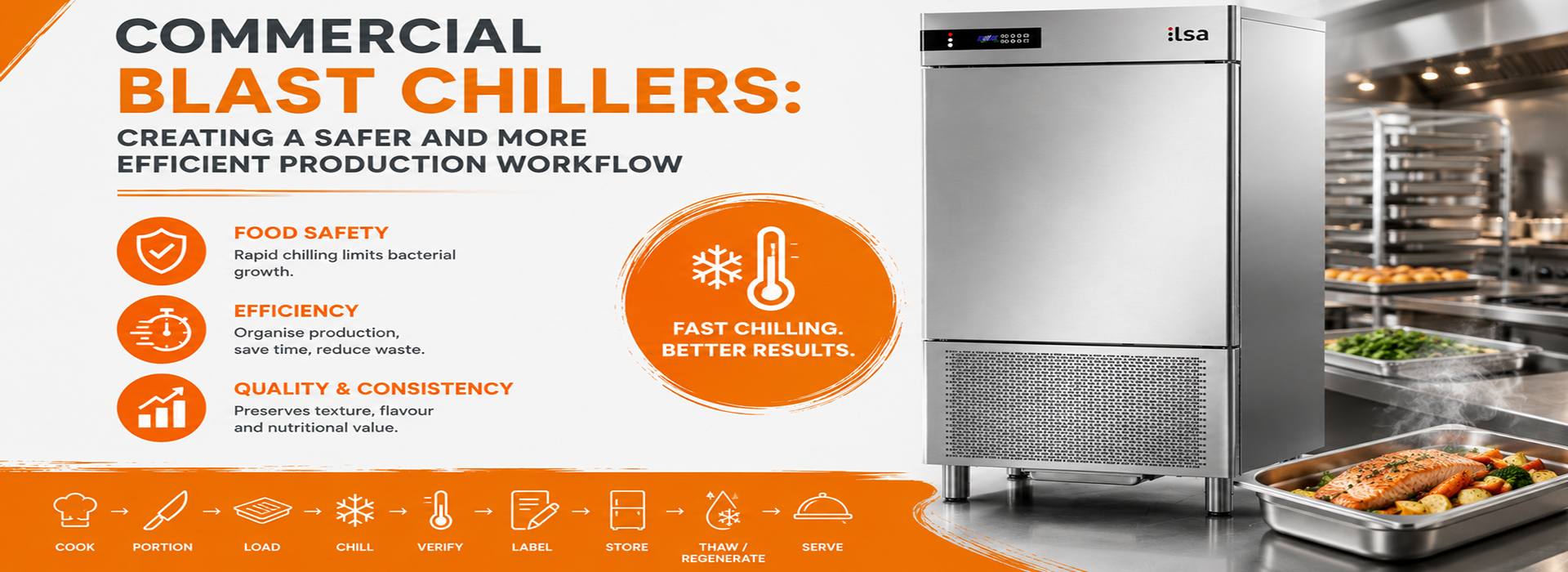
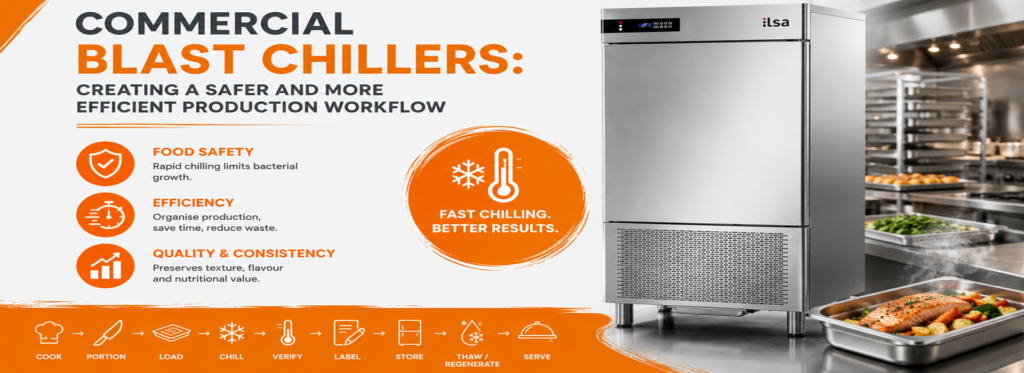
A commercial blast chiller does more than cool food quickly. When integrated correctly into a kitchen, it connects cooking, storage and service within one controlled production system.
Restaurants, hotels, bakeries, pastry shops, prepared-food businesses and catering operations can use blast chilling to organise advance preparation, improve consistency and reduce the time food spends within temperature ranges that can support rapid microbial growth.
The operational benefits depend on choosing the correct capacity and establishing a clear workflow. A blast chiller that is too small can become a production bottleneck, while an oversized appliance may require unnecessary space, electrical capacity and investment.
Before selecting a unit, operators should examine the food being processed, the weight of each batch, the tray formats used and the number of cycles required during peak production.
Blast Chilling as Part of a Production System
Blast chilling should not be treated as an isolated action performed after cooking. It is one stage in a sequence that includes:
- controlled cooking;
- hygienic portioning;
- rapid loading;
- selection of the correct chilling programme;
- core-temperature verification;
- labelling;
- refrigerated or frozen storage;
- controlled thawing or regeneration;
- final service.
Each step affects the next. Food that is cooked correctly but left waiting too long before chilling may not follow the intended safety procedure. A product that is chilled correctly can still be compromised by poor labelling, unsuitable storage or uncontrolled regeneration.
The kitchen therefore needs written procedures that connect the blast chiller with the ovens, preparation tables, refrigerated cabinets and freezers.
Why Conventional Refrigeration Is Not Enough
A commercial refrigerator is designed to hold food that is already cold. It maintains a stable storage environment but may not have enough refrigeration power or airflow to remove heat rapidly from freshly cooked products.
Loading hot food directly into a refrigerator can:
- increase the temperature inside the cabinet;
- expose stored products to temporary temperature fluctuations;
- produce excessive condensation;
- extend the cooling period;
- increase compressor workload;
- affect food texture;
- make the process difficult to monitor.
A blast chiller is designed specifically to handle a substantial thermal load. High-velocity cold air moves around the trays and removes heat much faster than standard refrigeration.
Once the cycle has finished, the product must be transferred to the appropriate refrigerator or freezer for storage.
Positive Blast Chilling
Positive blast chilling reduces the temperature of cooked food rapidly so that it can be stored under refrigeration.
It can support the production of:
- cooked meat;
- seafood;
- pasta and rice dishes;
- sauces and stocks;
- vegetables;
- soups;
- fillings;
- prepared meals;
- pastry creams;
- bakery products.
Rapid temperature reduction helps limit the time spent within conditions that favour microbial growth. Exact target temperatures and cycle times must be defined according to local requirements, the business’s food-safety system and the manufacturer’s instructions.
Positive chilling does not extend shelf life indefinitely. The storage period must be established according to the ingredients, preparation method, packaging and refrigerated-storage conditions.
Rapid Freezing
Rapid freezing brings the food to a negative core temperature within a controlled period.
During slow freezing, large ice crystals can form inside the product and damage its cellular structure. When the food is thawed, this damage may lead to greater liquid loss and a less stable texture.
Rapid freezing supports the formation of smaller ice crystals and can help preserve product quality more effectively.
It is particularly useful for:
- meat and seafood;
- fresh pasta;
- bread and leavened products;
- portioned prepared dishes;
- pastry components;
- individual desserts;
- semifreddos;
- production bases.
The product must be transferred to a suitable freezer immediately after the cycle. The blast chiller performs rapid freezing, while the storage freezer maintains the required temperature over time.
Start with the Products
Selecting the correct blast chiller begins with a list of the foods that will pass through it.
The kitchen should record:
- product name;
- weight of each batch;
- initial temperature;
- portion dimensions;
- depth of the product on the tray;
- tray format;
- cycle required;
- number of batches per day;
- final storage destination.
A sauce spread across several shallow containers will cool differently from the same quantity placed in one deep pan. Individual desserts require a different arrangement from a large roast or a container of cooked rice.
Product density and thickness influence the cooling time as much as total weight.
Calculate Capacity at Peak Production
Average daily output does not always indicate the capacity required.
A restaurant may concentrate batch production before a busy weekend. A bakery or pastry shop may process much larger volumes during seasonal periods. Catering companies can experience significant differences between ordinary days and large events.
Operators should calculate the greatest realistic quantity that must be blast chilled within a specific production window.
The assessment should include:
- maximum kilograms per cycle;
- available time between batches;
- number of trays required;
- frequency of consecutive cycles;
- positive-chilling workload;
- rapid-freezing workload;
- future growth.
An appliance that processes one batch correctly may still be insufficient if the kitchen needs several overlapping cycles and has no time available between them.
Tray Count and Kilogram Capacity
The number of tray levels describes the internal configuration, but it does not provide a complete measure of performance.
A five-tray model may physically accept five containers, but the quantity inside those containers must remain within the stated kilogram capacity.
When comparing blast chillers, check:
- positive-chilling capacity;
- rapid-freezing capacity;
- reference initial temperature;
- required final temperature;
- reference cycle duration;
- supported tray format;
- spacing between levels.
The manufacturer’s stated performance is based on specific test conditions. Actual cycle times can change when the product, loading pattern or ambient temperature differs.
GN and EN Tray Compatibility
Tray compatibility determines how easily the blast chiller fits into the kitchen.
Restaurants commonly use Gastronorm containers, while bakeries and pastry laboratories frequently rely on EN-format trays. Some blast chillers support only one format, while others accept both through specific guides or accessories.
Using the same trays in the oven and blast chiller provides several advantages:
- fewer product transfers;
- less handling;
- reduced washing;
- shorter preparation times;
- simpler batch identification;
- lower contamination risk.
Before ordering, operators should confirm the exact external dimensions and supported tray sizes rather than relying only on a general description such as “five trays.”
Product Depth and Container Selection
Deep containers slow down heat removal because cold air acts primarily on the exposed surface while the centre retains heat.
Whenever the preparation allows it, food should be distributed in a uniform and controlled layer.
Operational sheets can specify:
- maximum weight per tray;
- maximum product depth;
- type of container;
- number of portions;
- spacing between products;
- probe position;
- approved cycle.
Metal trays generally transfer heat more effectively than thick or insulating containers. Every container must be suitable for the temperatures reached during the selected cycle.
The food should not be covered in a way that obstructs heat transfer unless the validated procedure specifically requires it.
Loading the Chamber Correctly
The blast chiller depends on effective airflow. Trays placed too closely together, overloaded containers or obstructed vents can create uneven results.
Staff should:
- remain within the stated weight capacity;
- leave the required space between tray levels;
- avoid blocking ventilation openings;
- distribute the load evenly;
- avoid mixing incompatible products;
- close the door promptly;
- minimise door opening during the cycle.
A chamber that appears full is not necessarily being used efficiently. Correct loading is based on thermal performance, not simply on available physical space.
Using a Core Probe
A core probe provides direct information about the temperature inside the product.
It should be inserted into the section expected to cool most slowly. Depending on the preparation, this may be the centre of the thickest piece or the central area of a deep container.
The probe should not:
- touch a bone;
- rest against the tray;
- sit inside an air pocket;
- remain too close to the surface;
- measure a smaller item that cools faster than the rest of the load.
Incorrect positioning can cause the appliance to end the cycle before the entire batch has reached the required condition.
The probe must be cleaned and sanitised before and after use. When multiple trays are loaded, staff should identify which one represents the most demanding cooling condition.
Timed Programmes
A timed cycle can be effective when production has been highly standardised.
To obtain repeatable results, the kitchen must keep the following variables consistent:
- recipe;
- batch weight;
- initial temperature;
- tray format;
- product thickness;
- loading position;
- selected programme.
Timed cycles should be validated through temperature checks. Staff should not assume that a programme suitable for one product will also be appropriate for another item of similar weight.
Changes in portion size or starting temperature may require a different cycle.
Soft and Hard Chilling
Soft chilling applies a more gradual reduction in temperature and may be suitable for delicate or thin products.
Depending on the appliance and manufacturer’s instructions, it can be used for creams, vegetables, small pastry items and preparations that could be affected by excessively cold surface temperatures.
Hard chilling provides more intensive refrigeration for dense, thick or high-temperature products such as roasts, deep containers of sauce and layered dishes.
The most powerful programme is not automatically the best. The correct cycle balances safe heat removal with the quality requirements of the food.
Planning the Workstation
The blast chiller should be positioned within a logical production route.
An efficient sequence moves from:
- ingredient preparation;
- cooking;
- portioning;
- blast chilling;
- labelling;
- cold storage;
- regeneration or dispatch.
If staff must carry hot trays across long or congested walkways, the process becomes slower and less safe.
The machine should be close enough to the cooking area for rapid loading but protected from excessive ambient heat. It also needs suitable access for cleaning and technical maintenance.
Installation planning should consider:
- door-opening space;
- surrounding ventilation;
- electrical connection;
- drainage, when required;
- floor or supporting-surface strength;
- route for trays or trolleys;
- proximity to refrigerated storage.
Ambient Temperature and Ventilation
A blast chiller removes heat from food and releases that heat into the surrounding environment through its refrigeration system.
If the condenser cannot dissipate heat effectively, cycle times may increase and energy consumption can rise.
The appliance must not be enclosed without the ventilation clearances specified by the manufacturer. Filters and condenser surfaces must remain clean and unobstructed.
A very hot kitchen can reduce refrigeration performance. This factor should be considered when locating the unit near ovens, fryers or other high-temperature equipment.
Electrical Requirements
Blast chillers can have substantial power requirements because they must manage high thermal loads rapidly.
Before purchase, verify:
- voltage;
- frequency;
- total connected load;
- single-phase or three-phase supply;
- cable and connection type;
- electrical protection;
- available capacity during peak operation.
The calculation must include the other equipment operating simultaneously, such as ovens, dishwashers, refrigeration systems and cooking appliances.
Electrical installation should be completed and verified by qualified personnel.
Labelling After Blast Chilling
Food should not remain unidentified after the cycle.
The label can include:
- product name;
- production date;
- chilling date and time;
- batch number;
- responsible operator;
- final temperature;
- storage instructions;
- use-by date;
- allergens.
The information must remain legible throughout storage. Labels should be applied consistently so that staff can follow stock rotation and retrieve the correct batch.
Blast chilling is only effective when the product is transferred promptly to the correct storage environment.
Thawing and Regeneration
The production plan must cover the complete return path from storage to service.
Frozen products should be thawed under controlled conditions according to the food-safety procedure. Leaving food at room temperature for extended periods can create unsafe temperature exposure.
Regeneration should use suitable professional equipment and a validated programme.
The procedure should establish:
- quantity regenerated;
- appliance and programme;
- required core temperature;
- maximum holding time;
- plating or service method;
- management of unused portions.
Repeated cooling and reheating should not take place without a specifically validated process.
Supporting Consistent Food Quality
A blast chiller can help the kitchen produce standardised bases during planned preparation periods.
Stocks, sauces, fillings, cooked vegetables, meat preparations and desserts can be divided into controlled batches. During service, staff work with measured portions and established regeneration procedures.
This can improve:
- portion consistency;
- recipe repeatability;
- service speed;
- stock visibility;
- workload distribution;
- food-cost control.
The system remains effective only when production reflects actual demand. Preparing excessive quantities simply because blast chilling is available can increase stock and create unnecessary waste.
Food-Waste Reduction
Blast chilling can support waste reduction by allowing operators to plan batches, divide products into useful portions and regenerate only the quantities required.
It may help the business:
- manage planned surplus;
- use ingredients more efficiently;
- reduce repeated preparation;
- organise stock rotation;
- preserve quality during the approved storage period;
- monitor actual consumption.
It should never be used to recover food that has already remained under unsuitable conditions. Only products prepared, handled and stored correctly should enter the process.
Allergen Management
Blast chillers may process many different categories of food, creating potential allergen cross-contact risks.
Staff must control:
- tray identification;
- production sequence;
- probe sanitation;
- drips between tray levels;
- chamber cleaning;
- packaging;
- labelling.
Allergen-containing products should be handled according to the business’s food-safety procedures. A visually clean probe or tray may still require complete cleaning and sanitation before reuse.
Cleaning and Preventive Maintenance
The internal chamber should be cleaned after production in accordance with the appliance manual.
Cleaning normally includes:
- walls;
- tray runners;
- grids;
- door seals;
- drain;
- core probe;
- handle;
- external surfaces.
Abrasive tools, aggressive chemicals and unauthorised water jets can damage the appliance.
Preventive checks should also cover:
- condenser cleanliness;
- ventilation;
- door-seal condition;
- probe accuracy;
- alarm history;
- unusual ice formation;
- cycle duration.
Longer-than-normal cycles can indicate overloading, poor airflow, a dirty condenser or a technical problem.
Selecting for Long-Term Productivity
The correct blast chiller is the unit that processes the business’s maximum realistic workload without becoming a bottleneck or an oversized source of unnecessary cost.
Before ordering, confirm:
- products to be processed;
- maximum kilograms per cycle;
- positive-chilling requirements;
- rapid-freezing requirements;
- tray quantity and format;
- product thickness;
- available installation space;
- electrical supply;
- daily cycle frequency;
- expected production growth.
The range of professional blast chillers available from Ristorazione-Refrigerazione includes configurations for restaurants, hotels, bakeries, pastry shops, catering operations and commercial food-production laboratories.
Sull'autore