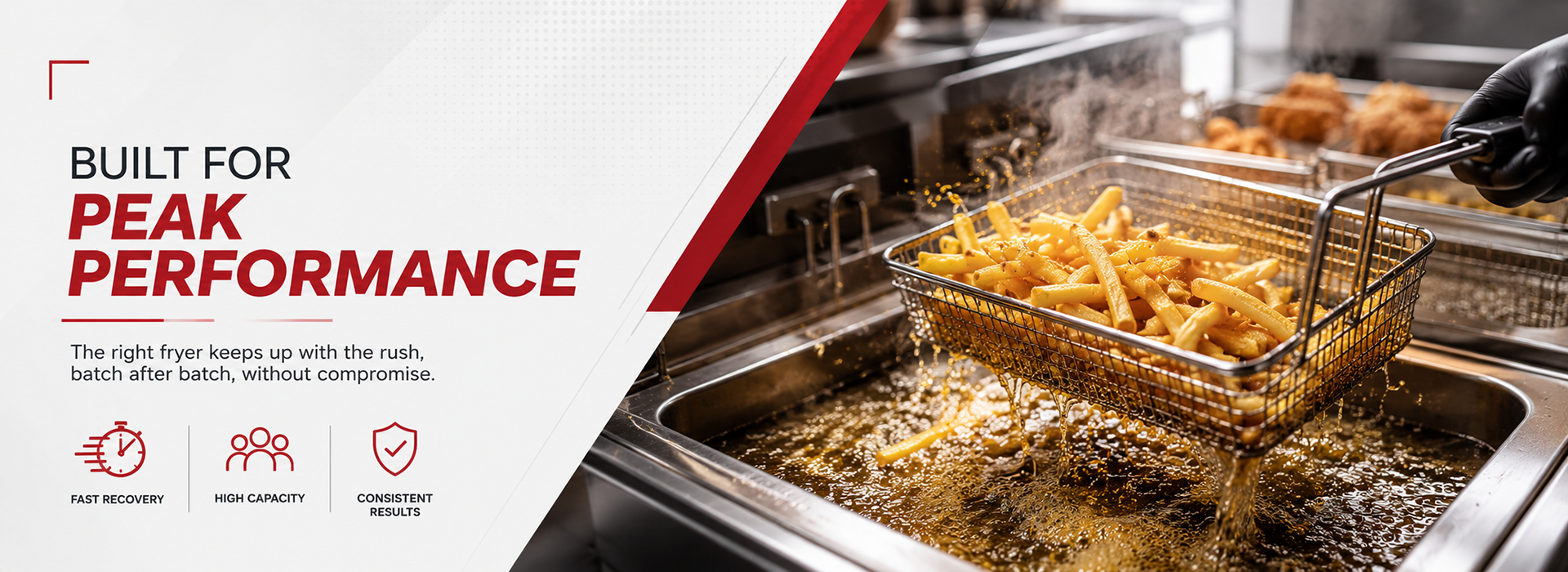
A commercial deep fryer can become one of the busiest appliances in a professional kitchen. Fries, chicken, seafood, croquettes, vegetables, snacks and desserts can all be produced quickly when the equipment is correctly sized and the workflow is properly organised.
Selecting a fryer involves more than comparing tank capacity and purchase price. Power, temperature recovery, energy supply, number of tanks, filtration, drainage and extraction all influence how the appliance performs during peak service.
The correct fryer should support the busiest production period without forcing staff to overload baskets, wait too long between batches or operate the machine continuously at its limit.
Begin with the Menu
The selection process should start with a complete list of the products that will be fried.
A restaurant may use its fryer mainly for side dishes and appetisers. A burger operation may require continuous production of fries and breaded products. A seafood business may need completely separate tanks to prevent flavour and allergen transfer.
The menu analysis should identify:
- products being fried;
- portion weight;
- maximum orders during the busiest hour;
- average cooking time;
- fresh or frozen starting condition;
- required oil temperatures;
- breaded and battered foods;
- allergen-separation requirements.
This information provides the basis for calculating tank capacity, basket size and the number of independent frying zones.
Calculate Peak-Hour Output
Average daily production does not show how demanding the busiest service period will be.
If a business sells 100 portions throughout the day but receives 40 orders within one hour, the fryer must be able to support that concentrated demand.
The calculation should include:
- grams per portion;
- maximum basket load;
- cooking time;
- heat-recovery time;
- number of consecutive batches;
- additional fried menu items;
- time required for residue removal or filtration.
Loading a larger quantity into the basket does not always increase output. An overloaded basket causes a greater temperature drop and may extend the cooking cycle enough to reduce total productivity.
Tank Capacity
Fryer tanks are generally described in litres. This indicates approximate oil volume but does not provide a complete measure of production capacity.
Two fryers with similar tank volumes can perform very differently because of variations in:
- heating power;
- heat-transfer design;
- basket dimensions;
- cold-zone configuration;
- recovery speed;
- temperature control.
A larger oil volume can support a greater load, but it also requires sufficient power to reach and recover the selected temperature.
Operators should compare tank capacity and power as a combined system.
Why Temperature Recovery Matters
Every food product removes heat from the oil when it enters the tank.
The temperature drop is greater when:
- the product is frozen;
- loose surface ice is present;
- the basket is overloaded;
- portions are large;
- batches are loaded too closely together;
- the fryer has insufficient power.
If recovery is slow, food remains in the oil for longer before an effective crust forms. This can produce a softer, heavier and less consistent result.
A productive fryer should restore its operating temperature quickly enough to maintain regular cooking times throughout service.
Electric Commercial Fryers
Electric fryers use heating elements to transfer energy directly to the oil.
They are available as small countertop models and larger floor-standing units with one or two tanks.
Before ordering an electric fryer, confirm:
- voltage;
- frequency;
- connected load;
- single-phase or three-phase supply;
- cable and connection type;
- available electrical capacity;
- simultaneous kitchen loads.
High-output fryers may require a three-phase supply. An electrician should verify that the site can operate the fryer together with ovens, refrigeration equipment, dishwashers and other appliances used during service.
Electric models can be practical for all-electric kitchens, compact businesses, mobile operations and sites without a gas connection.
Gas Commercial Fryers
Gas fryers use burners to heat the oil through the tank’s heat-transfer system.
Depending on the model, they may be configured for natural gas or LPG. Gas type, pressure, ventilation and combustion requirements must be confirmed before purchase.
Installation and conversion require qualified personnel and must follow the manufacturer’s technical documentation.
A gas fryer can integrate effectively into an existing gas cooking suite and support demanding production. The isolation valve should remain accessible, and the extraction system must be suitable for the appliance.
Countertop Fryers
A countertop fryer can add useful production capacity to a small kitchen or an existing cooking line.
It may be suitable for:
- cafés;
- small bistros;
- pubs;
- pizzerias;
- food trucks;
- seasonal operations;
- businesses with a limited fried-food menu.
The supporting surface must be stable, heat-resistant and capable of carrying the appliance when filled with oil.
Working height is also important. Staff must be able to load and remove baskets without lifting them into an unsafe or uncomfortable position.
Compact dimensions do not automatically mean low electrical demand. Connection requirements must still be checked carefully.
Floor-Standing Fryers
Floor-standing fryers are designed to create a permanent, high-output workstation.
They can form part of a modular cooking suite in restaurants, hotels, fast-food businesses and specialised fried-food operations.
The base provides a suitable working height and may simplify access to drainage and technical components. Some models can accommodate oil-management equipment or collection containers, depending on their design.
Installation planning should consider:
- overall width and depth;
- utility-connection positions;
- access for servicing;
- oil-draining procedures;
- floor cleaning;
- relationship with adjoining appliances.
The fryer should not block staff routes or make maintenance difficult.
Single-Tank Fryers
A single-tank fryer concentrates the appliance’s full capacity in one area.
This arrangement is effective when the business prepares one primary product in high quantities, such as fries.
A large single tank can also use two baskets, allowing separate portions of the same product to cook at slightly different times.
However, every basket shares the same oil. Products placed in the same tank can transfer flavours, residues and allergens.
Twin-Tank Fryers
Independent tanks provide greater flexibility for a varied menu.
They can be used to:
- separate seafood and meat;
- keep fries away from breaded products;
- distinguish sweet and savoury foods;
- operate at different temperatures;
- use different oils;
- activate only one tank during quieter periods;
- support allergen-management procedures.
True separation requires more than two tanks. Each side should have dedicated baskets, utensils, draining containers and filtration procedures.
One Tank with Two Baskets
One tank equipped with two baskets is useful for dividing portions and improving control over individual cooking times.
It does not create separate frying environments because both baskets enter the same oil.
This distinction is important when a kitchen must manage:
- fish allergens;
- gluten-containing breading;
- vegetarian or vegan menu claims;
- sweet and savoury products;
- strong flavour transfer.
Where real separation is required, independent tanks and dedicated operating procedures are necessary.
Cold-Zone Design
Some commercial fryers include a cooler area below the primary cooking zone.
Crumbs and food particles settle into this section, where they are exposed to less intense heat and burn more slowly.
A cold zone can help:
- reduce burnt flavours;
- keep oil cleaner;
- improve colour consistency;
- simplify filtration;
- manage breaded products more effectively.
The tank still requires regular residue removal and cleaning. A cold zone cannot compensate for poor oil management.
Drainage and Oil Handling
Large fryer tanks should include a controlled method for draining oil.
Lifting and tipping a fryer filled with hot oil creates significant risks. A drain tap allows the contents to flow into a compatible container more safely.
The procedure should define:
- when the appliance is switched off;
- the permitted oil temperature;
- protective equipment;
- type and capacity of the collection container;
- filtration method;
- oil-storage or disposal process;
- cleaning of the drain.
The operator must ensure that the tap is closed before the tank is refilled.
Integrated Filtration
Bread crumbs, batter and small food fragments continue to heat after settling in the oil. These residues darken, produce burnt flavours and can accelerate oil deterioration.
Frequent filtration is particularly important for:
- breaded chicken;
- croquettes;
- battered vegetables;
- coated seafood;
- fried desserts;
- heavily seasoned products.
An integrated filtration system can reduce handling and make the procedure easier during intensive service.
Manual filtration can also be effective but requires heat-resistant equipment, a safe working area and trained staff.
Monitoring Oil Condition
Oil quality changes according to temperature, heating time, oxygen exposure, water, salt and food residues.
Operators should monitor:
- persistent foam;
- unusual smoke;
- increased viscosity;
- unpleasant odour;
- burnt flavour;
- rapid darkening of food;
- unstable frying behaviour.
Colour alone does not provide a complete assessment.
The business should establish a documented control method as part of its food-safety system. Specific testing equipment may support the decision to replace the oil.
Adding new oil does not restore oil that has already deteriorated beyond the accepted condition.
Standardising Basket Loads
Every recipe should specify the maximum quantity that can be loaded into one basket.
The standard should include:
- portion weight;
- maximum batch weight;
- initial product temperature;
- oil temperature;
- cooking time;
- basket movement;
- draining time;
- final seasoning.
Pre-portioned containers allow staff to load the fryer quickly without estimating quantities during a busy service.
Consistent loads also make recovery times and finished colour more predictable.
Preparing Food for Frying
Food preparation affects the oil and the final product.
Excess surface moisture can cause splashing and slow crust formation. Loose breading contaminates the oil and creates an uneven coating.
Before frying, staff should:
- maintain uniform portion dimensions;
- remove excess surface moisture;
- allow breading to adhere;
- shake off loose flour or crumbs;
- control batter consistency;
- store prepared products correctly;
- separate allergen-containing items.
Frozen products require particular care because loose ice reacts strongly with hot oil. Baskets should be loaded with controlled quantities and lowered slowly.
The Frying Workflow
A productive frying station follows a clear sequence:
- retrieve the prepared portion;
- load the basket;
- lower it carefully;
- monitor cooking;
- lift the basket;
- allow the product to drain;
- season away from the tank;
- transfer to the pass or packaging area;
- remove loose residues;
- prepare for the next batch.
Raw products, cooked food, clean utensils and serving containers should remain clearly separated.
Staff should not have to cross busy walkways while carrying hot baskets or oil containers.
Draining and Finishing
Food should drain briefly after frying to remove surface oil.
Leaving it above the tank for too long can expose the crust to steam and reduce crispness. Transferring it directly into a closed container can produce the same effect.
Depending on the product, the kitchen may use:
- draining racks;
- perforated trays;
- food-safe absorbent material;
- a heated finishing area.
Salt and seasoning should normally be applied away from the fryer so that they do not fall into the oil.
Holding Fried Food
Freshly fried products offer their best texture when served immediately.
Extended holding can cause:
- loss of crispness;
- condensation;
- reduced temperature;
- softening of the coating;
- stronger perception of oil.
During busy periods, smaller and more frequent batches usually provide a better result than one large batch held for several orders.
When brief holding is unavoidable, the food should remain ventilated and should not be piled deeply in a closed container.
Allergen and Flavour Separation
Frying oil transfers substances between products.
A dedicated basket used in a shared tank does not prevent allergen transfer. A product without gluten-containing ingredients cannot be treated as separated if it is fried in oil used for breaded foods containing gluten.
The food-safety procedure should cover:
- dedicated tanks;
- basket identification;
- utensil separation;
- filtration;
- oil labelling;
- cleaning;
- production order;
- customer information.
The same controls apply to fish, shellfish, milk, eggs and other allergens present in coatings or fillings.
Extraction and Ventilation
Deep frying produces heat, vapour, odours and airborne grease.
The fryer must be installed beneath a correctly sized extraction system. Hood capacity should be appropriate for the fryer’s power, width and operating intensity.
The kitchen also needs adequate replacement air to prevent excessive negative pressure and maintain a suitable working environment.
Filters, hood surfaces and ductwork require scheduled cleaning because grease deposits can reduce performance and create safety risks.
Fire and Burn Safety
Hot oil requires strict procedures.
The workstation should remain dry, stable and free from unnecessary traffic. Water containers and washing areas should not be positioned where splashes can reach the fryer.
Staff must understand:
- normal controls;
- emergency shut-off;
- high-temperature limiter;
- safe basket handling;
- drainage procedure;
- filtration process;
- correct fire response.
Water must never be used on an oil fire. The site must provide suitable fire-safety equipment and training in accordance with the applicable requirements.
Daily Cleaning
Cleaning should only begin when the fryer is in the safe condition specified by the manufacturer.
The procedure generally includes:
- switching off the appliance;
- controlled cooling;
- draining or filtering the oil;
- removing residues;
- cleaning the tank;
- cleaning baskets and supports;
- cleaning the drain;
- rinsing when permitted;
- complete drying;
- cleaning external surfaces.
No water should remain in the tank before oil is added.
Cleaning chemicals and tools must be compatible with the fryer materials.
Preventive Maintenance
A fryer cannot maintain consistent performance if its heating and control systems are neglected.
Regular checks should cover:
- thermostat accuracy;
- safety limiter;
- heating elements;
- gas burners;
- ignition;
- valves;
- drain tap;
- baskets;
- electrical connections;
- tank integrity.
Slow heating, poor recovery, unusual odours, unstable temperature or repeated shutdowns require inspection by a qualified technician.
Selecting the Right Commercial Fryer
Before purchasing, confirm:
- peak-hour production;
- portion and batch weights;
- required tank capacity;
- power and recovery performance;
- electric or gas supply;
- single-phase or three-phase connection;
- single or twin tanks;
- basket quantity and dimensions;
- cold-zone design;
- drainage and filtration;
- countertop or floor-standing configuration;
- available installation space;
- extraction requirements;
- cleaning access;
- future production growth.
The best fryer is not necessarily the largest model. It is the unit that provides enough capacity and recovery performance for the menu without creating unnecessary energy demand or operational complexity.
The selection of commercial deep fryers available from Ristorazione-Refrigerazione includes electric and gas models, countertop and floor-standing configurations, single and twin tanks, and solutions for different commercial food-service requirements.
Sull'autore