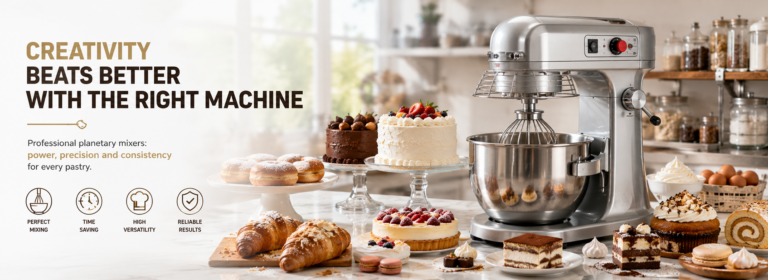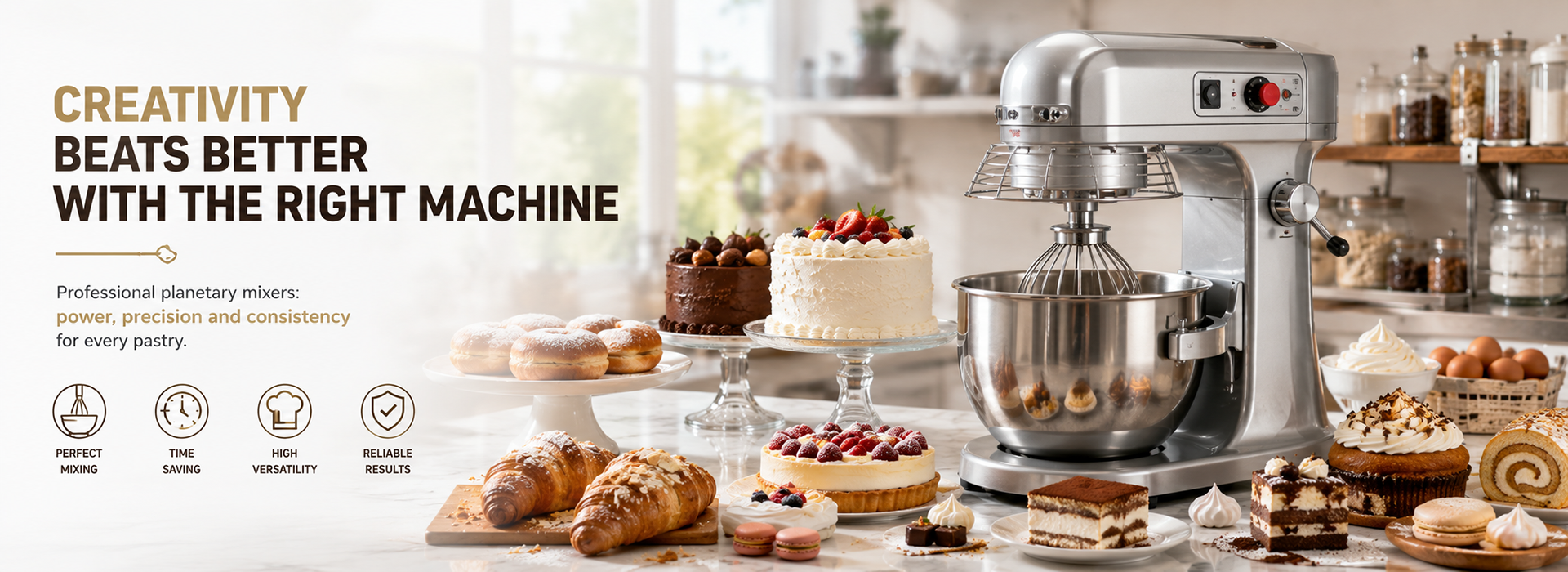
A professional planetary mixer can support a wide range of processes in bakeries, pastry shops, restaurants, cafés and food-production laboratories. By changing the mixing attachment, one machine can whip light preparations, blend medium-density mixtures and process compatible doughs.
This versatility makes the planetary mixer a valuable production tool, but it can also lead businesses to assume that every model can handle every recipe. Bowl volume, minimum batch size, dough consistency, attachment design and permitted operating cycle all affect performance.
The most suitable machine is the one that can process the business’s actual recipes consistently without being overloaded or becoming ineffective when working with smaller quantities.
Identify the Production Requirements
The selection process should begin with the recipes rather than the machine catalogue.
A pastry shop may need to produce whipped cream, meringues, sponge mixtures, buttercream, biscuit dough and small batches of leavened products. A restaurant may use the mixer for desserts, fillings, purées and savoury preparations.
A bakery may install a planetary mixer alongside a spiral mixer to handle products that do not require the specialised action of a spiral.
The initial production assessment should record:
- preparations made each day;
- batch weight;
- number of daily cycles;
- attachment required;
- mixing speed;
- processing time;
- minimum quantity;
- maximum quantity;
- ingredient temperature.
These details provide a realistic basis for choosing bowl capacity and power.
Bowl Volume Does Not Equal Dough Capacity
Planetary-mixer bowls are normally described in litres. This figure indicates physical volume but does not define how many kilograms of every product the machine can process.
A light whipped mixture expands and requires free space above the starting level. A stiff dough may occupy less space but place a considerably greater load on the motor and transmission.
Actual capacity depends on:
- product density;
- hydration level;
- resistance of the mixture;
- attachment used;
- selected speed;
- cycle duration;
- expected expansion;
- manufacturer’s limits.
The technical documentation should be checked for capacity recommendations relating to specific preparations.
Minimum Batch Size Matters
Businesses frequently focus on maximum output and overlook the smallest quantity that the machine can process effectively.
In a large bowl, the whisk may not reach a small amount of cream or egg white. A paddle can also leave a shallow mixture on the base and sides of the bowl.
Before selecting a high-capacity mixer, operators should compare the minimum workable quantity with their smallest regular recipes.
Possible solutions include:
- selecting an intermediate bowl size;
- using a compatible reduction bowl and attachments;
- installing mixers of two different capacities;
- reorganising production into larger batches;
- purchasing an additional compact mixer.
The correct solution depends on how often small quantities are required.
Understanding the Planetary Action
The attachment rotates on its own axis while travelling around the bowl. This combined movement allows it to reach a broad area and process ingredients consistently.
The clearance between the attachment and bowl must remain within the manufacturer’s specification.
If the whisk sits too high, it may not reach small batches. If it sits too close, it can strike the bowl and damage both components.
Adjustments should only be performed using the approved procedure. Staff should not bend attachments or alter their position as an improvised solution.
Using the Whisk
The whisk is designed to incorporate air into light preparations, including:
- cream;
- egg whites;
- meringue;
- sponge-cake mixtures;
- whipped creams;
- mousses.
Temperature, quantity and speed all influence the volume and stability of the finished product.
Starting at a controlled speed can help establish a uniform bubble structure before increasing the mixing action. Immediate operation at maximum speed may create splashing and distribute product across the bowl guard.
The whisk must not be used for stiff dough, hard fats or mixtures outside the permitted capacity.
Using the Paddle
The paddle or flat beater processes mixtures of medium density, such as:
- shortcrust pastry;
- cookie dough;
- buttercream;
- cake batters;
- sweet and savoury fillings;
- soft mixtures;
- certain food-preparation recipes.
It blends ingredients with less aeration than a whisk.
The temperature of butter and other fats should be suitable for the recipe. Ingredients that are excessively hard can place unnecessary strain on the attachment, while very soft fats can produce an unstable mixture.
Processing time should also be limited when the recipe requires minimal gluten development.
Using the Dough Hook
The dough hook stretches and folds compatible leavened dough.
Depending on the machine, it may be suitable for bread, pizza, focaccia, brioche and enriched sweet doughs.
Before using the hook, operators must confirm:
- maximum dough weight;
- permitted hydration range;
- approved speed;
- maximum cycle duration;
- consistency limitations;
- manufacturer’s operating instructions.
A stiff, low-hydration dough can place a much greater load on the mixer than a soft preparation of the same weight.
The bowl volume alone cannot determine kneading capacity.
Planetary Mixer or Spiral Mixer?
A planetary mixer offers multiple functions, while a spiral mixer is designed primarily for leavened dough production.
A high-output bakery or pizzeria may use a spiral mixer for its main dough batches because the specialised action supports efficient gluten development.
The planetary mixer can then handle creams, whipped products, biscuit mixtures, fillings and smaller speciality doughs.
A small business with varied production and moderate dough quantities may obtain greater value from a planetary mixer.
The decision should consider:
- proportion of production dedicated to dough;
- average batch weight;
- dough consistency;
- variety of recipes;
- frequency of whisk and paddle use;
- available space.
In many professional laboratories, the two machines perform complementary roles.
Motor Power, Transmission and Duty Cycle
Motor power should not be evaluated on its own. The transmission system determines how that power is delivered to the attachment.
When comparing models, the business should examine:
- rated motor power;
- transmission design;
- specified dough capacity;
- permitted operating cycle;
- overload protection;
- available speed range;
- intended level of use.
A mixer continually operating close to its maximum capacity may experience accelerated wear. Sufficient performance margin can improve reliability during peak production.
Fixed and Variable Speeds
Planetary mixers may provide a set number of mechanical speeds or electronically controlled variable adjustment.
Low speeds are suitable for:
- incorporating dry ingredients;
- beginning a dough cycle;
- blending dense mixtures;
- reducing flour and powder dispersion.
Higher speeds are used primarily for preparations that require aeration.
The selected speed must be compatible with the attachment, product consistency and load. On certain machines, changing speed while the motor is running can damage the transmission.
The operating instructions should form part of staff training.
Countertop Mixers
Countertop planetary mixers can be suitable for restaurants, cafés, small pastry shops and laboratories with limited floor space.
The supporting surface must:
- carry the full weight of the mixer;
- remain stable during operation;
- resist moisture and cleaning chemicals;
- provide an ergonomic working height;
- leave the controls accessible;
- allow adequate ventilation and maintenance access.
The bench must also accommodate the movement required to lower and remove the bowl.
Floor-Standing Mixers
Floor-standing mixers are generally designed for higher capacities and form an independent production station.
The layout must provide space to:
- load ingredients;
- operate the bowl-lifting system;
- remove the bowl;
- use a bowl trolley where required;
- clean around the appliance;
- access technical components.
The mixer should be positioned close to ingredient-weighing and preparation areas while maintaining a clear route to the next production stage.
Bowl Handling and Ergonomics
A bowl containing a dense mixture can become extremely heavy. Its removal, transport and emptying must be considered before choosing a large machine.
Depending on capacity, the workstation may require:
- a bowl trolley;
- mobile supports;
- lifting equipment;
- a suitable discharge table;
- an approved two-person handling procedure.
High mixer capacity does not improve productivity if staff cannot handle the finished batch safely.
Electrical Requirements
Compact mixers may use a single-phase supply, while higher-capacity models can require three-phase power.
Before ordering, the business should verify:
- voltage;
- frequency;
- total electrical load;
- plug or connection type;
- circuit protection;
- socket location;
- compatibility with other equipment.
A qualified electrician should confirm the installation. A commercial mixer should never be connected based only on the appearance of the plug or outlet.
Safety Guard and Bowl Locking
The safety guard limits access to moving attachments and can help contain ingredients during mixing.
Before starting a cycle, the operator should:
- lock the bowl securely;
- install the correct attachment;
- close the safety guard;
- select the appropriate initial speed;
- confirm that no tools remain inside the bowl.
During operation, staff must not insert hands or spatulas into the bowl. The machine must be stopped completely before the sides are scraped or the preparation is checked manually.
Safety switches and guards must never be disabled.
Organising Ingredients Before Mixing
A productive mixing cycle begins with mise en place.
Ingredients should be weighed, identified and positioned in the order in which they will be added. This reduces interruptions and prevents refrigerated products from remaining unnecessarily at room temperature.
Correct preparation also reduces:
- dosing errors;
- omitted ingredients;
- unsuitable speed changes;
- flour and powder dispersion;
- inconsistent processing times.
Fine powders should generally be incorporated at low speed. Liquids, fats and inclusions should be added according to the technical sequence of the recipe.
Standardising Each Recipe
A timer alone cannot guarantee a consistent result. A professional production sheet should describe every significant variable.
Useful information includes:
- mixer model and bowl size;
- attachment used;
- total batch weight;
- order of ingredients;
- speed for each stage;
- duration of each stage;
- starting temperature;
- finishing temperature;
- expected appearance and consistency;
- final yield.
Visual indicators allow operators to recognise the correct finishing point when ambient conditions or raw materials change slightly.
Additional Bowls and Attachments
A second set of accessories can improve output without requiring another mixer.
Additional equipment may allow the laboratory to:
- prepare the next batch while the first bowl is being cleaned;
- separate recipes containing specific allergens;
- reduce downtime;
- dedicate tools to particular preparations;
- replace a damaged attachment quickly.
Exact compatibility must be confirmed before ordering. Bowls and attachments of similar capacity are not necessarily interchangeable between different models.
Cleaning and Allergen Management
Residues can remain on the bowl, attachments, guard, attachment shaft and supporting components.
A complete cleaning procedure should include:
- stopping and disconnecting the mixer;
- removing the attachment;
- lowering and removing the bowl;
- eliminating visible residues;
- washing removable components;
- rinsing when required;
- sanitising according to the HACCP plan;
- drying all parts completely;
- cleaning the fixed surfaces.
Gluten, eggs, milk, soya, tree nuts and other allergens may require dedicated tools, validated cleaning procedures and a planned production sequence.
Preventive Maintenance
Planetary mixers contain transmission and lifting components exposed to repeated mechanical loads.
Periodic checks should include:
- transmission operation;
- speed changes;
- attachment shaft;
- bowl supports;
- lifting mechanism;
- safety guard;
- interlock switches;
- electrical cable and connection;
- condition of bowls and tools.
New vibrations, unusual noises or irregular attachment movement should be investigated before the machine returns to production.
Choosing for Long-Term Productivity
The correct planetary mixer must support both the largest production batches and the smaller recipes prepared regularly.
Before purchasing, operators should confirm:
- minimum and maximum workable quantity;
- types of preparation;
- dough consistency;
- attachments supplied;
- speed range and control;
- electrical requirements;
- installation space;
- bowl-lifting method;
- cleaning procedure;
- availability of spare bowls, components and technical support.
The range of professional planetary mixers available from Ristorazione‑Refrigerazione includes countertop and floor-standing models for pastry shops, bakeries, restaurants and food laboratories with different production requirements.
Sull'autore