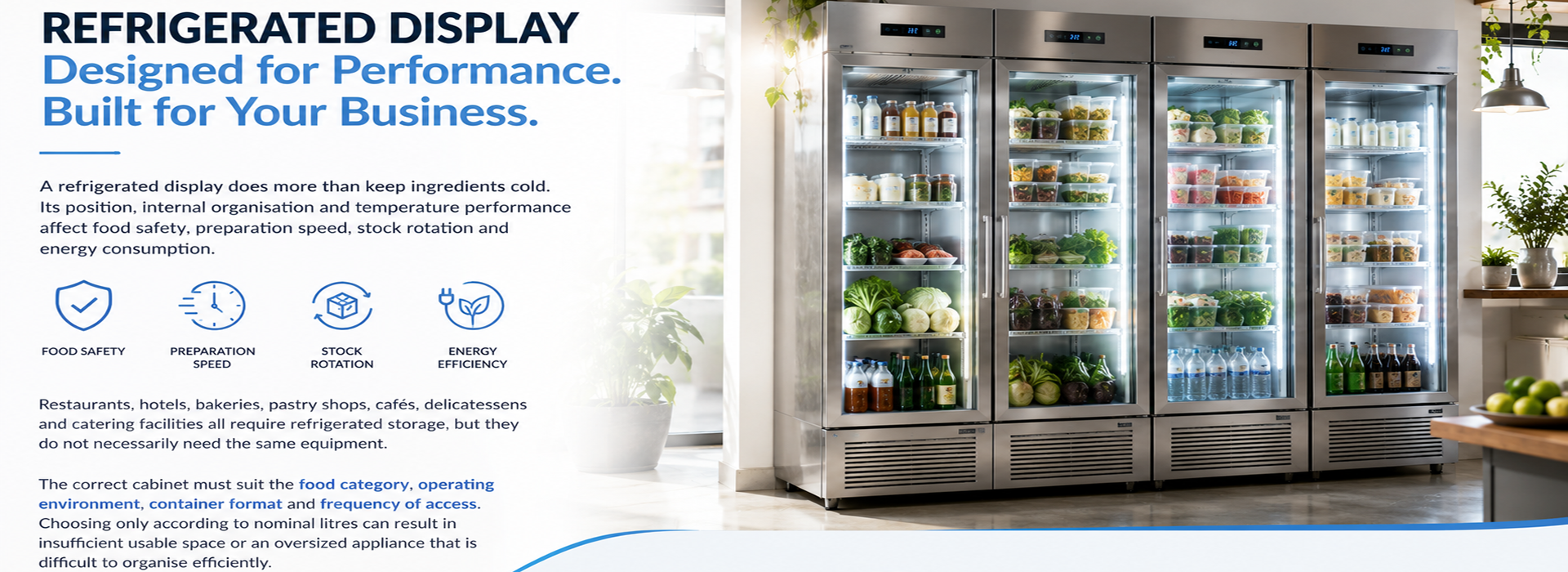
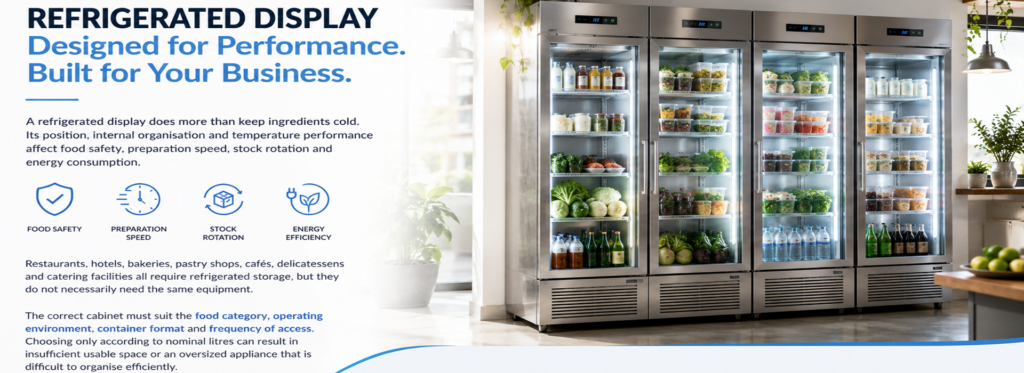
A professional refrigerated cabinet does more than keep ingredients cold. Its position, internal organisation and temperature performance affect food safety, preparation speed, stock rotation and energy consumption.
Restaurants, hotels, bakeries, pastry shops, cafés, delicatessens and catering facilities all require refrigerated storage, but they do not necessarily need the same equipment.
The correct cabinet must suit the food category, operating environment, container format and frequency of access. Choosing only according to nominal litres can result in insufficient usable space or an oversized appliance that is difficult to organise efficiently.
Map the Products Before Selecting the Cabinet
The selection process should begin with a complete list of products requiring refrigerated or frozen storage.
Typical categories include:
- meat;
- fish and seafood;
- dairy products;
- cured meats;
- fruit and vegetables;
- pastry ingredients;
- prepared foods;
- ready-to-eat products;
- beverages;
- frozen ingredients.
Each category may require a different temperature range, level of protection and storage procedure.
Separating products into dedicated cabinets or independent compartments can improve hygiene and prevent liquid, odour and allergen transfer.
Positive- and Negative-Temperature Storage
Positive-temperature cabinets are intended for chilled ingredients and preparations. Negative-temperature models are designed for frozen products.
The required temperature range must be confirmed before ordering. A cabinet should not be expected to change repeatedly between chilled and frozen storage unless the manufacturer specifically provides that function.
Operators should review:
- available temperature range;
- type of products permitted;
- temperature stability;
- recovery after door openings;
- climate class;
- defrost system;
- energy consumption.
The operating setting must correspond to the site’s HACCP procedures and the needs of the stored food.
Gross Volume and Usable Space
Capacity expressed in litres does not describe every part of the usable interior.
Insulation, evaporator position, air channels, runners and refrigeration components all reduce the space available for containers.
The business should calculate capacity by considering:
- number of GN containers;
- number and size of trays;
- shelf spacing;
- maximum production held at one time;
- delivery frequency;
- stock required for peak service;
- clearance needed for airflow.
A cabinet filled to its physical limit may not maintain an even temperature because products obstruct air circulation.
GN Containers, Shelves and Bakery Trays
Compatibility with the business’s existing container system can significantly improve workflow.
A kitchen using Gastronorm containers should confirm:
- GN size accepted;
- loading orientation;
- maximum container depth;
- number and spacing of runners;
- shelf load capacity;
- accessories included.
Pastry and bakery laboratories may use trays with different dimensions. Internal compatibility must be verified from the technical specification rather than inferred from the external cabinet width.
The correct format allows products to move directly between preparation, storage and service without unnecessary transfers.
Ventilated Refrigeration
Ventilated systems use fans to distribute cold air through the cabinet. This helps maintain a more uniform temperature and supports faster recovery after the door has been opened.
This configuration can be valuable when:
- the cabinet is opened frequently;
- food is stored on several levels;
- the kitchen has intensive service periods;
- rapid temperature recovery is required.
Air movement can cause exposed food to lose moisture. Ingredients and preparations should therefore be stored in suitable containers or packaging according to the site’s procedures.
Static Refrigeration
In a static system, cold air circulates naturally. Temperature differences can occur between various areas of the cabinet.
The product layout must account for these variations. The warmest and coldest zones should be identified and used according to the food-safety plan.
Static refrigeration can suit certain products that are sensitive to drying, provided that the cabinet’s characteristics and temperature range meet the application.
The choice between static and ventilated refrigeration should be based on the product and daily workflow.
Climate Class and Kitchen Conditions
Climate class indicates the surrounding temperature and humidity conditions in which the cabinet can provide its declared performance.
Commercial kitchens can become particularly warm because of:
- ovens;
- fryers;
- ranges;
- fry tops;
- dishwashers;
- steam-producing appliances;
- direct sunlight.
The most demanding room conditions usually occur during service. Measuring only when the kitchen is closed can underestimate the actual operating environment.
A cabinet unsuitable for the ambient conditions may run for extended periods, consume more energy and struggle to maintain the selected temperature.
Plan the Installation Position
The cabinet should be close enough to the preparation area for efficient access, but sufficiently separated from major heat sources.
The installation position must provide:
- full door opening;
- safe staff movement;
- removal of shelves and containers;
- ventilation around the refrigeration unit;
- access for side and rear cleaning;
- technical maintenance access;
- an appropriate electrical connection.
Operators should also verify doorways, corridors, lifts and ceiling height before delivery. A cabinet that fits its final position may still be impossible to move through the building.
Top- or Bottom-Mounted Refrigeration Unit
A top-mounted system can be less exposed to dust and debris from the floor, but may operate in warmer air accumulating near the ceiling.
A bottom-mounted unit may provide more accessible service points, although its air intakes require careful cleaning.
The choice should consider:
- room temperature distribution;
- presence of flour, dust or grease;
- available height;
- cleaning frequency;
- maintenance access;
- preferred internal storage height.
Both configurations can operate effectively when correctly installed and maintained.
Door Configuration
A single full-height door provides broad access to the compartment. Two doors or half doors can reduce the amount of warm air entering when staff need to reach only one section.
Multiple doors do not necessarily indicate independent temperature zones.
Before purchasing, the business should check:
- number of compartments;
- number of controllers;
- internal arrangement;
- door width;
- opening direction;
- available clearance;
- frequency of access to each section.
Door configuration should correspond to how the cabinet will be loaded and used during service.
Solid or Glass Doors
Solid doors are commonly used in kitchens and storage areas. They provide a robust solution and generally support effective insulation.
Glass doors enable staff to identify products before opening the cabinet. They may be useful in cafés, bars and service stations where rapid visual selection is important.
When comparing door types, evaluate:
- insulation performance;
- cleaning requirements;
- potential condensation;
- exposure to light;
- visibility required;
- energy-consumption data.
A glass door provides value only when visibility produces a genuine operational benefit.
Build an Internal Storage Plan
Every product category should have an assigned location. An improvised layout increases search time and encourages doors to remain open.
The storage plan should:
- separate raw and ready-to-eat food;
- keep products covered;
- prevent liquid from dripping onto other items;
- make labels visible;
- support FIFO or FEFO rotation;
- leave air outlets unobstructed;
- allow quick product removal.
Containers must not be stacked unsafely or placed directly on the cabinet floor unless the design and food-safety procedure allow it.
Labelling and Stock Rotation
Prepared, opened and decanted products must be identified according to the business’s internal rules.
A label may include:
- product name;
- preparation date;
- opening date;
- use-by date;
- batch reference;
- allergens;
- operator;
- intended use.
FIFO prioritises products received or prepared first. FEFO gives priority to the products with the earliest expiry.
Consistent rotation reduces waste and makes inventory control more accurate.
Do Not Use a Storage Cabinet as a Blast Chiller
A refrigerated cabinet maintains chilled food but is not designed to rapidly cool large quantities of hot product.
Loading hot preparations can:
- raise the compartment temperature;
- affect nearby foods;
- create condensation;
- extend compressor operation;
- result in uncontrolled cooling.
Cooked food requiring rapid cooling should follow the approved process using dedicated equipment, such as a blast chiller. It should only be transferred to the storage cabinet once the required cycle has been completed.
Door Openings and Temperature Recovery
Warm, humid air enters every time the door is opened. After closing, the refrigeration system must restore the internal conditions.
To reduce door-opening time:
- create a map of the shelves;
- keep labels visible;
- know which products are required before opening;
- avoid reorganising the cabinet during busy service;
- check self-closing systems;
- replace damaged door seals.
Brief openings may appear insignificant, but their repeated effect can influence stability and energy consumption.
Monitoring Temperature
The cabinet display normally shows the value measured by a sensor in a specific position. It does not necessarily represent the core temperature of every product.
The HACCP system should establish:
- monitoring frequency;
- instruments used;
- measurement points;
- permitted limits;
- recording method;
- corrective actions;
- responsible personnel.
Products should not cover temperature probes or air outlets.
Defrost and Condensate Management
Ice on the evaporator reduces heat transfer and restricts airflow. The defrost system removes this build-up according to the design of the cabinet.
Before purchasing, check:
- defrost method;
- programmable settings;
- condensate disposal;
- drainage requirements;
- tray accessibility;
- routine cleaning procedure.
Unusual ice formation may indicate issues involving the doors, seals, loading method or refrigeration system and should be investigated.
Cleaning Procedure
Cleaning must be organised without leaving food under unsuitable conditions. A suitable alternative refrigerated area should be prepared in advance.
A typical procedure can include:
- transferring and inspecting the products;
- switching off the cabinet where required;
- removing shelves and runners;
- eliminating visible residues;
- washing with compatible detergent;
- rinsing and sanitising;
- drying all surfaces;
- cleaning seals and drains;
- restarting the cabinet;
- waiting for temperature recovery before reloading.
Cleaning also provides an opportunity to check dates, containers and stock quantities.
Condenser Maintenance
The condenser releases the heat removed from the refrigerated compartment. Dust, grease and flour can restrict heat exchange.
A dirty condenser can cause:
- longer operating cycles;
- increased energy consumption;
- reduced cooling performance;
- high component temperatures;
- greater wear;
- unexpected shutdowns.
Cleaning frequency and method must follow the manufacturer’s instructions. Technical interventions should be completed by qualified personnel.
Evaluating Energy Consumption
Declared energy consumption should be compared alongside usable capacity and test conditions.
Actual consumption is also influenced by:
- room temperature;
- number of door openings;
- loading method;
- temperature of incoming products;
- condenser cleanliness;
- condition of door seals;
- distance from heat sources;
- selected temperature.
Energy efficiency depends on both appliance design and daily operating practices.
Prepare a Purchasing Checklist
Before selecting a cabinet, operators should confirm:
- products to be stored;
- temperature range;
- usable capacity;
- GN or tray format;
- static or ventilated system;
- climate class;
- number and type of doors;
- refrigeration-unit position;
- defrost system;
- controller and alarms;
- delivery-access dimensions;
- ventilation clearance;
- cleaning and technical-support requirements.
The range of professional refrigerated cabinets available from Ristorazione‑Refrigerazione includes positive- and negative-temperature solutions with different capacities and configurations for restaurants, hotels, pastry shops and food-production facilities.
Sull'autore