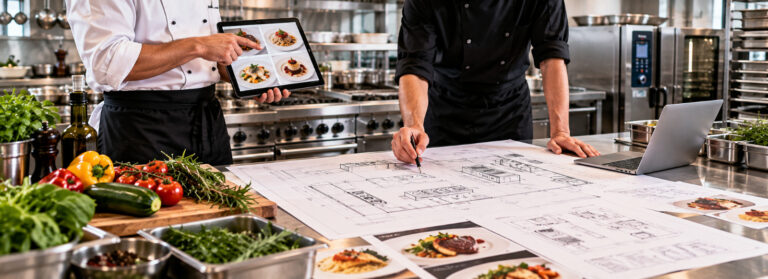
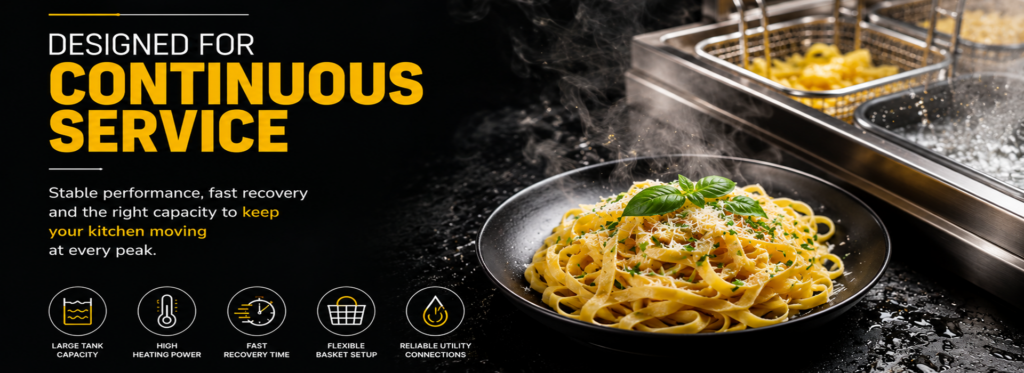
A commercial pasta cooker can transform the organisation of a professional cooking line. Instead of using several pots on the range, the kitchen can maintain a dedicated tank of boiling water and manage individual portions through separate baskets.
This configuration supports restaurants, hotels, canteens, Italian kitchens, delicatessens and high-volume foodservice businesses.
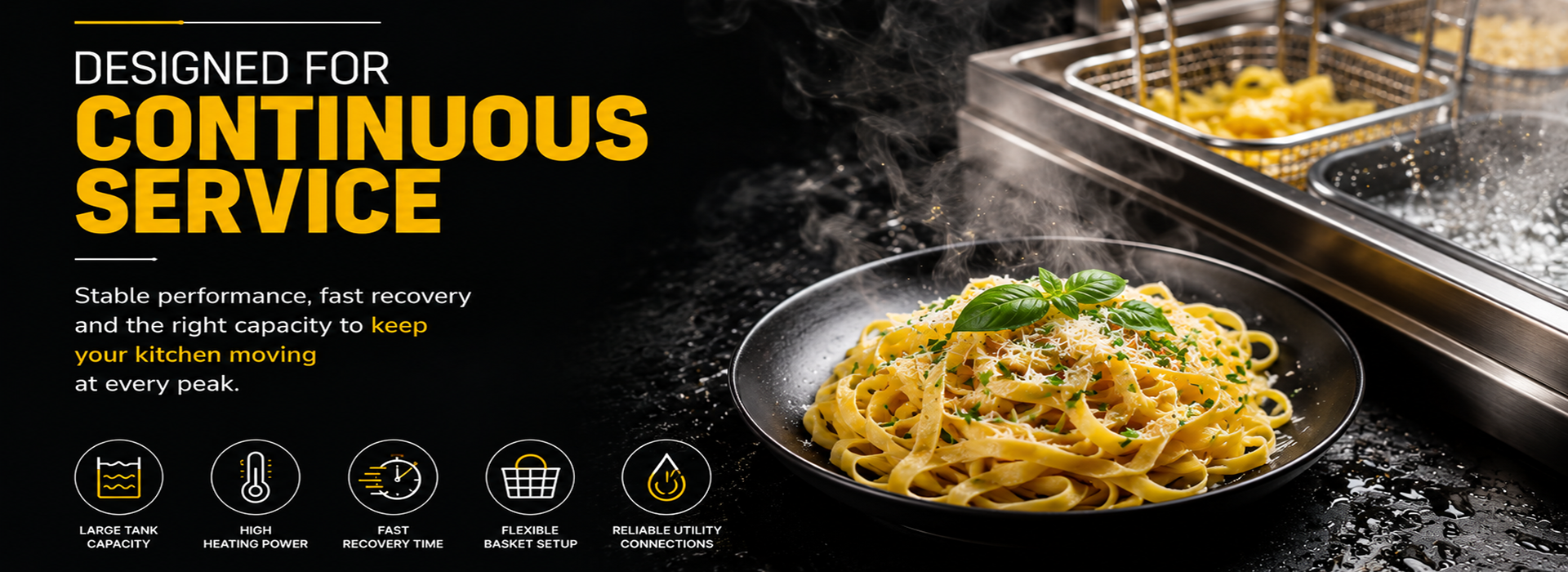
The appliance must, however, be selected according to peak production. Tank capacity, heating power, recovery time, basket configuration and utility connections all determine whether the station can maintain a continuous service.
Begin with Peak-Hour Demand
Total daily covers do not provide enough information to size a pasta cooker correctly.
A restaurant may serve many customers gradually, while a canteen may need to produce a large number of portions within a short period.
The production assessment should include:
- simultaneous pasta orders;
- portion weight;
- fresh or dried pasta;
- average cooking time;
- number of menu options;
- cooked-to-order or precooked service;
- pan-finishing time;
- staffing level.
The appliance should support the busiest realistic period without operating constantly beyond its intended capacity.
Tank Size and Usable Capacity
A larger tank holds more water and can accommodate more baskets. It also requires more energy and time to reach the boil.
The useful capacity is determined by how much pasta can be loaded while maintaining effective heat transfer.
Operators should check:
- usable water volume;
- internal dimensions;
- minimum and maximum fill levels;
- number of basket positions;
- maximum batch quantity;
- water-replenishment system;
- clearance required for boiling.
The tank must not be filled beyond the specified level. Excessive filling increases the risk of overflow when baskets and pasta are added.
Heating Power and Recovery
Cold pasta reduces the temperature of the water. The heating system must restore the boil quickly enough to maintain predictable cooking times.
Slow recovery can result in:
- longer service times;
- sticky pasta;
- excessive starch release;
- uneven texture;
- reduced output;
- delays at the finishing station.
Power must be evaluated in relation to tank volume and batch size. A high rating alone does not guarantee good performance if the machine is repeatedly overloaded.
Electric Pasta Cookers
Electric models use heating elements and can suit restaurants, food laboratories and all-electric kitchens.
Before purchasing, confirm:
- voltage;
- frequency;
- total electrical load;
- single-phase or three-phase requirements;
- connection type;
- circuit protection;
- available capacity alongside other appliances.
Higher-output units often require a three-phase connection. A qualified electrician should confirm that the installation can supply the appliance safely.
Gas Pasta Cookers
Gas models use burners to heat the tank and can integrate effectively with an existing gas cooking suite.
The installation should verify:
- natural gas or LPG configuration;
- supply pressure;
- ventilation;
- extraction;
- position of the isolation valve;
- maintenance access;
- compliance of the connection.
Installation and gas conversion must only be performed by qualified personnel following the manufacturer’s documentation.
Countertop and Floor-Standing Units
Countertop pasta cookers can add production capacity to compact kitchens and businesses with moderate demand.
The supporting surface must be:
- stable;
- heat- and moisture-resistant;
- able to carry the filled machine;
- easy to clean;
- positioned at a safe working height.
Floor-standing appliances form an independent station or section of a modular cooking line. They normally offer larger capacities and more basket positions.
Both formats require sufficient clearance for filling, drainage, cleaning and maintenance.
Single or Twin Tanks
A single tank provides a straightforward solution when the menu uses similar pasta formats and cooking procedures.
Twin tanks allow the kitchen to separate different processes and can support:
- fresh and dried pasta;
- formats with very different times;
- batch and à la carte production;
- independent water replacement;
- certain allergen-management procedures.
Separate tanks alone do not guarantee allergen control. Dedicated baskets, utensils, draining areas and finishing pans may also be required.
Selecting the Basket Configuration
Small baskets are suitable for individual portions and make it easier to associate each cooking cycle with an order.
Large baskets can support batch production in hotels, canteens and catering facilities.
When comparing baskets, consider:
- portion capacity;
- shape;
- mesh size;
- handle design;
- immersion stability;
- draining performance;
- replacement availability.
The mesh must retain the intended pasta format without trapping excessive residue.
A combination of basket sizes can provide flexibility if it is approved for the tank.
Fresh, Dried and Filled Pasta
Different types of pasta place different demands on the station.
Dried pasta usually requires longer cooking and sufficient heat recovery throughout the cycle.
Fresh pasta cooks quickly and needs close monitoring. Filled products can split when the water movement is too aggressive or the basket is overloaded.
A production sheet should identify:
- pasta type and supplier;
- weight per portion;
- basket used;
- cooking time;
- movement required;
- removal point;
- pan-finishing time;
- final yield.
A change of format or supplier may require a new cooking test.
Cooked-to-Order Production
Cooking after receiving the order provides direct control over texture, but the process must remain compatible with the expected ticket time.
A productive station requires:
- pre-portioned pasta;
- water at the correct condition;
- available baskets;
- individual timers;
- sauces prepared;
- pans ready;
- nearby plating space.
Pasta and sauce must be timed as one sequence. If the pasta finishes before the sauce is ready, it may overcook in the basket or begin sticking while it waits.
Precooking and Regeneration
Precooking can shorten the final service time in high-volume operations, but only when it follows a controlled procedure.
The process should define:
- initial cooking time;
- extraction point;
- cooling method;
- portioning;
- refrigerated storage;
- maximum permitted holding time;
- regeneration time;
- final pan finishing.
Precooked pasta must not be left to cool uncontrolled or stored without identification.
All times and temperatures should form part of the site’s HACCP plan.
Managing Starch in the Water
Every portion releases starch into the tank. Its concentration increases throughout service.
A moderate amount can produce useful cooking water for certain sauces. Excessive starch can create foam, deposits and sticky pasta.
The operator should monitor:
- water colour;
- foam level;
- strength of the boil;
- visible residue;
- salt concentration;
- cooking performance.
The kitchen procedure should specify when to add fresh water and when to drain and refill the tank completely.
Water Filling and Replenishment
A direct water connection can simplify initial filling and replacement during service.
The filling system must avoid adding enough cold water to cause an excessive temperature drop.
Installation should confirm:
- required inlet pressure;
- water quality;
- connection size;
- isolation-valve position;
- level-control system;
- maintenance access.
Where hard water is present, suitable treatment may be needed to reduce limescale. Any system must be compatible with the pasta cooker.
Drainage Connection
At the end of service, the tank contains very hot water with salt and starch.
A dedicated drain enables the tank to be emptied without carrying heavy containers of boiling water.
The installation plan should include:
- drain-valve position;
- outlet diameter;
- heat resistance of pipework;
- route to the waste connection;
- access for clearing obstructions;
- cleaning procedure.
Drainage should form part of the kitchen design and not be improvised after the appliance has been installed.
Water Hardness and Limescale
Limescale can build up inside the tank and on heating components.
Deposits may:
- reduce heat transfer;
- extend heating time;
- increase energy consumption;
- create uneven surfaces;
- reduce component life;
- make cleaning more difficult.
Descaling must follow the manufacturer’s instructions and use compatible products. Areas with particularly hard water may require more frequent checks.
Organising Timers and Orders
Using several baskets simultaneously creates a need for clear order identification.
Each timer should be associated with:
- table or order number;
- pasta format;
- portion quantity;
- start time;
- remaining time;
- sauce;
- requested finishing point.
The kitchen may use electronic timers, position-based organisation or a clear visual system.
Whatever method is selected must remain easy to understand during peak service.
Positioning the Finishing Station
The pasta cooker should be located close to the pans and sauces used for final preparation.
A productive sequence includes:
- taking the portion from storage;
- loading the assigned basket;
- starting the timer;
- preparing or heating the sauce;
- lifting and draining the pasta;
- transferring it immediately to the pan;
- finishing with sauce and cooking water;
- plating and serving.
Long distances between cooking and finishing increase delays and the risk of spills.
Draining the Pasta
Pasta should be drained sufficiently to control the amount of water entering the sauce, but it should not remain in the basket until its surface becomes dry and sticky.
The draining action should be short and appropriate to the recipe.
The station needs:
- a stable basket-resting area;
- clear access to the pans;
- a clean drip surface;
- no obstacles around the handles;
- a route that does not cross busy walkways.
Using Cooking Water in Sauces
Cooking water contains starch and can help emulsify a sauce.
Its characteristics change as production continues. The operator should assess:
- salt level;
- cloudiness;
- starch concentration;
- temperature;
- compatibility with the recipe;
- quantity required.
Water used for allergen-containing pasta must not be transferred into preparations presented as separately controlled.
Allergen Management
Cooking gluten-free pasta in a separate basket within shared water does not prevent contamination.
Where a business offers allergen-controlled dishes, the procedure may require:
- a separate tank;
- clean independent water;
- dedicated baskets;
- identified utensils;
- a separate draining area;
- dedicated pans and tongs;
- protected storage.
Staff must understand exactly what the kitchen can guarantee and communicate this consistently to customers.
Operator Safety
Boiling water, hot steam and wet floors create significant risks.
Operators should:
- lower baskets gradually;
- respect fill levels;
- position handles safely;
- avoid sudden movements;
- keep the surrounding floor dry;
- use specified protective equipment;
- never drain the tank during operation;
- follow the cooling procedure before cleaning.
Other staff routes should not interfere with basket lifting and movement.
Cleaning After Service
Salt, starch and food particles can form deposits inside the tank, baskets, overflow and drain.
A closing procedure should include:
- switching off the appliance;
- reaching the specified safe conditions;
- draining the tank;
- removing the baskets;
- eliminating visible residue;
- washing with compatible products;
- cleaning the drain and overflow;
- rinsing where required;
- drying surfaces;
- checking for limescale.
Abrasive tools and incompatible chemicals can damage stainless steel.
Preventive Maintenance
A reduction in heating speed can indicate limescale, element problems or irregular gas burners.
Periodic checks should cover:
- heating system;
- controls;
- water inlet;
- drain valve;
- baskets;
- electrical or gas connections;
- safety devices;
- appliance stability.
Technical repairs and work on utility connections must be completed by qualified personnel.
Choosing for Peak-Service Performance
Before purchasing a commercial pasta cooker, confirm:
- simultaneous portions;
- usable tank capacity;
- heating power and recovery;
- electric or gas supply;
- countertop or floor-standing installation;
- single or twin tanks;
- baskets supplied;
- water-inlet requirements;
- drainage connection;
- finishing-station space;
- cleaning and maintenance requirements.
The range of professional pasta cookers available from Ristorazione‑Refrigerazione includes electric and gas models for restaurants, hotels, canteens and foodservice businesses with different production volumes.
Sull'autore