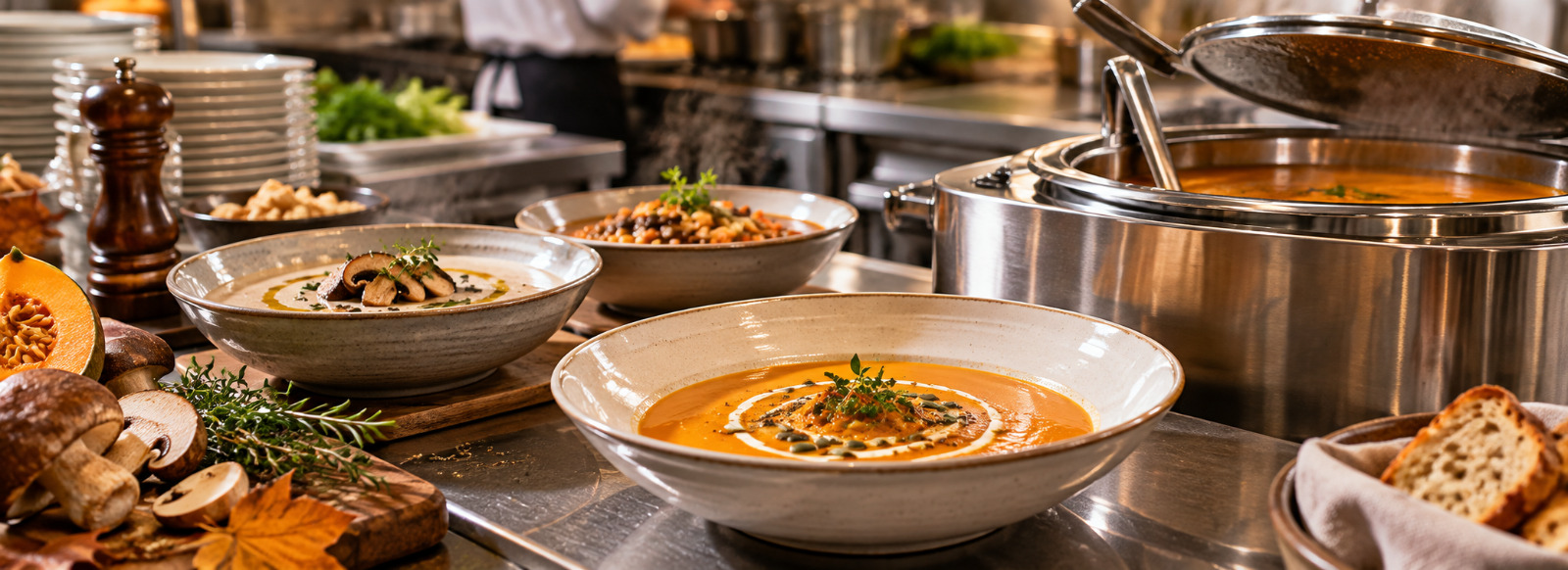
Soups, veloutés and creamy vegetable preparations naturally return to menus as temperatures fall. For restaurants, hotels, buffets and catering operations, however, producing a good soup is only half the challenge. The other half is managing it correctly between preparation and service.
A bowl of soup looks simple.
That simplicity can be deceptive.
Behind it may be stock preparation, vegetable processing, cooking, blending, seasoning, portioning and finally service.
In a professional operation, another factor appears:
time.
The dish may be ready before the customer orders it.
What happens between those two moments matters.
Cooking and holding are different phases
This distinction is fundamental.
Cooking is the process used to produce the dish.
Holding is what happens when prepared food must be managed until service.
The two should not be confused.
A soup kettle or professional food warmer should not automatically be considered another cooking appliance unless the specific equipment is designed and intended for that purpose.
Its role depends on the model and manufacturer’s specifications.
Why autumn changes the workload
During warmer months, menus may contain a larger proportion of cold starters, salads and lighter dishes.
As autumn arrives, kitchens often introduce:
- soups;
- vegetable creams;
- broths;
- hot sauces;
- stews;
- warm buffet items.
This changes not only the menu but the production pattern.
A restaurant that previously sold very few soups may suddenly need to manage dozens of portions during one service.
The texture problem
Cream soups are particularly sensitive to how they are managed.
Time and temperature can continue to affect the product after preparation.
A carefully balanced pumpkin velouté can gradually change in consistency.
This means the kitchen should think about the entire process rather than treating service as an afterthought.
A useful operational sequence is:
production → intermediate management → holding where required → portioning → service.
The role of professional soup kettles and food warmers
Professional soup kettles and food warmers can support this phase of service.
Their suitability depends on:
- the specific model;
- capacity;
- intended use;
- service volume;
- cleaning requirements;
- available workspace.
The correct machine is therefore not necessarily the one with the greatest capacity.
It is the one that fits the operation.
Capacity should follow service volume
Imagine two businesses.
The first is a small restaurant that offers one soup as a starter.
The second is a hotel serving a breakfast or buffet operation with a large and continuous flow of guests.
Both may need hot-holding equipment.
They probably do not need the same solution.
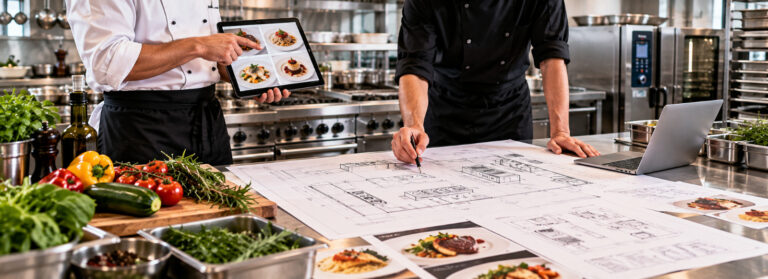
Before choosing capacity, operators should estimate:
- portions expected;
- portion size;
- duration of service;
- replenishment strategy;
- available counter space.
This produces a much more useful specification than simply asking for “a professional soup kettle.”
Pumpkin: autumn’s natural protagonist
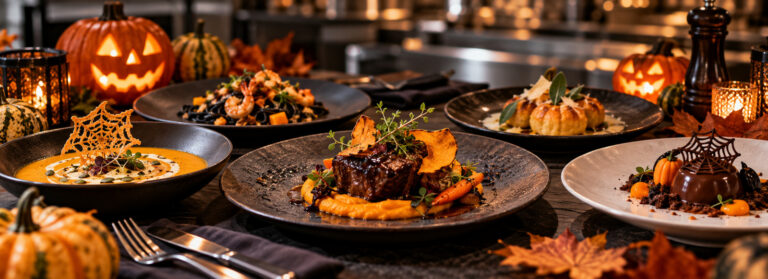
Few ingredients communicate autumn as clearly as pumpkin.
Its culinary value comes from its flexibility.
It can be paired with:
- chestnuts;
- rosemary;
- aged cheeses;
- mushrooms;
- spices;
- toasted seeds;
- nuts;
- croutons.
A basic pumpkin soup can therefore be positioned as comfort food, a refined starter or part of a buffet depending on the recipe and presentation.
The importance of toppings
In modern soup service, toppings can play an important role.
A smooth base gains complexity when contrasted with something crisp, aromatic or acidic.
From an operational perspective, however, toppings introduce another mise-en-place requirement.
They need to be portioned, stored and accessible during service.
Even a simple soup can therefore involve several workstations.
Buffets require a different way of thinking
Buffet service introduces a particular challenge because the guest may access food across an extended period.
The operation needs to consider:
- production volume;
- replenishment;
- presentation;
- holding;
- cleaning;
- food-safety procedures.
Equipment is only one component of this system.
A food warmer does not replace correct operational control.
Hot holding and HACCP
Professional kitchens should integrate holding procedures into their established food-safety system.
Requirements depend on the product, process and applicable regulations.
For this reason, generic assumptions about time or temperature should not replace the procedures defined for the operation.
The equipment supports the process.
It does not make the process automatically safe.
Chef Costantino’s seasonal idea
Pumpkin, Chestnut and Rosemary Velouté
The dish uses three elements strongly associated with the colder season.
Pumpkin provides sweetness and body.
Chestnuts reinforce the autumn character.
Rosemary introduces an aromatic contrast.
It demonstrates how a relatively simple category — soup — can still become a distinctive restaurant dish.
Simple food requires serious organisation
This is one of the paradoxes of professional cooking.
Some of the dishes customers perceive as simplest can require significant organisation behind the scenes.
The soup must be prepared correctly.
Its texture must remain coherent.
Service must be fast.
Portions should be standardised.
Food-safety procedures must be respected.
The role of professional equipment is to support these objectives.
Not to replace them.
Professional equipment focus: commercial soup kettles and professional food warmers.
TAGS
commercial soup kettle, professional soup kettle, food warmer, commercial food warmer, soup service, pumpkin soup, autumn menu, hotel buffet, restaurant buffet, hot holding, professional kitchen, restaurant equipment, foodservice equipment, HoReCa
Sull'autore