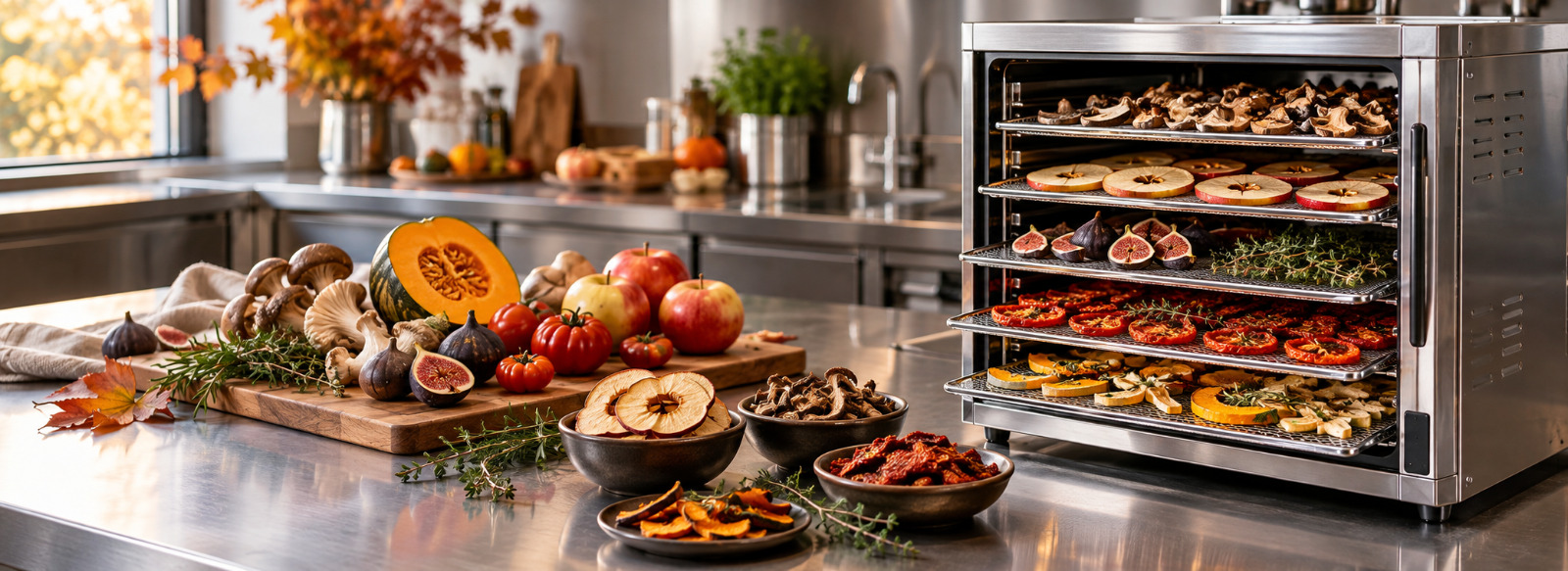
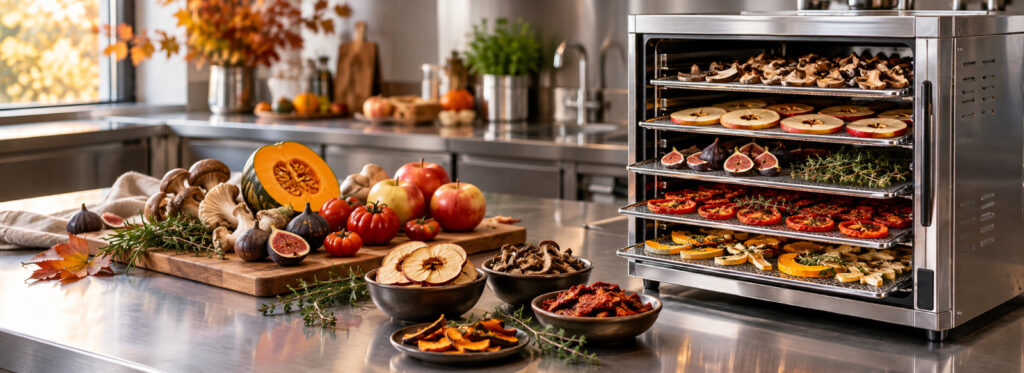
Mushrooms, apples, pears, herbs and vegetables arrive in professional kitchens at their best during autumn. Dehydration offers chefs a way to transform some of these seasonal ingredients into entirely different culinary components — from powders and garnishes to concentrated ingredients for sauces, risottos and desserts.
Seasonality has always shaped professional cooking.
Before modern refrigeration and controlled storage systems existed, preserving the harvest was not simply a culinary choice. It was a necessity.
Drying was one of the techniques used to extend the usability of certain foods.
Today, the context has changed dramatically.
Professional kitchens have refrigeration, freezing, vacuum packaging and many other technologies available.
Yet dehydration remains relevant.
The reason is interesting: chefs are no longer interested in drying food only to preserve it.
They are also using dehydration to change the ingredient itself.
Removing water changes more than shelf life
Consider a mushroom.
A fresh porcini mushroom has a particular texture, aroma and water content.
Once dried, it becomes a different culinary ingredient.
It can potentially be rehydrated for suitable preparations, but it can also be ground into a powder and used in entirely different ways.
The same principle can apply to fruit, vegetables and herbs.
Dehydration changes concentration, texture and the way an ingredient can interact with the rest of a dish.
This makes the technique particularly interesting for chefs who want to create new components from familiar raw materials.
Mushroom powder: a simple example of culinary transformation
One of the clearest examples is dried mushroom powder.
Once properly processed, dried mushrooms can be ground and incorporated into preparations such as:
- risottos;
- sauces;
- fillings;
- pasta dishes;
- seasoning blends;
- savoury creams;
- finishing elements.
The advantage is not simply convenience.
A powder distributes flavour differently from pieces of mushroom.
That allows the chef to use the same ingredient in multiple forms within one dish.
Fresh porcini, for example, might provide texture while dried porcini powder contributes another aromatic layer.
One ingredient begins to perform several culinary functions.
Fruit offers another direction
Autumn fruit can also become an interesting subject for dehydration.
Depending on the product and the intended preparation, dried fruit may be used in:
- breakfast service;
- pastry;
- dessert garnishes;
- cheese boards;
- bakery products;
- savoury dishes;
- snack concepts.
A thin dried apple slice, for example, behaves very differently from a piece of fresh apple.
The flavour, texture and visual effect all change.
For chefs, this is where dehydration becomes more than preservation.
It becomes a texture-building technique.
Herbs and aromatic ingredients
Herbs offer another useful application.
Professional kitchens often depend on aromatic ingredients that may vary in availability and quality throughout the year.
Drying suitable herbs can allow them to be incorporated into blends, powders and other preparations.
However, different ingredients respond differently to processing.
There is no universal dehydration programme suitable for every food.
Product characteristics, thickness, preparation and equipment settings all matter.
What does a professional food dehydrator actually add?
In a restaurant, hotel or food laboratory, repeatability matters.
A preparation that works once is not necessarily useful if the kitchen cannot reproduce it consistently.
A professional food dehydrator allows dehydration to become part of an organised production process.
Depending on the model, chefs can evaluate factors such as:
- usable capacity;
- tray configuration;
- temperature management;
- dimensions;
- electrical requirements;
- cleaning;
- production needs.
The machine should therefore be selected around the actual products and quantities being processed.
A larger dehydrator is not automatically a better dehydrator.
Production volume should determine capacity
This principle applies throughout professional catering equipment.
Before buying a machine, the operator should understand the workload.
How many kilograms of product will be processed?
How frequently?
Will dehydration be an occasional technique or part of daily production?
How much space is available?
The answers determine whether the equipment is correctly sized.
Oversized equipment may occupy valuable kitchen space without delivering a meaningful operational benefit.
Undersized equipment may require too many production cycles.
The correct choice sits between the two.
Dehydration is not automatic food safety
There is an important distinction between drying food and making it automatically safe for indefinite storage.
Removing moisture does not mean that every dehydrated product can simply be stored without further consideration.
Preparation, dehydration, handling, packaging and storage should all form part of the food business’s established food-safety and HACCP procedures.
This is particularly important in professional production, where consistency and traceability matter.
Autumn as a production opportunity
Seasonality is often discussed only from the customer’s perspective.
“Autumn menu.”
“Seasonal ingredients.”
“Limited edition.”
But chefs can also view seasonality from a production perspective.
When an ingredient is particularly relevant during one part of the year, the kitchen can explore different ways of using it.
Fresh.
Cooked.
Roasted.
Fermented where appropriate.
Dried.
Powdered.
The ingredient becomes a platform rather than a single product.
Chef Costantino’s autumn interpretation
Creamy Porcini Risotto with Dried Mushroom Powder and Parmesan
The concept uses porcini in different forms.
Fresh mushrooms contribute recognisable texture, while dried mushroom powder provides another aromatic dimension.
It is a useful demonstration of a broader culinary principle:
one ingredient can tell a more complex story when technique changes its form.
An old technique with a modern purpose
Professional dehydration is a good example of how contemporary kitchens often move forward by reconsidering traditional techniques.
The basic principle is ancient.
The intention can be completely modern.
For today’s chef, a dehydrator is therefore not simply a machine for making food last longer.
Used intelligently, it can become a tool for creating new textures, concentrated ingredients and additional ways of expressing seasonality.
Professional equipment focus: commercial food dehydrators.
TAGS
professional food dehydrator, commercial food dehydrator, food dehydration, dried mushrooms, porcini mushrooms, mushroom powder, dried fruit, dried herbs, autumn ingredients, seasonal cooking, professional kitchen, restaurant equipment, foodservice equipment, HoReCa
Sull'autore