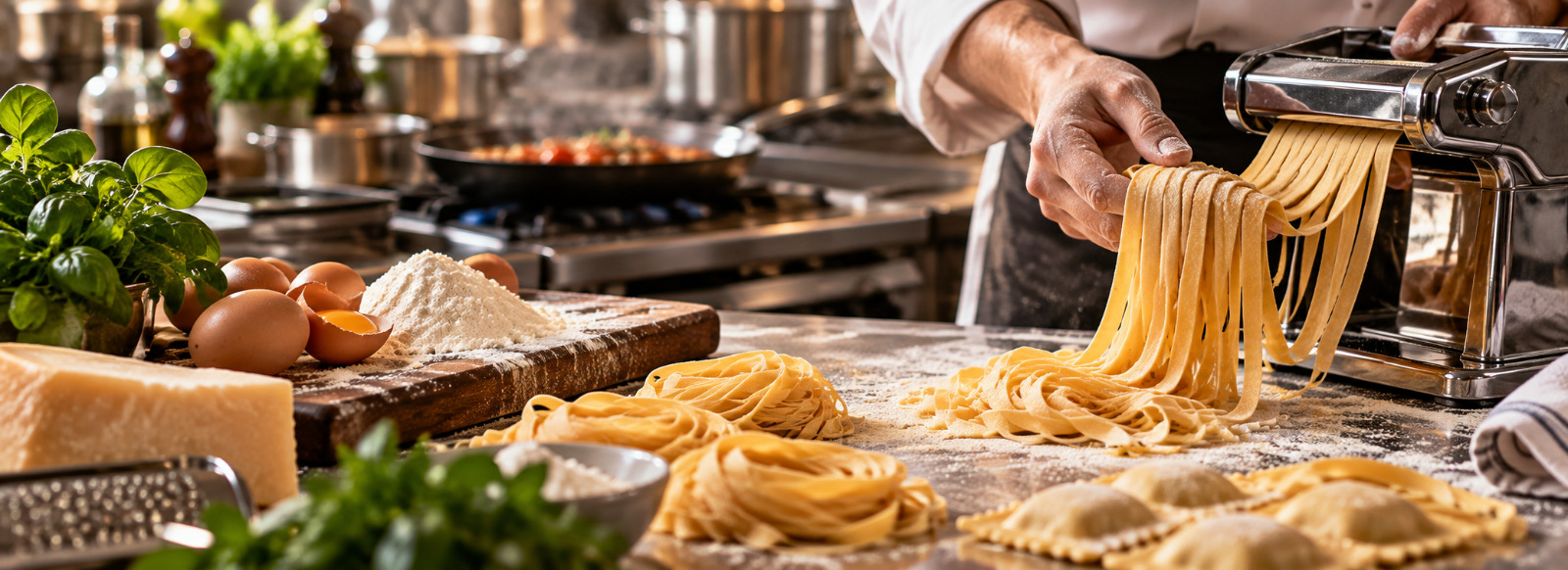
Fresh pasta is one of the most recognisable symbols of Italian cuisine. In a restaurant, however, producing it in-house means much more than mixing flour and eggs. It requires a production system capable of protecting craftsmanship while delivering consistency during real service.
Fresh pasta carries a powerful message.
When diners see tagliatelle, ravioli or tortelli described as house-made, expectations immediately rise.
The product suggests craftsmanship, tradition and attention to detail.
But “house-made” also creates a responsibility.
If a restaurant decides to produce fresh pasta internally, it must be able to repeat the result.
Not once.
Every service.
Craftsmanship becomes a workflow
Professional fresh-pasta production can involve several stages:
ingredient preparation → mixing → resting → sheeting or other processing → shaping → filling where required → portioning → storage → cooking → service.
Each stage influences the next.
A problem at the beginning of the process can reappear later.
Inconsistent dough can affect processing.
Irregular thickness can influence the final eating experience.
Poorly standardised filling can produce ravioli with inconsistent weight and balance.
This is why professional pasta production requires both culinary knowledge and organisation.
Standardisation does not destroy craftsmanship
There is sometimes a false opposition between handmade food and standardised food.
Professional cooking requires both identity and consistency.
Standardising dough ratios, portion sizes and procedures does not remove the chef’s creativity.
It protects it.
The objective is to ensure that the customer’s experience does not depend entirely on which member of the brigade happens to be working that day.
Why autumn is particularly interesting for fresh pasta
Few seasons offer such a natural range of fillings and sauces.
Autumn brings:
- porcini mushrooms;
- pumpkin;
- truffle;
- chestnuts;
- aged cheeses;
- richer meat sauces.
The production technique can remain relatively stable while the culinary identity changes with the season.
This is one of fresh pasta’s greatest strengths.
The process remains. The story changes.
How much pasta does the restaurant actually need?
Before discussing equipment, the kitchen should calculate production requirements.
Useful questions include:
- How many fresh-pasta portions are sold on an average day?
- What happens on peak days?
- How many formats are produced?
- Are filled pastas part of the menu?
- How frequently will production take place?
- How much labour is available?
- How much workspace is available?
These answers are far more useful than simply knowing the restaurant’s number of seats.
The role of professional fresh-pasta equipment
Depending on the production concept, a kitchen may use professional mixers, dough sheeters and fresh-pasta machines.
The exact solution depends on the desired product.
A restaurant producing primarily sheeted pasta has different requirements from an operation focused on other formats.
Equipment should therefore be selected around the final product, not around the assumption that one machine can solve every pasta-production need.
Productivity figures need context
A high output figure may look attractive on a technical sheet.
But output has meaning only when compared with demand.
If the kitchen needs a relatively small quantity of pasta, very high theoretical capacity may offer little practical advantage.
If production is high and the equipment is too small, repeated cycles may consume labour and time.
Correct sizing sits between undercapacity and unnecessary overcapacity.
Filled pasta adds another production layer
Ravioli and tortelli make the process more complex.
The kitchen must produce both dough and filling.
That filling may itself require:
- cutting;
- cooking;
- processing;
- cooling or other management as appropriate;
- portioning.
This means fresh-pasta production may interact with several other areas of the kitchen.
The pasta machine cannot be considered in isolation.
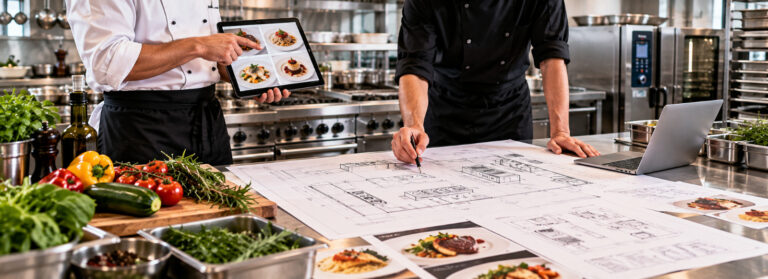
Space matters as much as machinery
Where will the dough be mixed?
Where will it rest?
Where will pasta be sheeted?
Where will filling be prepared?
Where will finished portions be organised?
Where will they be stored?
Professional workflow depends heavily on these physical relationships.
A machine placed in the wrong location can create unnecessary movement even if the machine itself performs perfectly.
Technology should protect the chef’s time
The most valuable resource in a kitchen is not always equipment.
It is skilled labour.
If machinery can make repetitive operations more consistent, chefs can concentrate on activities where human judgement creates greater value:
- recipe development;
- fillings;
- sauces;
- cooking;
- finishing;
- presentation.
This is where professional technology and craftsmanship can reinforce each other rather than compete.
Chef Costantino’s autumn interpretation
Fresh Tagliatelle with Porcini Mushrooms and Truffle
The dish deliberately keeps the pasta at the centre.
Porcini provide the unmistakable autumn character while truffle adds aromatic depth.
The result demonstrates why fresh pasta remains such an effective restaurant format: a traditional production technique can continually evolve through seasonal ingredients.
Fresh pasta is not about choosing between hand and machine
That is the wrong debate.
The real objective is to decide where human skill creates value and where professional equipment can make repetitive work more manageable.
A machine cannot decide whether a pasta shape is right for a sauce.
It cannot define the identity of the restaurant.
But it can help the kitchen turn that identity into a repeatable product.
And in professional foodservice, repeatability is what allows craftsmanship to survive a busy Saturday night.
Professional equipment focus: commercial fresh-pasta machines, professional dough sheeters and mixers.
TAGS
professional pasta machine, commercial pasta machine, fresh pasta restaurant, pasta production, dough sheeter, professional mixer, tagliatelle, ravioli, porcini mushrooms, truffle, Italian restaurant, professional kitchen, foodservice equipment, HoReCa
Sull'autore