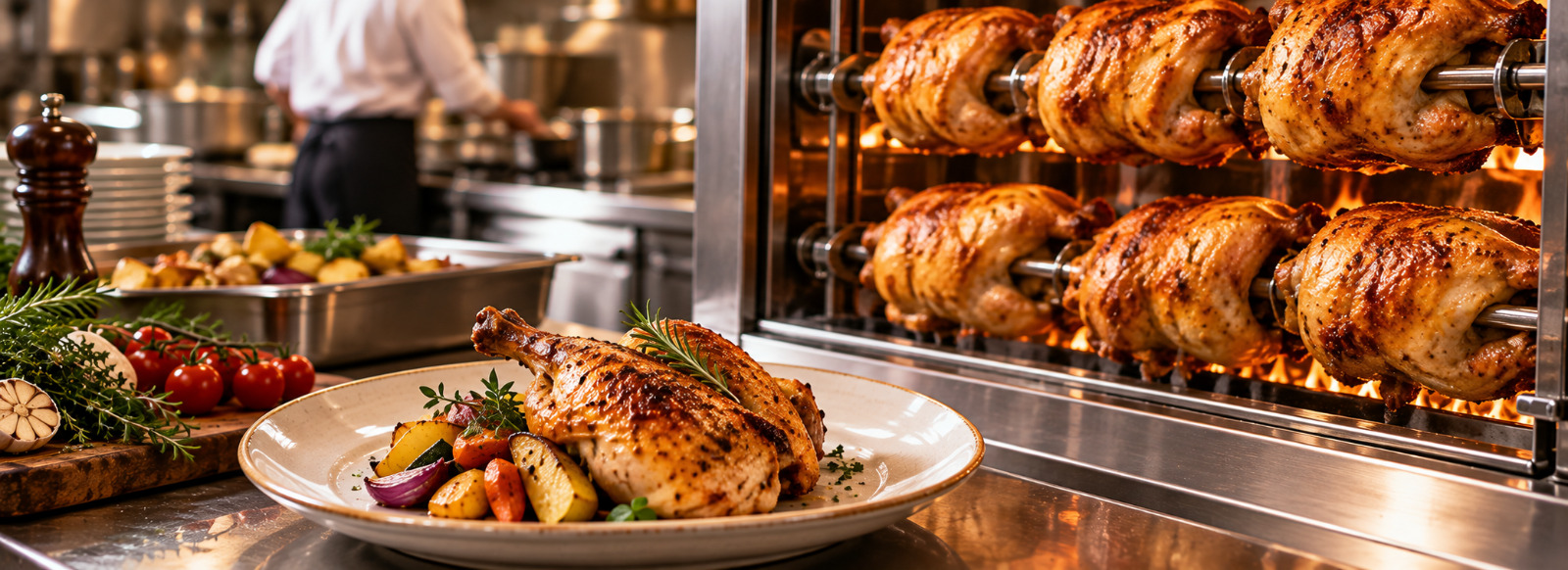
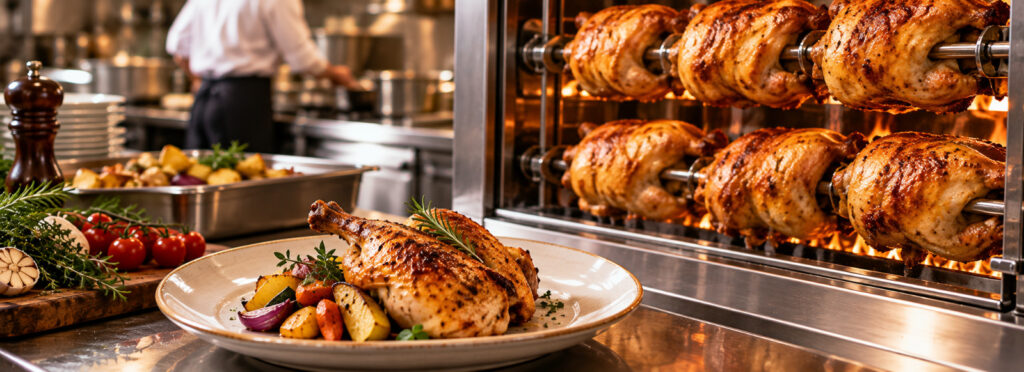
The slow rotation of roasting meat is one of the most recognisable images in food retail. Yet behind the visual appeal of a professional rotisserie lies a serious production system involving capacity, timing, food safety, merchandising and peak-demand management.
Some cooking equipment is hidden from the customer.
The rotisserie often does the opposite.
It wants to be seen.
The movement of the spits, the gradual browning of the product and the visible cooking process can turn production itself into part of the commercial experience.
This combination of cooking and merchandising helps explain why rotisserie chicken remains relevant in modern foodservice.
Simplicity is one of its greatest strengths
Roast chicken is immediately understandable.
Customers know the product.
They know how they might eat it.
It works for family meals, takeaway, gastronomy counters and restaurant service.
From a commercial perspective, this familiarity reduces the amount of explanation required.
But operationally, simplicity should not be confused with a lack of control.
Consistency begins before cooking
Products should be organised according to the production process established by the business.
Size, preparation, seasoning and loading strategy can all affect the final result.
If a business wants customers to receive a consistent product, the process must be repeatable.
The machine is one component of that repeatability.
Capacity is about the rush, not only the day
Suppose a rotisserie business sells a significant number of chickens every Sunday.
Knowing the total daily number is useful.
But it is not enough.
If most customers arrive within a short period around lunchtime, the critical question becomes:
how many products need to be ready at approximately the same time?
This is peak demand.
And peak demand is often the more useful figure for equipment sizing.
Production planning matters
Cooking too little may create stockouts and lost sales.
Producing too much can increase waste or create unnecessary holding challenges.
Professional rotisserie management therefore involves forecasting.
Historical sales, day of the week, reservations, local events and seasonal patterns can all help operators estimate production more intelligently.
The rotisserie is therefore connected not only to cooking but also to production planning.
Gas or electric?
Both may be available depending on the equipment range and market.
The choice should not be reduced to a universal claim that one technology is always superior.
Operators need to consider:
- specific equipment characteristics;
- available utilities;
- installation requirements;
- production needs;
- workspace;
- applicable ventilation or extraction requirements.
The correct decision depends on the individual site.
The rotisserie as a selling tool
When customers can see the cooking process, equipment becomes part of the visual identity of the business.
This creates an important consequence:
cleanliness is no longer only a back-of-house matter.
The appearance of the machine and surrounding area communicates something about the operation.
A clean and organised visible cooking station can reinforce confidence.
A neglected one can do the opposite.
Takeaway makes timing even more important
Rotisserie products fit naturally into takeaway models.
But takeaway often creates concentrated demand.
Customers may arrive around lunch or dinner rather than being evenly distributed throughout the day.
This makes production cycles and availability particularly important.
The objective is not simply to maximise output.
It is to align output with demand.
Food safety cannot be judged by appearance alone
Browning is visually attractive.
It is not, by itself, a sufficient food-safety control.
Cooking and handling should follow the procedures established by the food business, using appropriate controls rather than relying only on external colour.
The same principle applies to subsequent holding and service.
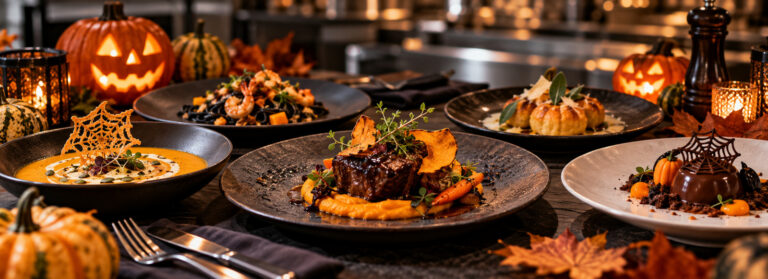
Autumn changes the plate
Roast chicken can remain on the menu throughout the year while its accompaniments change.
In autumn, ingredients such as:
- potatoes;
- chestnuts;
- mushrooms;
- pumpkin;
- rosemary;
- sage;
can move the dish into a completely different seasonal context.
This is useful for operators because it demonstrates that seasonal menus do not always require entirely new production systems.
Sometimes the equipment remains the same.
The culinary story changes around it.
Chef Costantino’s seasonal interpretation
Herb-Roasted Chicken with Potatoes and Chestnuts
The recipe retains the recognisable identity of roast chicken while using chestnuts and herbs to create an autumn character.
It is familiar enough to be commercially accessible and seasonal enough to feel relevant.
Traditional equipment can solve modern problems
The rotisserie may be an old cooking concept.
But the business problems it can address are extremely current:
- batch production;
- takeaway;
- visual merchandising;
- peak-demand management;
- product consistency.
This is a useful reminder that innovation in professional kitchens does not always mean replacing traditional methods.
Sometimes it means organising them better.
Professional equipment focus: commercial rotisserie ovens and professional rotisserie equipment.
TAGS
commercial rotisserie, professional rotisserie oven, rotisserie chicken, roast chicken, takeaway food, gastronomy equipment, food retail equipment, autumn menu, professional cooking equipment, restaurant equipment, foodservice, HoReCa
Sull'autore