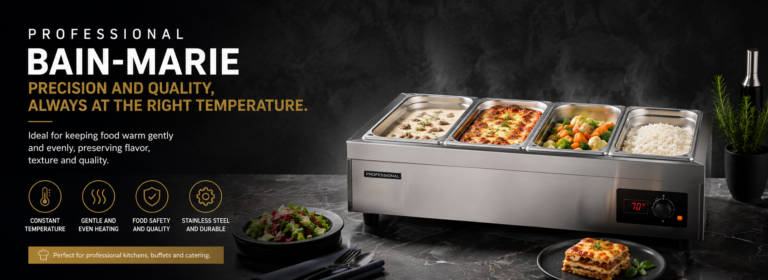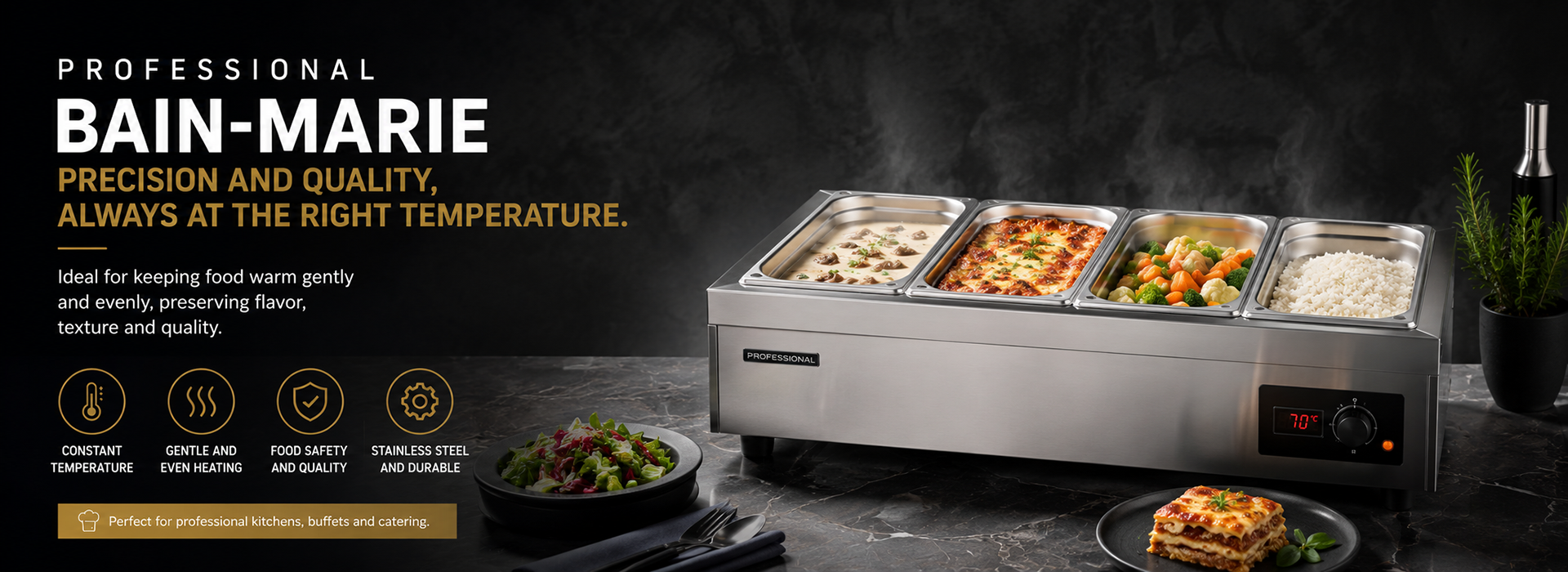
A commercial bain-marie provides gentle, indirect heat for holding cooked food during service.
Hot water surrounds Gastronorm containers and distributes energy more evenly than direct contact with a hot plate or flame. This makes the appliance suitable for sauces, soups, mashed potatoes, stews, vegetables, rice dishes and buffet preparations.
Restaurants, hotels, canteens, self-service businesses, catering operations and institutional kitchens can use bain-maries to organise several hot products within one workstation.
The correct model should match the number of dishes, required GN formats, service duration, installation space and replacement frequency.
Define the Role of the Appliance
Before selecting equipment, the business should establish where and how the bain-marie will be used.
A small restaurant may need a countertop unit for sauces and side dishes. A hotel may require a drop-in model integrated into a buffet. A canteen may need a floor-standing unit capable of supporting several full-size pans.
The assessment should include:
- number of products;
- expected portions;
- service duration;
- staff or customer access;
- available space;
- container replacement;
- cleaning procedures;
- relationship with other equipment.
The intended use determines the most practical configuration.
Hot Holding Is Not Slow Reheating
A bain-marie is primarily designed to receive food that is already hot and maintain it under the required conditions.
Cold food placed directly into the unit may heat too slowly.
A professional production sequence should separate:
- cooking;
- blast chilling, when required;
- refrigerated storage;
- regeneration;
- hot holding;
- service.
Food prepared in advance should be regenerated with suitable equipment before entering the bain-marie.
The operating procedure should define the required entry condition and the checks performed during holding.
Why Indirect Heat Is Useful
Direct heat can create a hot layer at the bottom of the container while the upper section remains cooler.
Water distributes energy around the pan and reduces the intensity of the heat transfer.
This is useful for products that may:
- stick;
- burn;
- dry out;
- form a surface skin;
- separate;
- reduce excessively.
Indirect heating does not prevent all quality changes. Food can still thicken, lose moisture or continue cooking when held for too long.
Select the Correct GN Formats
Commercial bain-maries are generally designed around Gastronorm dimensions.
A GN 1/1 well may support:
- one GN 1/1 pan;
- two GN 1/2 pans;
- three GN 1/3 pans;
- combinations of smaller containers.
This makes it possible to adapt the workstation to different menus.
Before ordering, verify:
- maximum GN format;
- permitted combinations;
- divider bars;
- pan depth;
- lid compatibility;
- clearance for pan removal;
- usable volume.
A greater number of small pans increases menu variety but reduces the quantity available for each product.
Container Depth
Deep pans hold more food but can create practical and thermal-management challenges.
Dense products in a deep container may require more frequent stirring. A full pan can also become heavy and difficult to lift safely.
Depth selection should consider:
- product density;
- number of portions;
- sales rate;
- holding time;
- stirring frequency;
- serving utensil;
- weight when full.
Smaller quantities replaced regularly often provide better quality than one deep pan held throughout the entire service.
Countertop Bain-Maries
Countertop units are compact and can be added to an existing kitchen or service area.
They may be suitable for:
- cafés;
- small restaurants;
- delicatessens;
- food trucks;
- pizzerias;
- catering events;
- compact preparation lines.
The supporting surface must carry the combined weight of the appliance, water, containers and food.
It should also be heat-resistant, moisture-resistant, stable and easy to clean.
The working height must allow staff to remove lids and pans without unsafe lifting.
Floor-Standing Models
Floor-standing bain-maries create a complete workstation and can integrate with modular kitchen lines.
They are suitable for:
- canteens;
- hotels;
- self-service restaurants;
- hospitals;
- production kitchens;
- high-volume food-service operations.
The base provides structural support and may include an open or enclosed compartment, depending on the model.
Connections, drainage and maintenance areas must remain accessible.
Drop-In Units
Drop-in bain-maries can be built into counters, buffet structures and self-service lines.
Installation planning should confirm:
- cut-out dimensions;
- structural support;
- heat insulation;
- ventilation;
- electrical or gas connection;
- filling method;
- drainage;
- maintenance access.
The surrounding counter must tolerate heat, moisture and the full operating weight.
A fully enclosed installation can create service and ventilation problems if it does not follow the manufacturer’s requirements.
Electric Models
Electric bain-maries use heating elements to warm the water.
Before purchasing, check:
- voltage;
- frequency;
- connected load;
- single-phase or three-phase supply;
- plug or connection type;
- available electrical capacity;
- simultaneous equipment loads.
Large wells require more energy to heat and recover after containers are inserted.
The electrical installation should be verified before the equipment is ordered.
Gas Models
Gas bain-maries may be configured for natural gas or LPG.
Installation must consider:
- gas type;
- pressure;
- heat output;
- ventilation;
- combustion requirements;
- isolation-valve position;
- safety devices;
- regulatory compliance.
Connection and gas conversion must be completed by qualified personnel.
Thermostatic Control
The thermostat controls the appliance, but its selected value does not necessarily equal the temperature at the centre of the food.
Heat transfer is influenced by:
- water level;
- pan size;
- container depth;
- product quantity;
- food density;
- use of lids;
- stirring.
Food temperature should be checked directly with a clean, sanitised probe according to the business’s procedure.
Every product should have defined entry conditions, inspection intervals and a maximum holding time.
Filling the Well
The water should reach the level specified by the manufacturer.
Too little water can create uneven heating, excessive evaporation and overheating. Too much can overflow when pans are inserted.
The filling procedure should account for water displacement.
Before filling:
- inspect cleanliness;
- close the drain;
- check the appliance;
- confirm permitted water temperature;
- observe the maximum level;
- position supports correctly.
Long services may require controlled water replenishment.
Preheating
The well should be fully preheated before food is loaded.
Placing hot pans into cold water removes heat from the food and delays correct holding.
The opening procedure should include:
- cleanliness inspection;
- drain closure;
- filling;
- switching on;
- setting the control;
- preheating;
- verification;
- loading hot containers.
Start-up time depends on power, water volume and initial temperature.
Using Lids
Lids reduce heat loss, evaporation and contamination.
They can also help prevent surface drying and lower energy demand.
During service:
- close pans whenever practical;
- manage condensation;
- keep handles clean;
- do not exchange lids between products;
- use compatible ladle openings;
- place removed lids on clean supports.
Buffet installations may also require sneeze guards or other protective structures.
Stirring and Product Consistency
Dense sauces, creams and mashed potatoes can develop different temperatures at the surface, centre and bottom.
Periodic stirring distributes heat and helps maintain consistency.
The operating sheet should define:
- stirring frequency;
- dedicated utensil;
- acceptable texture;
- permitted corrections;
- maximum holding time.
Adding water, stock, milk or other liquid without a standard quantity changes flavour, yield and food cost.
Replacing Containers
Topping up an old batch with newly regenerated food makes time control and stock rotation difficult.
A better process is to remove the nearly empty pan and replace it with a clean pan containing hot food.
The procedure should establish:
- who performs the replacement;
- how remaining food is handled;
- entry time;
- temperature verification;
- labelling;
- FIFO management.
Replacement pans must be held correctly until required.
Limiting Holding Time
Correct temperature does not preserve quality indefinitely.
During extended holding, food may:
- dry out;
- thicken;
- separate;
- change colour;
- lose aroma;
- continue cooking;
- deteriorate.
Every preparation needs a maximum time based on food safety and quality.
Smaller batches replaced according to demand usually produce better results and reduce waste.
Organising a Buffet
A self-service station must allow safe access without compromising temperature or hygiene.
The layout should provide:
- visible labels;
- dedicated utensils;
- stable lids;
- protective guards;
- plate space;
- a logical customer route;
- portion control;
- room for pan replacement.
Staff should be able to clean and check the station without completely interrupting service.
Allergen Management
Closely positioned containers create a risk of transfer through utensils, drips, lids and customer handling.
Controls should include:
- clear identification;
- dedicated utensils;
- clean pan rims;
- careful positioning;
- separate lids;
- staff training;
- correct customer information;
- replacement after contamination.
Physical separation within the same well may not be sufficient for specific allergen-free claims.
Safe Drainage
Water can remain extremely hot after the appliance is switched off.
Before opening the drain:
- remove all food containers;
- switch off the unit;
- wait for the specified safe condition;
- prepare a suitable drain or container;
- use protective equipment;
- clear the area;
- open the tap slowly.
The discharge route should remain away from cables, sockets and staff walkways.
Water Quality and Limescale
Hard water can create deposits on the well, heating elements and drain.
Limescale may:
- reduce efficiency;
- increase heating time;
- restrict drainage;
- make cleaning more difficult;
- damage components.
Descaling should follow the manufacturer’s instructions and use compatible products.
The schedule should reflect water hardness and frequency of use.
Daily Cleaning
After service, the appliance should be emptied and cleaned when it reaches the specified safe condition.
Cleaning normally includes:
- well;
- edges;
- divider bars;
- lids;
- drain tap;
- external surfaces;
- surrounding area.
The well should be washed, rinsed and dried.
Abrasive tools, aggressive chemicals and unauthorised water jets should not be used.
Preventive Maintenance
Regular maintenance should include checks on:
- thermostat;
- heating elements;
- burners;
- cables and connections;
- drain tap;
- controls;
- safety devices;
- well condition;
- limescale accumulation.
Leaks, slow heating and unstable temperatures should be investigated by a qualified technician.
Selecting the Correct Model
Before ordering, prepare a specification including:
- installation position;
- number of dishes;
- service quantities;
- GN formats;
- pan depth;
- countertop, floor-standing or drop-in configuration;
- electric or gas supply;
- power;
- filling method;
- drain tap;
- service duration;
- maintenance access;
- cleaning procedure;
- buffet requirements;
- expected production growth.
The correct bain-marie should hold realistic service quantities without requiring unnecessarily large containers.
The selection of commercial bain-maries available from Ristorazione-Refrigerazione includes electric and gas models, countertop, floor-standing and drop-in configurations, and units compatible with different Gastronorm arrangements.
Sull'autore