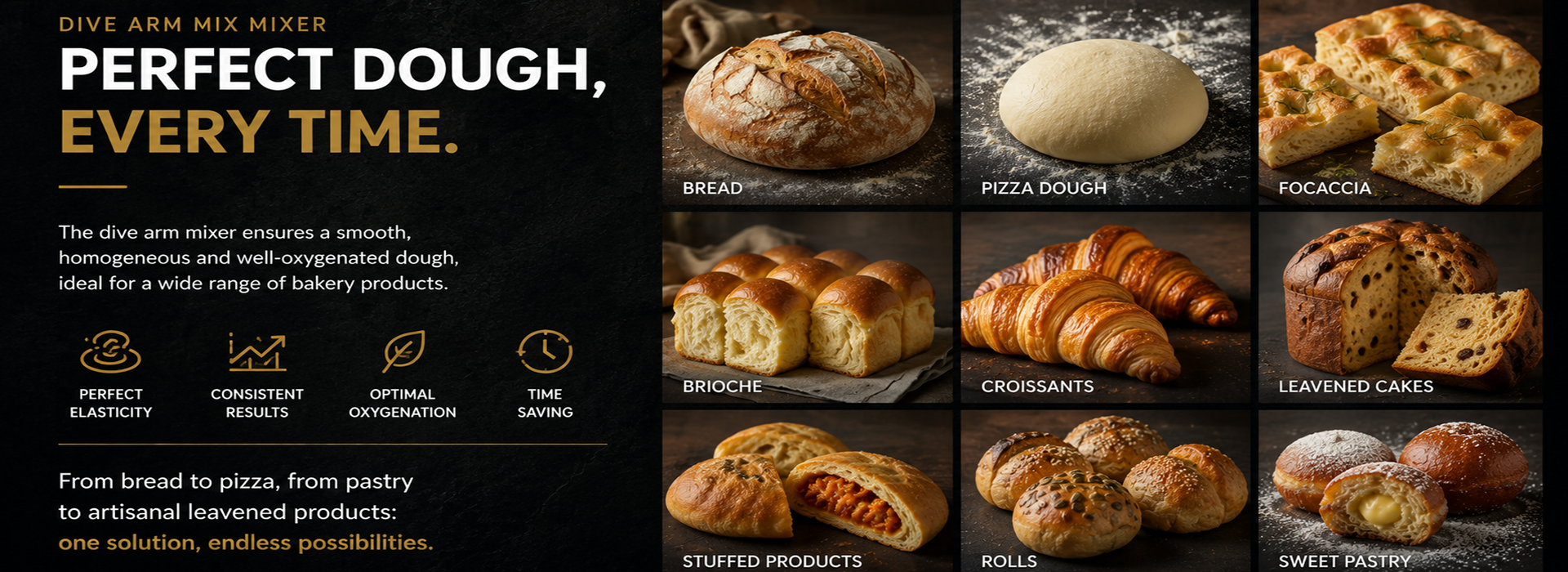

A twin-arm mixer is designed for bakeries and pastry laboratories that need to develop dough progressively while controlling aeration, structure and temperature.
Its two alternating arms lift, stretch and fold the dough in a movement inspired by traditional manual kneading. This action can be particularly valuable for high-hydration bread, focaccia, tray pizza, brioche and enriched products such as panettone, pandoro and colomba.
Selecting the correct machine requires more than comparing bowl volume and motor power. Operators must examine minimum and maximum batches, dough consistency, ingredient sequence, bowl configuration, electrical requirements and the capacity of the equipment used later in the process.
Understand the Twin-Arm Mixing Action
The two arms enter the bowl alternately. Each movement collects part of the dough, lifts it and folds it back into the mass.
This repeated action helps:
- hydrate the flour;
- distribute ingredients;
- incorporate air progressively;
- develop the gluten network;
- stretch the dough;
- support liquid absorption;
- limit excessive heat development.
The mixer provides the mechanical action, but the result still depends on flour quality, hydration, ingredient temperature, batch size and mixing duration.
A machine cannot compensate for a poorly balanced formula or an incorrect production method.
Identify the Products to Be Made
The purchasing process should begin with a detailed production list.
A bakery making bread and focaccia has different requirements from a pastry laboratory specialising in enriched fermented products. Dough resistance, hydration and processing times can vary substantially.
The assessment should record:
- products;
- total dough weight per recipe;
- flour quantity;
- hydration;
- sugar and fat content;
- daily production cycles;
- required final temperature;
- use of sourdough or preferments;
- inclusions such as fruit or chocolate;
- seasonal changes in output.
This information helps determine whether a twin-arm system is suitable and which capacity will provide the best working range.
Calculate Total Dough Weight Correctly
Mixer capacity may be described using bowl volume, flour weight or total dough weight. These values should not be treated as interchangeable.
The complete batch includes:
- flour;
- water;
- eggs;
- sugar;
- butter and other fats;
- sourdough or preferments;
- salt;
- flavourings;
- fruit and additional inclusions.
Operators should calculate the weight of the complete formulation and confirm which measurement the manufacturer uses in its specification.
The same total weight can place a different load on the machine according to hydration and consistency. A stiff dough creates greater mechanical resistance than a very soft mixture.
Check the Minimum Batch
The minimum working quantity is essential for consistent mixing.
If the batch is too small, the arms may not collect and stretch the mass correctly. Dough can remain on the bottom or walls of the bowl, producing uneven development.
This matters particularly for:
- businesses offering many products;
- test batches;
- seasonal recipes;
- small pastry laboratories;
- sites dividing production throughout the day.
Purchasing a very large machine in anticipation of future growth may create difficulties with current batch sizes.
The supplier should confirm the practical minimum for the specific types of dough being produced.
Allow Capacity Without Continuous Overloading
Operating continually at the maximum limit can reduce flexibility and place unnecessary strain on the mixer.
Capacity planning should include a margin for:
- variations in flour absorption;
- additional ingredients;
- increased seasonal demand;
- product volume during mixing;
- formulation changes;
- unexpected production requirements.
This does not mean choosing an excessively large machine. The correct capacity allows the normal batch to be mixed efficiently while remaining within the mixer’s optimum working range.
Calculate the Required Number of Cycles
A mixer should be evaluated as part of the daily production schedule.
A smaller model may complete multiple batches, but every additional cycle requires weighing, loading, mixing, unloading and cleaning. A larger unit reduces the number of cycles but may require more space and higher minimum quantities.
The calculation should consider:
- daily dough requirement;
- average mixing time;
- ingredient preparation;
- loading;
- unloading;
- cleaning between recipes;
- resting and fermentation;
- available staff;
- capacity of downstream equipment.
Producing dough faster does not increase overall output if the divider, proofer or oven cannot process it.
Compare Fixed and Removable Bowls
A fixed-bowl mixer offers a robust and relatively straightforward configuration. It may suit bakeries with regular batches and a manual unloading process that remains safe for staff.
A removable or mobile bowl can provide operational advantages in higher-output facilities.
It may support:
- consecutive batches;
- use of multiple bowls;
- dough transfer;
- integration with bowl lifters;
- reduced manual handling;
- easier access during cleaning.
The choice should consider the full weight of the batch. Large quantities of dough can become difficult and unsafe to remove manually.
A mobile bowl also requires adequate floor space, clear routes and a smooth surface for movement.
Plan Dough Discharge
Discharge should be considered before the machine is positioned.
The finished dough may need to move to:
- a resting container;
- a workbench;
- a divider;
- a moulder;
- a laminator;
- a proofing system;
- an automated production line.
The route should be short, safe and free from obstacles.
Where heavy batches are involved, a bowl lifter or tipping system may reduce physical handling. The discharge height must be compatible with the receiving container or machine.
A high-capacity mixer without a practical discharge system can create a bottleneck immediately after every cycle.
Coordinate Mixing with Downstream Equipment
The mixer is only one part of the bakery’s production capacity.
Its output should be matched with:
- dividing equipment;
- dough rounders;
- moulders;
- sheeters;
- proving cabinets;
- retarder provers;
- ovens;
- cooling and packaging areas.
If the mixer produces a large batch that must wait too long before dividing, fermentation can progress unevenly. Conversely, an undersized mixer can leave expensive downstream machines waiting for dough.
Capacity should therefore be assessed across the entire production line.
Plan the Ingredient Sequence
Twin-arm mixers can handle complex formulas, but ingredients must be introduced in an appropriate order.
A basic bread process may begin with flour, water and yeast or preferment, with salt and part of the water added according to the chosen method.
An enriched dough may require a more controlled sequence:
- initial flour hydration;
- formation of a basic gluten structure;
- gradual sugar addition;
- staged introduction of eggs or yolks;
- recovery of dough strength;
- progressive butter incorporation;
- final addition of flavours and inclusions.
Each stage should be sufficiently absorbed before a large quantity of the next ingredient is introduced.
The operator must evaluate when the dough is ready to continue rather than relying only on elapsed time.
Manage High-Hydration Doughs
High-hydration doughs may benefit from holding back part of the water at the beginning.
Once an initial structure has formed, the remaining water can be introduced gradually through bassinage.
During this phase:
- add small quantities;
- allow complete absorption;
- monitor dough temperature;
- select the appropriate speed;
- avoid extending the cycle unnecessarily.
The mixer’s power does not determine how much water a flour can absorb. Absorption depends on the flour, the complete formula and the required final product.
A dough should not be pushed to a higher hydration unless its structure and production method can support it.
Control Final Dough Temperature
Temperature affects fermentation speed, dough stability and production timing.
The final result is influenced by:
- room temperature;
- flour temperature;
- water temperature;
- preferments;
- eggs and butter;
- bowl temperature;
- mechanical energy;
- mixing duration;
- batch size.
The bakery should define a target range for every recipe and measure the dough after each cycle.
Recorded temperatures make it easier to identify seasonal changes and adjust water or ingredient conditions. Without these records, operators may change the formula when the real cause is a warmer room or a longer mixing cycle.
Use Mixing Speeds Correctly
The first speed is generally used to combine ingredients and hydrate the flour while limiting dust dispersion.
A higher speed can develop the gluten structure, increase aeration and help the dough absorb liquids or enriched ingredients.
Variable-speed control provides additional flexibility for different recipes.
A programmed process may use speed changes to:
- begin with gentle mixing;
- develop structure progressively;
- add water;
- incorporate sugar and eggs;
- add butter;
- distribute inclusions at low speed;
- prepare the dough for discharge.
The same programme should not automatically be applied to bread, brioche and panettone. Each product requires an appropriate sequence.
Evaluate Controls and Programming
The control panel should be easy to understand and operate.
Depending on the model, features may include:
- multiple speeds;
- variable-speed adjustment;
- separate timers;
- stored programmes;
- automatic phase changes;
- bowl controls;
- automatic stopping;
- emergency stop.
Programming can improve repeatability, but it does not eliminate the need to inspect the dough.
Changes in flour, temperature or ingredient condition may require an adjustment. Programmes should remain part of a controlled process rather than replacing operator judgement entirely.
Plan for Preferments and Sourdough
Biga, poolish and sourdough can change dough behaviour significantly.
They influence:
- hydration;
- acidity;
- elasticity;
- mixing time;
- fermentation;
- final temperature;
- flavour development.
Preferments should enter the mixer at the maturity and temperature defined by the recipe. A cold or overripe preferment may distribute differently and change the mixing cycle.
Stiff preferments may need to be divided into smaller pieces before loading to support even incorporation.
For enriched products based on sourdough, the condition of the culture is a major factor in structure and fermentation performance.
Incorporate Sugar Gradually
Sugar binds water and affects flour hydration.
In enriched dough, adding the entire quantity at the start can interfere with the initial formation of the gluten network. A staged addition allows the dough to develop before handling a higher sugar concentration.
Each portion should be incorporated before the next is introduced.
Honey, syrups and liquid sugars also contribute moisture. Their water content must be included in the formulation rather than treated separately from the hydration calculation.
Add Eggs and Yolks in Stages
Eggs contribute water, proteins, fat and emulsifying components.
In highly enriched formulas, eggs or yolks may be divided into several additions. The dough should recover its structure between stages.
Introducing too much liquid at once can make the mass slippery and temporarily disorganised. The mixer may then require additional time to restore the structure, increasing the final temperature.
Egg ingredients should be weighed rather than counted by unit, because individual sizes vary.
Incorporate Butter at the Correct Condition
Butter should generally be added after the dough has developed sufficient strength.
Butter that is too cold may remain in firm pieces and damage the structure. Butter that is excessively warm or partly melted can coat the mass and make incorporation difficult.
The appropriate condition depends on the formula, but the butter should normally be plastic and divided into manageable portions.
A controlled process may involve:
- checking dough development;
- adding a small portion of butter;
- allowing it to absorb;
- repeating the addition;
- monitoring temperature;
- completing the process with flavours or inclusions.
The dough should maintain the ability to support fermentation after the fat has been incorporated.
Manage Fruit, Chocolate and Other Inclusions
Inclusions are usually added near the end of the process after the structure has developed.
The speed should be reduced to limit damage to:
- candied fruit;
- raisins;
- nuts;
- chocolate pieces;
- seeds;
- other delicate additions.
Ingredients should be weighed, prepared and brought to the condition specified by the recipe.
Excess surface liquid on soaked fruit can alter the dough consistency. Very cold inclusions can reduce temperature suddenly, while warm ingredients may soften fat or affect the structure.
Mixing should stop once distribution is even.
Confirm Electrical Requirements
Larger twin-arm mixers commonly require a three-phase electrical supply.
Before ordering, verify:
- voltage;
- frequency;
- phase configuration;
- absorbed power;
- circuit protection;
- panel capacity;
- connection position;
- simultaneous operation of other bakery equipment.
The electrical assessment should include ovens, proofers, refrigeration equipment and every other machine operating during production.
A nearby outlet does not confirm compatibility. Installation and commissioning must follow the manufacturer’s requirements.
Check the Delivery Route
Machine dimensions must be compared with the complete route from the delivery point to the production area.
Check:
- external access;
- doors;
- corridors;
- corners;
- lifts;
- stairs;
- floor load;
- ceiling height;
- equipment weight;
- lifting requirements.
The delivery route should be checked using the transport dimensions, which may differ from the installed measurements.
Any need to remove doors, use lifting equipment or arrange specialist handling should be identified in advance.
Position the Mixer for Safe Workflow
The machine should be close to ingredient preparation and the next dough-processing stage.
The installation area needs space for:
- ingredient loading;
- opening safety guards;
- control access;
- dough unloading;
- bowl movement;
- cleaning;
- maintenance;
- staff circulation.
The emergency stop must remain accessible. Electrical connections must not obstruct passages or cleaning operations.
If a mobile bowl is used, the turning radius and travel route should be tested before the final position is approved.
Organise Ingredient Handling
Flour, water, sugar, butter and other ingredients should reach the mixer through a simple and safe route.
Heavy bags should be stored or moved in a way that reduces manual lifting. High-volume facilities may benefit from flour-handling or dosing systems.
Temperature-sensitive ingredients should remain under the required conditions until use. Butter and egg products may need a specific temperature to incorporate correctly.
Prepared ingredients should be labelled clearly to prevent errors involving salt, sugar, yeast, improvers or recipe-specific components.
Standardise Each Batch
A production sheet should accompany each mixing process.
It can record:
- recipe name;
- batch reference;
- total quantities;
- ingredient temperatures;
- loading sequence;
- speeds;
- time for each stage;
- water retained for bassinage;
- final dough temperature;
- expected consistency;
- operator;
- destination after mixing.
Ingredients should be weighed before the cycle begins whenever possible. Interrupting the process to locate or measure a missing component can change time and temperature.
Records allow the bakery to compare results and identify the cause of inconsistency.
Train Operators in Safety
The mixing arms apply substantial force and must remain protected during operation.
Operators should never:
- place hands inside a moving bowl;
- introduce scrapers or utensils during operation;
- bypass a guard or interlock;
- exceed the approved load;
- move the machine while it is running;
- clean without isolating the power supply.
Training should cover normal controls, emergency stopping, safe loading and the correct response to unusual noise or vibration.
Any fault affecting a guard or safety system requires the machine to be taken out of service until inspected.
Establish a Cleaning Procedure
Dough dries quickly on the bowl and mixing arms, so cleaning should begin soon after unloading.
A controlled procedure may include:
- stopping and isolating the mixer;
- waiting until movement has completely ceased;
- removing large dough residues;
- cleaning the bowl;
- cleaning both arms;
- treating guards and accessible surfaces;
- wiping the external structure;
- drying every component;
- inspecting less visible areas;
- replacing all guards correctly.
Water must not be sprayed onto controls, motors or electrical connections.
Cleaning products should be compatible with food-contact surfaces and the machine’s construction materials.
Schedule Preventive Maintenance
The alternating movement of the arms depends on mechanical systems that must remain correctly aligned and synchronised.
Planned maintenance may include:
- arm inspection;
- transmission checks;
- fasteners;
- motor;
- safety interlocks;
- timers;
- controls;
- electrical connections;
- machine stability;
- lubrication where specified.
Metallic noises, abnormal vibration, irregular movement and delayed stopping should be investigated promptly.
Before purchasing, the business should also confirm spare-part availability and access to qualified technical support.
Consider the Complete Cost of Ownership
The purchase price is only one part of the investment.
Additional costs may include:
- transport;
- unloading;
- positioning;
- electrical work;
- commissioning;
- additional bowls;
- bowl lifters;
- staff training;
- cleaning;
- maintenance;
- energy consumption.
A lower-priced machine that does not process the normal batch correctly may increase labour and reduce output.
The decision should be based on long-term productivity, process control and dough quality.
Choose for Actual Production
The best twin-arm mixer is not necessarily the model with the largest bowl or the greatest number of programmes. It is the machine that works within the bakery’s normal batch range and integrates smoothly with the remaining production stages.
Before ordering, confirm:
- products and formulas;
- hydration levels;
- minimum and maximum batches;
- daily cycles;
- speed options;
- fixed or mobile bowl;
- unloading method;
- electrical requirements;
- dimensions and delivery access;
- cleaning needs;
- maintenance support.
The selection of professional twin-arm mixers available from Ristorazione-Refrigerazione includes different capacities and configurations for bakeries, pastry laboratories, pizzerias and other professional production environments.
Sull'autore